Aligning Cybersecurity Content Strategy With Product Launch Cycles
Buyers decide on vendors before your launch happens, so content strategy must start months earlier.
One directory tracks thousands of mapped security products, and in Identity and Access Management and Security Operations alone, hundreds of tools overlap. Another announcement, by itself, makes almost no sound in a market this crowded. The deeper problem is behavioral. Buying groups lock in most of their vendor shortlist on day one of their search, and they pick the winner from that shortlist 95% of the time. A product launch lands in front of buyers who have, in practical terms, already made up their minds. CISOs carry personal risk on every purchase decision (a bad call can mean breach exposure, regulatory scrutiny, even a job), so trust outweighs feature lists, and building that trust takes far longer than any single launch week. Content is the mechanism that gets a vendor onto the shortlist before the buying cycle even starts, and that mechanism has to already be running before a launch date ever gets picked.
How buyers research security purchases before contacting a vendor
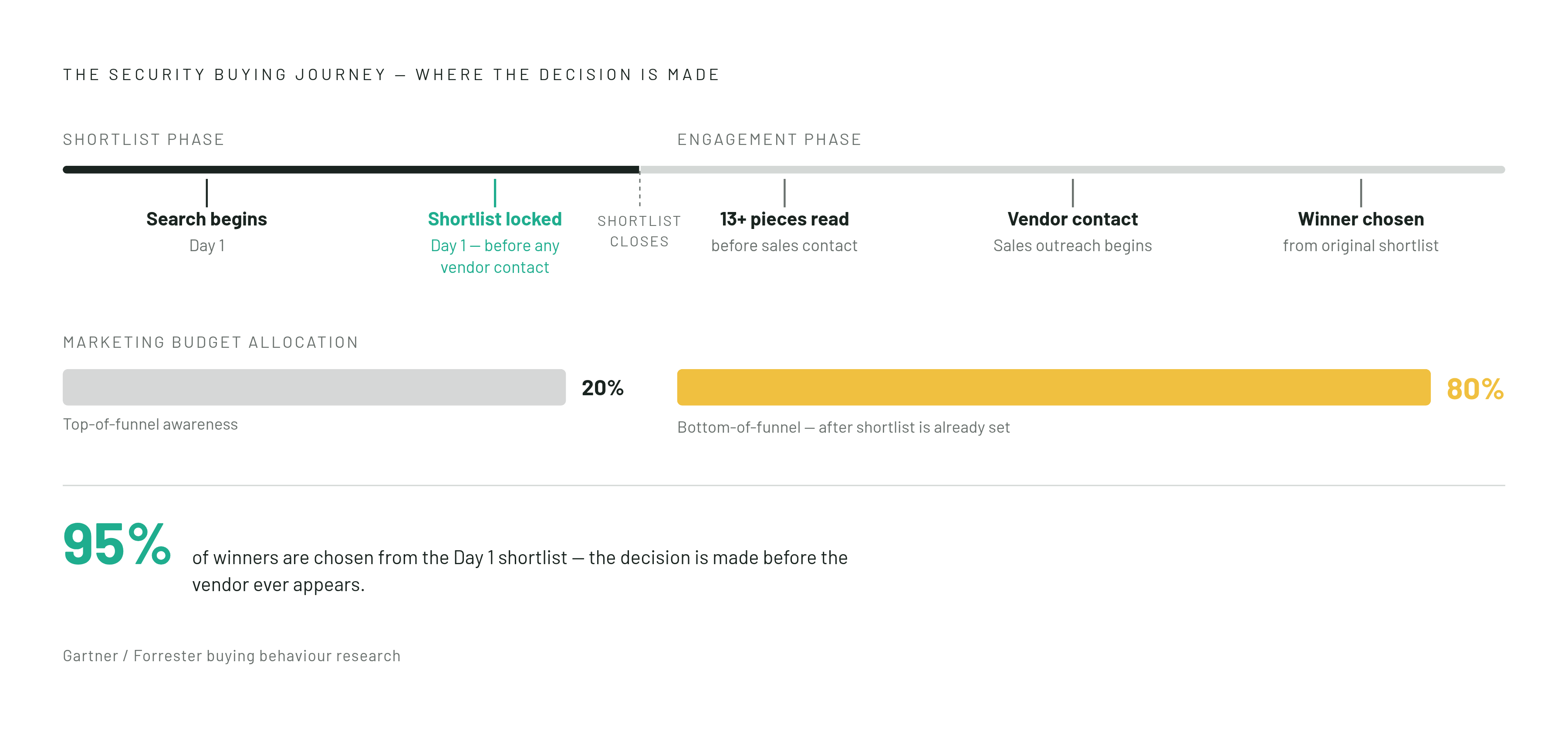
Security buyers do their homework before any salesperson knows they exist. Architects and engineers, the technical staff who run the evaluation, form opinions from public material long before a vendor conversation happens, and security forums are full of people calling out vendors who chase executives for demos while they ignore the engineers who actually drive the decision. Security prospects read 13 or more pieces of content before they'll even talk to sales, and they read each one the way an auditor reads a vendor risk questionnaire. It's closer to due diligence, done quietly, with no vendor in the room.
AI-mediated research changes what "getting found" actually means. ChatGPT, Claude, Gemini, Perplexity, and Google's AI Overviews now sit between a buyer and a vendor's website for a meaningful share of security research. A vendor's visibility depends on whether its content gets cited inside an AI answer, not just whether it ranks on a results page. A buying committee rarely has one person making the call. It has several, each one pulling from different content, at different depths, on different timelines, and no single blog post or single webinar reaches all of them. So a phase-mapped content strategy exists, because one content track can't serve a research process this wide and this fragmented.
Why the launch fails as a single content moment
Security marketing teams build launch content on a product calendar. Security buyers consume it on a research calendar that can stretch for months. That mismatch is structural, and it means most leads a vendor generates aren't ready to buy at the moment the launch happens. Most firms still pour 80% of their marketing budget into bottom-of-funnel messaging, but buyers spend most of their journey earlier than that, researching quietly before they're anywhere close to purchase-ready. So the vendor goes dark during exactly the window when shortlists get built.
Generic production also undermines the launch timing. AI-written filler content has stopped ranking and stopped converting in this market, so if a launch leans on undifferentiated collateral, it won't survive a practitioner's first skeptical scan. Fear-based pitches don't save a weak launch either. CISOs and security engineers see hundreds of fear-driven vendor messages every week and have built a near-total filter against them, so if a launch opens with threat urgency instead of demonstrated understanding, it signals immaturity to the exact audience that would otherwise champion the product internally. Put these failures together: a launch announcement drops into a market where shortlists have already formed, buyers are AI-researching vendors they already recognize, and practitioners are screening for credibility signals that take months to build, so it cannot succeed on announcement alone. Announcement day, on its own, cannot do that work.
Pre-Launch: Building Category Authority Before the Product Exists Publicly
Pre-launch content has one job: make the vendor a trusted voice on the problem before it ever makes a claim about the product. Do it right, and the eventual announcement lands inside a frame the market already trusts, instead of asking for blind faith in something brand new.
Threat intelligence is the single highest-leverage asset a vendor can build in this window. CrowdStrike is the clearest case study available. The threat intelligence narrative around AI agent risk was already established before Falcon Guardian ever shipped, so when the product launched at Fal.Con 2026, it landed inside a frame the market already believed, and buyers never had to accept a brand-new claim cold. Wiz followed a similar path in cloud security. Wiz Threat Research anchors its entire marketing engine, and the payoff shows up as citation presence inside AI engine answers about cloud security, built through sustained volume and specificity across the pre-launch period rather than a burst of ad spend at launch.
Named, credentialed authors matter here too. The strongest cybersecurity content programs put real experts' names on their work, because anonymous corporate posts don't earn the kind of peer trust this phase exists to build. Different members of the buying committee read different material, so pre-launch content needs to speak to the engineer and the executive separately, not just the CISO at the top of the org chart.
What Launch Window Content Must Do Differently
The launch window has a different job than everything that came before it. Pre-launch content earns trust in the problem space. Launch-window content has to spend that trust on something specific: a verifiable product claim that can survive a practitioner trying to poke holes in it.
Compliance framing still works as a door-opener. A line like "we help you meet SOC 2 requirements" gets the meeting booked, and a line like "we help you build a security posture that actually reduces your breach risk" is what keeps that customer around once they're in the room. Launch content built around a named compliance outcome catches the immediate buying trigger, then it pivots into real security value to hold attention past the first conversation. SentinelOne's OneCon shows what a well-built launch window looks like in practice. The annual conference, held in Las Vegas since 2024, served as the stage for a suite of four AI-focused security tools, and SentinelLabs stood behind them as the research backbone that gave those product claims weight. The conference supplied the moment. The research behind it is what made the claims stick.
Gating decisions trip up more vendors at this stage than almost anything else. Ungated content builds trust, earns organic search value, and reaches people who will never fill out a lead form but still shape the purchase decision from inside the organization. The fix is simple: gate the handful of research assets worth real value exchange, and leave everything aimed at the practitioner (the person with informal veto power over the whole deal) wide open. AI discovery rewards this approach directly. AI engines cite white papers, comparison guides, and practitioner-authored explainers, not product pages, so launch content built to be cited reaches buyers at the exact moment they're forming their shortlist through an AI assistant instead of a search bar.
How post-launch proof generation sustains the deal cycle and builds the next launch
The content job doesn't end when the product ships. Post-launch content has to convert the trust and attention built in the earlier phases into the one thing security buyers trust more than any vendor claim: proof, validated by other buyers who've already lived with the product.
Customer case studies carry more influence on purchasing decisions than any explanatory content a vendor can write (claim cited separately in the research as a top buyer influence), and post-launch is the first point where that asset class even becomes possible, since the product now has real customers using it. Proofpoint's customer storytelling shows what you can do with a named-outcome proof point. Coventry University Group's CTO reports that Proofpoint's approach "dramatically improved how we manage threats," with monthly investigations dropping from roughly 36 to 40 down to zero. A skeptical practitioner can weigh that number on its own terms, because it is specific and checkable.
Not every customer will go on the record with that kind of detail, and cybersecurity has a particular confidentiality problem baked in: companies that just got breached, or just closed a security gap, often don't want their name anywhere near the story. Expel's answer is aggregation instead of a single spokesperson. Instead of leaning on one customer, Expel surveyed 46 respondents across multiple companies in several countries to build a composite picture of risk-reduction outcomes, and this works especially well when individual customers won't share specifics about their own setup.
Post-launch content also feeds the account-based marketing layer, the part of the funnel that carries long sales cycles across the months between first contact and signed contract. Automated nurture sequences built on substantive content keep a vendor present with something useful until a buyer's timing finally lines up, and low-volume, high-quality ABM aimed at a defined list of named accounts still produces real response rates at a time when mass outreach has largely stopped working.
The real payoff accrues over multiple cycles rather than appearing in any single quarter. Post-launch proof, case studies, technical write-ups, incident retrospectives, becomes the pre-launch authority material for the next product cycle. Vendors who run sustained content programs widen their credibility lead with every cycle, but vendors who treat each launch as a standalone event start from zero every single time.
Why the quality of the content team determines whether the strategy works at all
A phase-mapped content calendar is only as good as the people filling it in. The strongest cybersecurity content programs share one trait no amount of planning can substitute for: senior writers with real security backgrounds who understand both the technology and the buyer reading it. A generalist content team can be handed that same phase map, but practitioners still dismiss the output on first read.
That's not a stylistic preference, either. Security practitioners are trained, professionally, to distrust claims, check assertions, and notice what a sentence leaves out. Content that can't survive that kind of adversarial reading doesn't just fail to convert. It actively burns the credibility the entire pre-launch phase was built to earn.
Forrester raises a fair objection: vendor threat reports are strategic marketing dressed up as research, not neutral information, and sophisticated buyers already know that. But knowing the motive behind a report doesn't make genuinely rigorous research any less useful. CrowdStrike's Global Threat Report gets cited by practitioners constantly, regardless of its commercial origin, because the research itself holds up. That's the bar a generalist team can't clear. Original research, customer data, and technical depth are also the content formats AI search engines preferentially cite, so the ROI from hiring domain experts to produce this material compounds across both the trust-building and the discovery dimensions of the launch cycle.
Closing that execution gap is where a purpose-built cybersecurity content studio earns its place, one where security expertise is the starting point rather than something layered on afterward. Cyberou's model fits that description: its research-and-content approach is built around the same practitioner credibility standard the rest of this argument rests on, treating domain depth as the baseline rather than a feature.
The measurement framework that tells a cybersecurity vendor whether its launch content is working
Page views and download counts tell a vendor almost nothing useful about whether a launch is landing with the right people. A better framework tracks the phases laid out above, each with its own signal.
Pre-launch success looks like citation and reach among practitioners: is the vendor's threat research getting picked up in security community discussion, and is it showing up inside AI engine answers the way Wiz's research does? Launch-window success looks like engagement from the accounts that actually matter, the named list an ABM program is built around, not raw traffic from anyone who happened to click a link. Post-launch success looks like the proof assets themselves: how many customers are willing to go on record, how specific the outcomes are (investigations going from 36 to 40 a month down to zero is the kind of number that moves a deal), and whether those stories are feeding both current pipeline and the next product cycle's pre-launch authority.
None of these numbers replace a closed deal as the final scoreboard. But in a market so overcrowded that one directory alone tracks thousands of mapped security products, with categories like Identity and Access Management and Security Operations each listing hundreds of overlapping tools, and where buying groups fill most of their shortlist on day one and pick the winner from it 95% of the time, tracking credibility by phase is the only way to know whether a launch is actually being heard, or just added to the noise.