Measuring Content Marketing ROI for Cybersecurity Vendors
Cybersecurity buyers move too fast and too dark for standard attribution models.

Global spending on information security hits $213 billion in 2025, up from $193 billion the year before, according to Gartner. Budgets grew across the board in 2024, and most security leaders say they got more money for 2025 too. That growth hasn't made buying easier; there's more vendor noise fighting for the same skeptical, technically literate audience, and the old way of measuring content ROI just doesn't hold up against that audience.
Buyers say the real problem is clarity. When decision-makers find vendor claims indistinguishable, they stall. So the market handed marketing teams a bigger budget and a harder crowd at the same time. That's the environment this whole conversation about ROI has to live in.
How the cybersecurity buying process breaks standard attribution models
A cybersecurity purchase isn't one person clicking "request demo." It's a committee, usually eight to fifteen people, dragging a decision through six to eighteen months of legal review, compliance sign-off, and internal debate. Every one of those steps is a place where your attribution data goes dark.
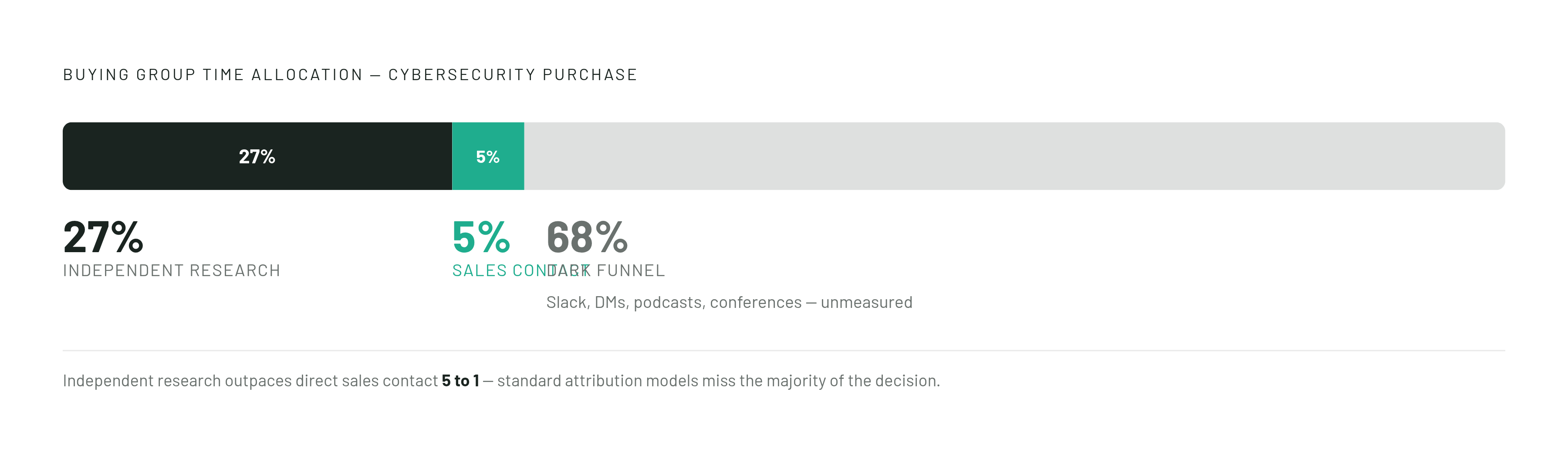
Buyers do their homework before anyone from sales gets a phone call. Roughly two-thirds of cybersecurity buyers read at least three pieces of content before they ever reach out to a vendor. Independent research eats up about 27% of the buying group's total time on the purchase; direct sales contact accounts for something like 5%. Most of the real decision-making happens somewhere your analytics can't see: closed Slack communities, DMs between peers, a podcast episode someone mentioned in a meeting, a conference hallway conversation. People in the industry call this the dark funnel, and it's a fitting name, because the last click your dashboard credits is typically the most marginal moment in the whole journey.
A standard 30- or 90-day, single-touch attribution window was built for a faster, simpler sale, and this longer, murkier one outgrew it long ago. Running the numbers on paid search doesn't rescue you either; cybersecurity keywords are some of the priciest real estate in B2B, with median cost-per-click running $16 to $18, and high-intent compliance terms climbing north of $175. Treating that spend as your ROI stand-in is expensive and misleading in equal measure.
The real fix is accepting that trust gets built in places analytics cannot reach, and building your measurement around influence signals rather than a tidy path from ad to purchase.
The metrics that actually reflect pipeline influence with technical buyers
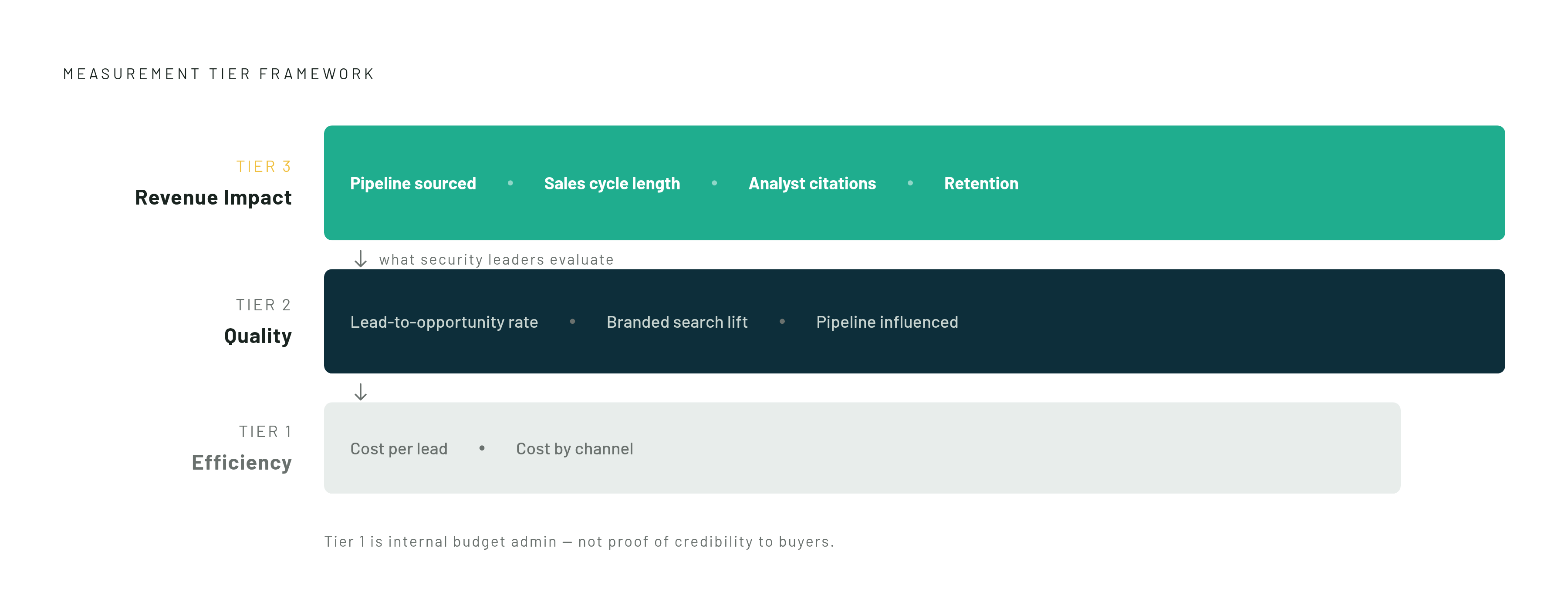
Think of measurement in three tiers. Efficiency covers cost per lead, cost by channel, that kind of thing. Quality looks at how many of those leads actually turn into real opportunities, and whether your content is lifting branded search. Revenue Impact asks the biggest question: is this content tied to actual dollars, actual retention, actual account growth?
The signals worth trusting: pipeline that content sourced or influenced, shorter sales cycles for prospects who read your work before they talked to sales, your research getting cited by an analyst firm, sales reps pulling up a specific piece mid-deal because it answers the exact objection sitting in front of them.
Then there's the stuff that fills dashboards and tells you almost nothing: page views, time on page, bounce rate, raw form fills. They make a marketing team look busy while leaving unanswered whether a single security architect trusts you more than they did last quarter.
Impressions and form fills measure visibility, while credibility is a separate thing entirely, and with a buyer who reads your documentation before your ads, credibility determines whether visibility converts. Pipeline velocity, how fast a qualified deal actually moves, is the most reliable indicator of content quality. And of the three tiers, Quality and Revenue Impact are the ones that map to how a security leader actually evaluates you. Efficiency metrics matter for budget conversations internally, though pipeline quality and sales cycle length explain why someone picked you over the other guy.
Why self-reported attribution and multi-touch models need different roles in a cybersecurity programme
Ask a new customer one simple question: "What made you reach out?" That answer is often the most honest data point in your entire stack. It catches all the dark-funnel influence that no pixel, no cookie, no UTM parameter was ever going to catch.
Multi-touch attribution earns its keep as a budget-allocation tool. Use it to spot which channels deserve more investment and which ones are coasting. Claiming you know exactly which blog post closed a six-figure deal wastes everyone's time in the quarterly review.
Correlation is the more useful lens here. Look for the pattern: are the deals that read your research moving faster through the pipeline? That pattern tells you more than demanding a clean, provable attribution line from every single asset.
Here's the practical version. Every time a new customer closes, ask what they read, watched, or got forwarded before they picked up the phone. Put that answer in a structured CRM field. And be careful what you punish. Teams that insist on clean last-touch ROI for every dollar spent end up starving brand and community work first, despite those being the channels that build practitioner trust long before any buying signal shows up. SEO content plays the same long game: it compounds over six to twelve months, not days, and any attribution model with a short window will always undervalue it.
How original threat research produces ROI signals that no other content type can
Original research does something no blog post about "5 tips for better endpoint security" can do. Sales reps use it in live deals because it gives them something real to point to.
CrowdStrike's annual Global Threat Report is a widely cited example. It became an industry reference point because it handed practitioners real intelligence, customer or not. Cloudflare Radar works the same way. It runs on data nobody else has access to, because nobody else sits where Cloudflare sits on the internet's infrastructure. That's a moat built out of proprietary telemetry, inaccessible to vendors without the same infrastructure.
The pattern repeats across the industry: a vendor publishes original threat research, it gets picked up by the press and cited by analysts, and the resulting authority outlasts any campaign built around it. One piece of original research can build years of credibility. That's the ceiling this kind of work can reach, and it's why the ROI signals from original research look different from anything else: analyst citations, inbound press calls, sales reps quoting it in the room, and its appearance in RFP responses months or years later.
What technically shallow content costs in a market where practitioners vet every claim
Security architects, SOC analysts, pen testers, security engineers: this crowd reads documentation for fun and treats your marketing page as a claim to be tested against evidence. If there's a hole in your technical argument, they'll find it, usually before they finish the second paragraph.
Once they find it, they carry that mistrust into the next email, the next demo, the next renewal conversation. It's a debt that follows the relationship. Recent survey data puts it plainly: 98% of buyers now reject content that feels generic or is dressed up with AI-enhanced imagery that doesn't match the substance underneath.
Fear-based marketing has hit its ceiling, too. Security leaders wade through hundreds of "this threat will destroy your business" messages every week, and every vendor claims to be the one that stops it. The filter practitioners have built against that noise is close to bulletproof at this point. Content that tries to scare rather than inform tends to burn trust instead of building it.
Generic AI-written content has quietly stopped working on two fronts at once: it loses search visibility and fails to convert the readers it does reach. Technical specificity is now table stakes. The only content that survives a practitioner's read is the stuff written by people who actually understand the threat landscape, in language precise enough to prove it. That's the price of admission, plain and simple.
Building a measurement programme that can justify a serious content investment
A real cybersecurity content program puts out four to eight strong pieces a month, each one running 2,000 to 4,000 words, written or reviewed by someone with genuine domain expertise, and tied to a specific outcome: an SEO target, a sales enablement need, an analyst briefing, a campaign. Rigour at that level is what earns practitioner trust.
Distribution belongs inside the ROI conversation, not as an afterthought. A piece sitting alone on the company blog does a fraction of the work the same piece does once it's pushed through LinkedIn, email, practitioner communities, and analyst briefings.
Sales enablement doubles as a measurement layer here. Track how often reps pull a specific piece into an active deal. Check whether prospects who engaged with your content close faster than ones who didn't. That connects content straight to revenue on observable evidence alone. Branded search lift, tracked over six to twelve months, tells you more about content authority than any single-post engagement number ever could.
Some programs build this in from the start by having practitioners, not editors, decide what's worth publishing, paired with writers who actually work in the field. The strongest programs run on that model: threat intelligence drives the calendar, so every piece connects to something the audience is already watching closely. That approach aims at something durable: shrinking the credibility gap between vendor and buyer, and tracking that shrinkage through pipeline quality, sales cycle length, analyst engagement, and what customers say, in their own words, when you ask what got them to pick up the phone.