Developing a Cybersecurity Content Strategy From Scratch
Ground your content strategy in actual threat intelligence, not generic keyword lists.

A cybersecurity content strategy built from scratch only works if it's tied to the actual threat landscape practitioners deal with every day, rather than a content calendar or a keyword list borrowed from fintech or SaaS. The global cybersecurity market sits at $234.01 billion in 2025 and is on track for $424.14 billion by 2030, which means every vendor with a blog and a budget is fighting for the same eyeballs. Add in the FBI's Internet Crime Complaint Center logging over a million complaints tied to more than $20.8 billion in reported losses last year, and you get a buyer who has seen real damage and reads vendor claims the way a customs agent reads a suitcase. Gartner has security and risk-management spend climbing from $193 billion in 2024 to a projected $240 billion by 2026, so the money keeps growing too, which just means more noise chasing the same tired attention.
The practitioner reading your content, whether they're an engineer, a detection lead, or a security architect, can smell shallow work in about four seconds. Fear-mongering makes them stop reading. That is the FUD problem: pile on danger without a grounded fix, and you train your own readers to ignore you.
What it actually means to anchor a content strategy in the threat landscape
Threat intelligence functions as a source of editorial signal, one you publish from, not a product line. Active campaigns, new attacker techniques, infostealer trends, vulnerability disclosures, these are inputs to what you publish next week, treated as editorial decisions rather than paragraphs buried in press releases.
The threat intelligence market itself is growing fast, from an estimated $11.55 billion in 2025 to a projected $22.97 billion by 2030, a 14.7% compound annual growth rate. Buyers increasingly expect the vendors they read to speak this language fluently, not merely reference it in passing. Recorded Future's 2025 State of Threat Intelligence Report, based on 615 respondents, found 43% of cybersecurity executives already use threat intelligence to guide strategic investment decisions, which points to how deeply intelligence has worked its way into how buyers think before they ever talk to a vendor.
Here's a number that should reorder anyone's editorial calendar: IBM X-Force's 2025 Threat Intelligence Index found an 84% jump in infostealer phishing emails in 2024 compared to the year before. A shift that size should show up in your content within weeks, well before a quarterly planning offsite catches up to it. And with average attacker breakout time down to 29 minutes, the pace of the threat landscape is itself an argument for how you build content: anything written off last quarter's data is already stale by the time it publishes.
There's a real difference between pulling from live threat data and building a calendar off keyword volume borrowed from an adjacent industry. The threat intel market's rapid growth reflects organizations treating cybersecurity as a board-level priority. Content strategy needs the same elevation to carry any weight.
Mapping the audience before writing the first brief
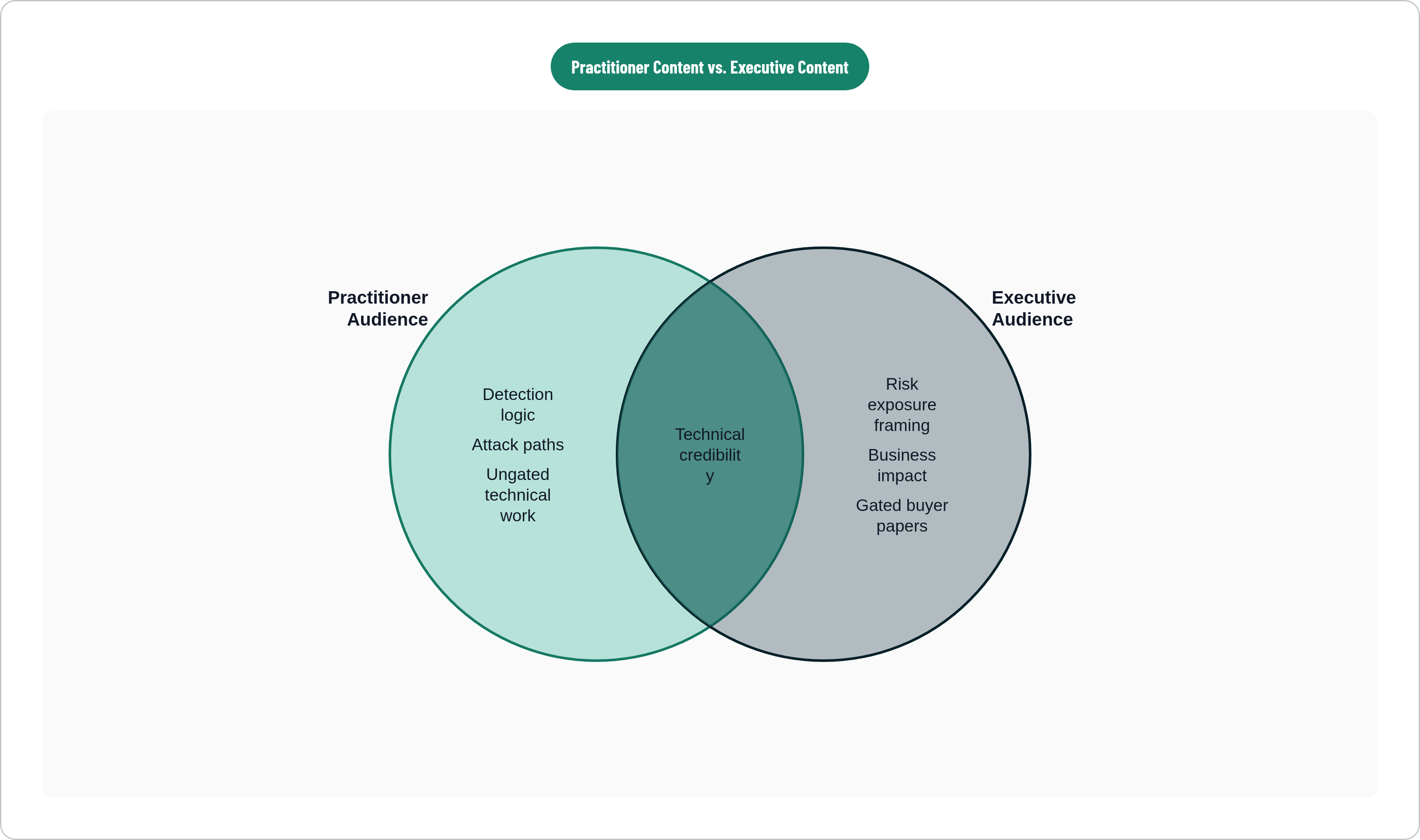
Cybersecurity buying has at least two distinct readers with fundamentally different priorities. Practitioners, meaning detection engineers, security architects, red teamers, judge technical credibility line by line, while security leaders and executives judge risk exposure and business impact. Writing for both requires a deliberate two-tier approach.
The fix is a two-tier model: technical depth for the practitioners, business-outcome framing for the leaders, running side by side rather than mashed into one confused piece. A practitioner reading your white paper is hunting for the mistake, the oversimplified diagram, the hand-wavy claim that gives away that you don't actually understand the problem you're writing about.
So go find out what they're actually arguing about. Security-focused publications, forums, Reddit threads, Substack newsletters, community Slack channels, these surface real debates, distinct from what a marketing team assumes matters. Certain topic clusters tend to generate stronger engagement than others and can serve as a useful baseline, but the specific threat conditions facing a target segment should always override a generic list. Recognition without trust amounts to noise with your logo on it. The goal is credibility that makes awareness worth having.
Building the intelligence intake process that feeds the content calendar
An intake process is what keeps a strategy tied to threat reality month over month. Skip it, and even a well-built strategy drifts back toward generic templates within weeks, quietly and fast.
The inputs are concrete: your own telemetry and research, third-party threat reports, vulnerability disclosures, infostealer campaign tracking, and the vulnerability clusters that actually matter to your sector. Not every one of these deserves a published piece, and that is where triage comes in. Triage is a judgement call: is the signal material enough to publish, timely enough to matter this week, and does the team have something original to say about it?
Automated feeds surface volume; deciding what's worth a reader's fifteen minutes still needs a human. Bitsight's State of Cyber Risk and Exposure 2025 report found that 85% of companies use attack surface or exposure-management tools, but only 17% can actually map threats and connect multiple risk factors in real time. That gap, between owning the tool and knowing how to use it, is exactly the kind of finding that makes for a real article, in contrast to yet another generic post explaining why threat intelligence matters, which nobody needed written in 2025.
The output of a good intake process is a set of editorial decisions, each one tied to a live threat condition and a specific reader's actual need. Cadence matters too: annual or quarterly research franchises (CrowdStrike, Mandiant, and IBM X-Force have proven this model works), fast breakdowns of active campaigns, and ongoing coverage of malware families relevant to your specific domain.
Choosing content formats that match technical depth to reader intent
Format tells the reader how much you respect their time and their expertise. A rushed video explainer says one thing; a detailed technical breakdown says another.
Technical white papers written for practitioners depend entirely on specificity: detection logic, attack paths, data flows, actual signals a reader could act on. One vague diagram or one wrong claim, and you've lost that reader permanently, not just for this piece but for the next five. Gating logic follows from this. Buyer-facing educational papers can sit behind a form, since a download signals real intent from someone earlier in their research, while deep technical papers for practitioners should stay ungated, since engineers avoid forms like they avoid Windows Update at 4pm on a Friday, and ungated technical work spreads through the community on its own anyway.
Case studies rate as the most effective content type for 69% of B2B marketers, but in cybersecurity they only land when they're loaded with real technical detail, alongside a tidy outcome summary and a client logo. Product-led content works the same way: articles that answer a real operational question, where the product shows up because it genuinely belongs in the solution. Interactive formats, security assessments, simulated attack scenarios, ROI calculators, have become a standard part of the toolkit, and they work when they reflect actual threat conditions instead of made-up scenarios that feel like a training exercise from 2015.
A tutorial that reaches 500 engineers actively evaluating a product category beats a much larger audience of general visitors. Optimise for precision.
The production standards that determine whether technical content holds up
A solid brief and a rigorous technical review are the two gates that determine whether technical content survives contact with its audience.
A solid brief spells out the threat condition being addressed, the specific reader type, the technical depth required, the actual claim being made, and what the reader should walk away able to do or understand. Technical review means a real check, done by someone with domain fluency, on whether the detection logic is right, the attack path is described accurately, and the framing holds up when a sceptical engineer starts poking at it.
Employee-led content carries weight a corporate account cannot match. Researchers and engineers who publish their own findings, answer questions in public, and show up in community discussions build individual credibility, and that adds up to a network of trusted people. Worth remembering: the practitioner community is small and tightly connected, and shallow or inaccurate content travels fast in exactly the circles you're trying to win over, and it works against you.
This standard holds regardless of team size: practitioner triage paired with specialist authorship, where the intelligence process stays human, and every piece gets built to survive a technical reader who's actively looking for a reason to distrust it.
Distributing content where practitioners actually spend their attention
Security is a community first and a market second. Practitioners trade findings and opinions in Discord servers, Slack channels, conference hallway tracks, open-source project spaces, and forums, and reputation there gets built through participation.
An employee sharing a real finding in a relevant thread earns more attention than a sponsored post, and the two operate by entirely different rules. Search still matters: B2B SEO in cybersecurity delivers a 748% return on investment compared to paid channels. Yet 60% of searches in 2025 end without a single click, so content must answer the question directly in the snippet, building recognition among readers who stay on the search page.
AI search platforms tend to cite content that's 25.7% "fresher" than what shows up in traditional organic results, and threat-anchored content has a built-in edge here, since recency comes standard when your editorial signal starts from live intelligence rather than an evergreen template. Knowledge hubs, FAQs, case studies, structured technical write-ups, have become the actual mechanism for getting picked up by AI engines now, alongside their role as a nice-to-have for human search rankings.
Distribution and format aren't really separate decisions. Ungated technical papers spread through practitioner networks on their own, while gated educational content converts people who already have intent, and community participation builds the background credibility that makes both feel earned.
Measuring what a threat-anchored content programme is actually producing
Pageviews are a vanity metric here, plain and simple: traffic from the wrong audience says nothing about whether you're building trust with the practitioners who actually influence a purchase.
Better signals: engagement from identifiable practitioner segments, content showing up inside AI-generated answers to relevant searches, inbound interest from named accounts in your target segment, and community sharing or citation by practitioners themselves. Recorded Future's 2025 report found 91% of respondents plan to spend more on threat intelligence in 2026, so vendors whose content already tracks the intelligence landscape are standing where buyer attention is headed next.
That same report found 81% of respondents plan to consolidate their threat intelligence vendors. Buyers are looking at fewer vendors, more carefully, which means demonstrated depth across a vendor's content becomes a real selection factor.
The measurement question should mirror the editorial one: is this piece earning trust with the practitioners who'll eventually shape a buying decision, or is it generating a number that looks good in a monthly report and matters only on a dashboard? A threat-anchored content programme compounds. Every piece that survives a technical read adds to a body of work that defines where a vendor stands in the market, durable beyond any single campaign or trend cycle.