Evaluating a Cybersecurity Marketing Agency's Technical Credibility
How to spot whether a cybersecurity marketing agency actually understands the domain.
Picking the wrong cybersecurity marketing agency does not just waste budget; it actively damages your credibility with the exact people who decide whether to buy from you. Those are the real stakes here. In a market where practitioners are professionally trained to spot bad information, technically illiterate content is a liability. So the question you need to answer before signing anything is: "what specific signals prove they can survive a practitioner's read?"
What the buying environment actually looks like for cybersecurity vendors right now
The cybersecurity market is enormous and getting bigger fast. We are talking about a $227.59 billion global market in 2025, projected to hit $351.92 billion by 2030. Gartner forecasts worldwide end-user security spending at $240 billion in 2026, up from $213 billion in 2025. Budget is growing, fast.
Here is the catch: more budget means more competition, not less.
IT-Harvest tracks over 4,000 vendors and 11,000-plus products in this space. Vendors raised $13.97 billion across 392 funding rounds in 2025 alone; that is a 47% jump over 2024. More money means more marketing. More marketing means more noise. And paid search competition on cybersecurity keywords jumped 42% year-over-year in early 2025, with the overwhelming majority of cybersecurity firms planning to increase marketing budgets that same year.
So everyone is spending more to reach the same sceptical audience. That raises the floor on content quality dramatically.
And here is what makes this market genuinely different from most B2B categories. Buying committees typically include six to ten stakeholders. Buyers spend roughly 70% of their journey doing independent research before they ever contact a vendor. Content is doing the heavy lifting throughout that entire process, at awareness, at the bottom of the funnel, and everywhere in between.
When practitioners encounter content that gets things wrong, they do not just move on. They remember. And they tell colleagues.
Why generalist agencies consistently fail the practitioner test
The failure pattern here is painfully consistent. A cybersecurity vendor hires a generalist agency. They get a stack of content. Traffic nudges upward. Pipeline does not move. And the internal technical team ends up rewriting every draft before anything goes live.
That last part is the tell.
Generalist writers make errors that practitioners catch immediately. They use MDR and MSSP as if the terms are interchangeable. They describe Zero Trust as a product feature rather than an architecture philosophy. They misrepresent how MITRE ATT&CK is actually used in a SOC. These are signals. And security buyers are wired to notice signals like this because their literal job is to detect deception.
Cybersecurity content that exaggerates, oversimplifies, or uses terminology incorrectly actively damages credibility. It communicates that the vendor does not understand its own domain. That is a credibility hit with someone who might sit on your buying committee.
There is also a 2024 TrustRadius finding worth noting: 88% of B2B buyers prefer vendors who educate without pushing products. Generic thought leadership fails both tests at once: it stays shallow and reads as promotional.
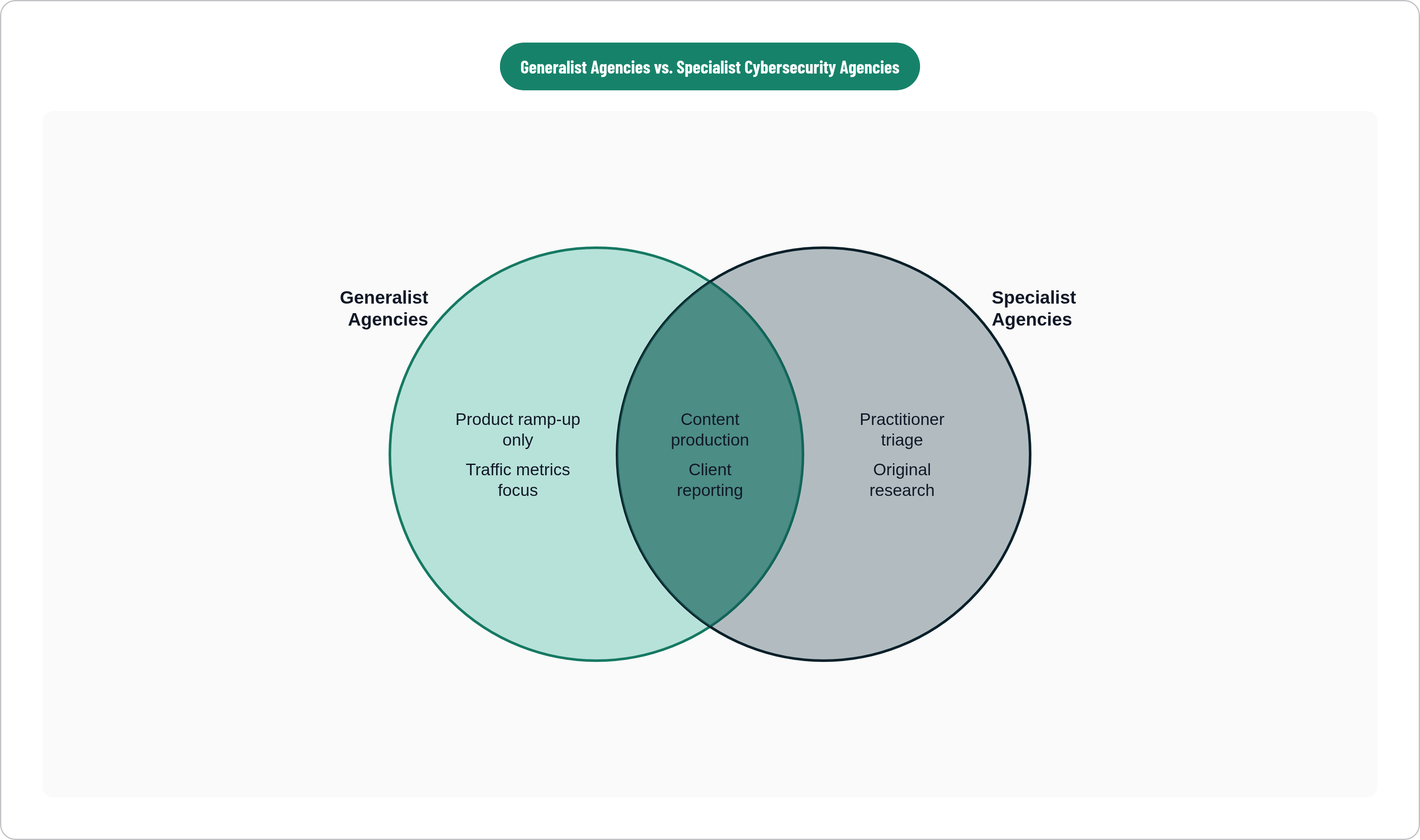
The structural problem is this: generalist agencies ramp up on your product, not on the security domain. They can learn your features but never practitioner context. The difference between how a security leader reads a piece versus how a SecOps engineer reads the same piece stays beyond their grasp. That gap persists through onboarding calls.
Surface-level cybersecurity branding (logos, claims of "deep expertise," a page on the website about security clients) is easy to produce and unreliable. Only verifiable signals carry weight.
Whether the agency demonstrates native language fluency before being coached
Here is the single most useful thing you can do in an early agency conversation. Stop presenting. Start asking.
The clearest test of domain fluency is whether the agency can engage in the security space without you acting as their translator. Before you brief them on your product, before you share your positioning docs, throw them a technical scenario and watch what happens.
Try something like: "How would you approach marketing a solution that uses homomorphic encryption?" You are watching whether they engage thoughtfully, ask the right clarifying questions, or go completely blank.
A sharper version: ask them to walk through how they would frame CMMC requirements for a defence contractor versus HIPAA compliance for a medical practice. Most generalist agencies treat cybersecurity as a single vertical; they will stumble immediately.
Real fluency means knowing when to use technical language, when to abstract it, and which audience needs which version. The CFO approving the budget does not read the same piece as the SecOps lead building detections.
Check whether they reference current threat conditions in conversation without prompting. Recent vulnerability disclosures, shifts in attacker TTPs, regulatory changes. Agencies with genuine domain depth follow the field because their people are embedded in it. Not because they ran a Google search before your call.
Staff composition is a direct proxy for this. Ask whether the team includes writers or strategists with prior security roles, practitioner certifications, former IT journalism backgrounds, or hands-on security experience. This is often the clearest structural signal available. Who actually works there is the signal that matters.
How to read an agency's existing work as a technical audit
Do not accept a general portfolio. Request published samples specifically in your subdomain. Network security, identity and access management, cloud security, OT/ICS. A firm that has produced credible IAM content operates in a different world from incident response.
Apply what I call the engineer-proof standard. Would a practitioner on your technical team accept a draft from this agency without significant revision? Look for accurate use of frameworks like MITRE ATT&CK, NIST CSF, and SOC 2. Look for correct product category terminology. Look for claims that are precise rather than inflated.
Then try to break the content. Does the piece explain detection logic, identity flows, or encryption models accurately? Or does it gesture at technical depth without actually delivering it? There is a huge difference between those two things and a practitioner will see it instantly.
Whitepapers and research reports are higher-signal than blog posts. Longer-form work is harder to fake; it usually reveals whether the team has genuine domain knowledge or is producing surface-level synthesis dressed up with technical vocabulary.
One specific red flag: content that uses the right terminology in the headline but oversimplifies or contradicts it in the body. This is a very common pattern. It happens when writers have learned a vocabulary list but not the underlying concepts. The headline sounds credible. The body falls apart.
The strongest signal in the other direction is original research. Proprietary data, practitioner surveys, investigations that get cited by third parties. That indicates the agency can produce work that holds up to external scrutiny, not just content that checks a publishing cadence.
Here is a concrete example of what that standard looks like. A researcher named Daniel Kelley conducted an investigation into WormGPT while working with SlashNext. The piece was published under SlashNext's brand, was later covered by The Wall Street Journal, and remained core intellectual property through the company's acquisition by Varonis. The test is whether the research holds up after the engagement ends. That one did.
What verified proof looks like versus what agencies typically show instead
Here is what verified proof actually looks like.
Named cybersecurity clients, not just logos without attribution
Published case metrics tied to specific commercial outcomes
Third-party ratings with review counts and capture dates
Concrete results set the bar. Published examples in this space include 340% organic traffic growth for IBM Security and 180-plus marketing-qualified leads per quarter for Morphisec. The point is that credible agencies can name outcomes at all. They can connect their work to something real.
Industry awards are a signal, but a weak one standing alone. An award means more when it sits alongside named clients and measurable results. When it is the only proof on the table, it does not tell you much.
What agencies typically show instead of verified proof: aggregate impressions, domain authority scores, social follower counts, and unnamed "enterprise security" clients. Connecting marketing activity to pipeline and demonstrating domain competence requires more than these signals.
The working consensus in practitioner communities is pretty consistent on this. Agencies that claim cyber expertise often cannot survive a technical question. Named security clients plus a team that speaks the domain language unprompted is the safest predictor.
Also worth noting: subspecialty alignment matters. An agency with a strong track record in SMB endpoint security is not automatically qualified for enterprise SIEM or OT/ICS marketing. Ask for examples specifically within your niche. "We've done cybersecurity" is not an answer.
How pipeline accountability separates credible agencies from those optimising for their own metrics
The most reliable red flag is results framed exclusively in impressions, click-through rates, and traffic, with no connection to sales-qualified leads, meetings booked, or pipeline created.
Pipeline and revenue require a direct connection to commercial outcomes. An agency that connects work to your commercial outcomes is optimising for your interests; otherwise they are optimising for their own metrics.
Fee structure is a structural signal worth examining. Agencies that charge a percentage of ad spend, typically 10 to 20%, have a financial incentive to increase spend regardless of whether that spend is working. Ask directly: "Does your fee scale with our ad spend?" The answer tells you a lot about whose interests the pricing model serves.
Watch for the bait-and-switch. Senior strategists lead the pitch. Junior staff manage the account. Ask who specifically will write your content, who will review it for technical accuracy, and who your day-to-day contact will be six months after you sign. Get names. Ask to speak with those people before you commit.
Long lock-in contracts reduce accountability by design. A credible agency operating on shorter engagement terms has a stronger incentive to produce results that justify renewal.
On timelines: credible agencies are honest about how long things take. Expect 3 to 6 months before meaningful pipeline movement. PPC results on high-intent terms solidify in 30 to 90 days. SEO takes 6 to 12 months. Monthly investment for ongoing programmes typically runs somewhere in the $5,000 to $25,000-plus range depending on scope. Promises of faster results are a diagnostic red flag. Not a feature.
A PwC survey of nearly 4,000 executives found that 78% of organisations plan to increase cybersecurity budgets in the coming year. The budget environment rewards patience with the right partner and punishes a fast, wrong choice.
The questions to ask in an agency evaluation that most vendors don't think to raise
Most vendors ask about pricing and timelines. Here is what to ask instead.
On domain fluency: "Walk me through how you would explain our detection logic to a SecOps engineer versus the CFO approving the budget."
This reveals whether they think in audiences or in single messages. An agency that can only write one version of a concept does not understand the buying committee they are writing for.
On staff: "Who on your team has a security background, and who specifically would write our content?"
Then ask to speak with that person directly before you sign anything. The answer to this question on a slide deck and the answer when you are on a call with the actual writer can be very different things.
On proof: "Show me a published piece in our specific subdomain and walk me through how it performed against pipeline metrics."
Generalist agencies will redirect to traffic figures; credible ones can connect content to commercial outcomes.
On incentive structure: "Does your pricing change based on our ad spend?" and "What does the account team look like six months after we sign?"
Both questions surface conflicts of interest and staffing patterns before you are locked in.
On timeline honesty: "When should we expect to see pipeline movement, and what would cause you to revise that estimate?"
An agency that answers with a range and a set of conditions is more credible than one that commits to a number without caveats. Certainty is a red flag.
On original research: "Have you produced primary research that was cited by third parties or covered by trade media?"
This is the highest bar. It identifies research and content studios above content producers. The agencies that can answer yes are worth a longer conversation.
The evaluation requires asking the questions that most vendors skip. Ask them. The answers will tell you everything.