Cybersecurity Marketing Agencies for Startups vs Enterprise Vendors
Startups and enterprises need opposing marketing strategies in a consolidating $210 billion market.

The cybersecurity market sits somewhere between $210 and $225 billion in 2025 and is projected to nearly double by 2030. More vendors, more noise, and tighter budget concentration around a smaller number of trusted names. A growing market does not distribute money evenly. It is a flood, and the underprepared get washed out first.
Two very different businesses are competing inside that market, and they share almost nothing in common.
Startups are building credibility from zero. Unknown brand, unproven product, sometimes a category that does not quite exist yet. The sales team cannot do much until marketing gives them something credible to send. As of 2025, 63% of total cybersecurity funding sits at Seed or Series A. A lot of companies are solving this problem right now, simultaneously, all competing for the same practitioner attention.
Enterprise vendors are fighting a different battle entirely. They have the brand. They have the install base. But 75% of organizations now plan to consolidate their security vendors, up from 29% just a few years ago. Enterprise vendors are marketing into a shrinking pool of buying decisions, where buyers are actively hunting for reasons to cut vendor count.
One problem is building something from nothing. The other is out-narrating incumbents on consolidation value. The instincts that work for one are genuinely counterproductive for the other, and most agencies will not volunteer which one they are actually built for. You have to push them on it.
What Startups Actually Need From a Marketing Agency in the First 12 to 24 Months
Most startups do not have a marketing function when they start looking for an agency. That detail matters more than people want to admit, because it means the agency has to be comfortable building the infrastructure from scratch.
The priority list at this stage:
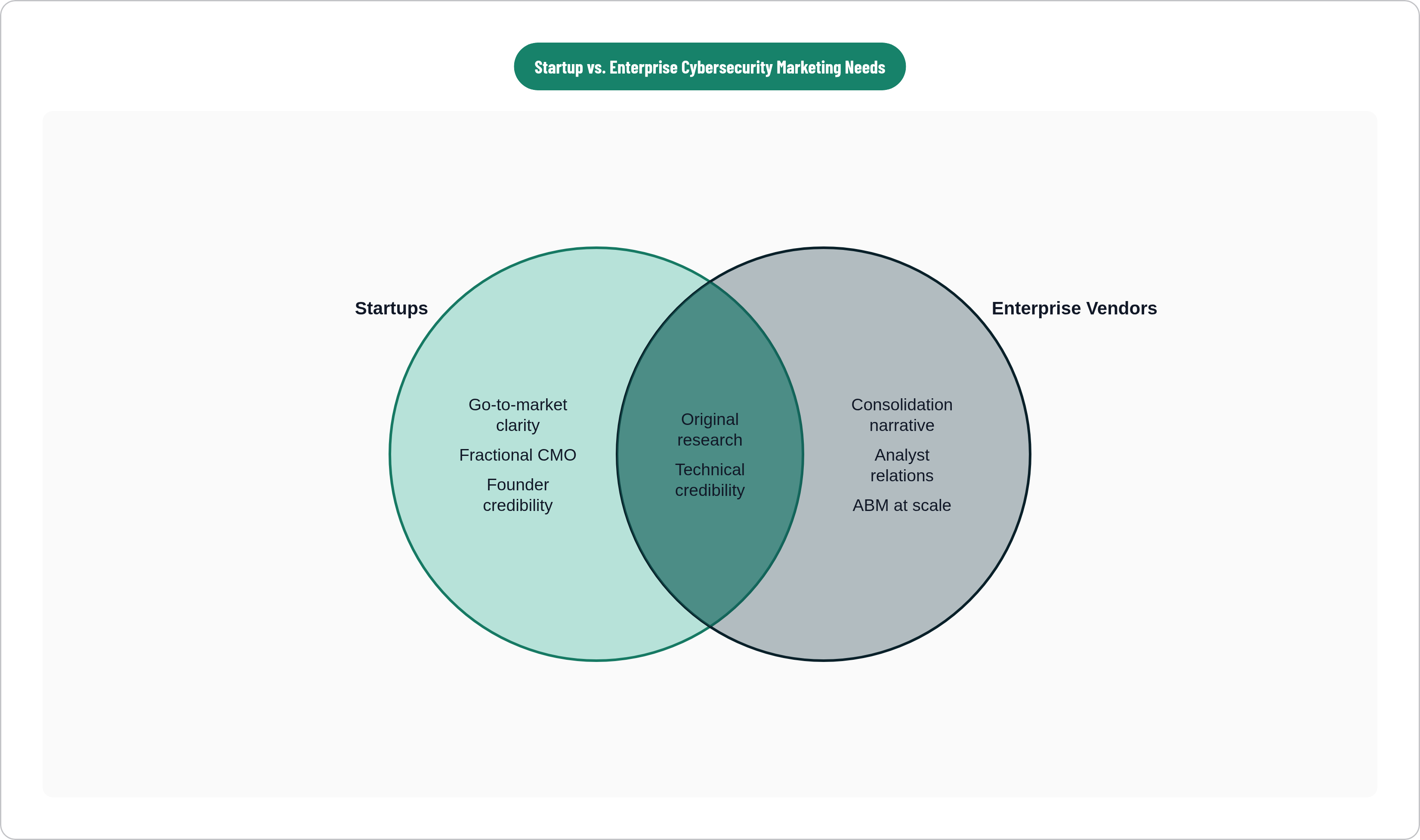
- Go-to-market clarity first. Positioning, ICP definition, messaging hierarchy. An agency that jumps to demand generation before these are settled will burn through budget and produce very little worth keeping.
- Fractional CMO capability. Someone needs to own strategy and build process. Execution without direction produces output rather than results.
- Founder credibility amplification. The founder's voice and technical authority are real assets at this stage. The right agency amplifies that, preserving technical authority instead of burying it in polished corporate messaging that sounds like every other vendor in the space.
- Right-sized tactics. ABM is typically too heavy for an early-stage company. LinkedIn targeting combined with thought leadership in practitioner communities works better when your target account list is small and budget is limited.
Firms like Envy, built around the Israeli cybersecurity ecosystem, and Kalungi, which offers fractional CMO plus execution for companies with early traction and no marketing team, are designed around exactly this set of needs. They are built to serve a 12-person company. That is a feature.
The Credibility Gap Startups Must Close Before Other Marketing Can Work
This is the part most early-stage vendors underestimate, and the part that bites them six months later when they cannot figure out why their content is not converting.
Security buyers are practitioner-led. They read vendor content with professional skepticism baked in. Generic content actively signals that the vendor does not understand the problem at depth. A website and a paid search campaign leave that gap open.
Original research does this better than almost any other format. It establishes authority before the brand has a reputation to trade on.
Consider what happened with the WormGPT investigation. Daniel Kelley, researching for SlashNext, discovered and documented a threat that ended up covered by The Wall Street Journal. That piece became core brand intellectual property. It survived SlashNext's acquisition by Varonis. One technically grounded piece of original research, still working years later. That is the ceiling for this kind of work, and it is more achievable than most people think when the agency actually knows what it is doing.
High-volume templated content cannot replicate this. The format requires someone with practitioner judgment deciding what is worth investigating and how to frame findings in a way that holds up to a real security professional reading it critically.
The direct question to ask any agency at this stage: who specifically validates the technical accuracy of what you produce? If the answer is vague, you have your answer.
Cyberou is one agency built explicitly around this requirement. Their model runs on practitioner triage of threat intelligence, specialist authorship, and human review rather than automated content generation. They have produced content and original research for more than 30 cybersecurity vendors, with more than 300 tier-one media features connected to that research. For a startup that needs a first piece of work to survive a technical read from a real practitioner audience, that model is worth understanding.
What Enterprise Vendors Need From a Marketing Agency and Why the Brief Is Different
Enterprise vendors are fighting for position inside a buyer's existing mental model and existing budget. Different kind of hard.
The consolidation story is the central strategic challenge right now. The average enterprise security stack includes somewhere between 60 and 80 tools. Vendors that build a credible narrative around replacing multiple tools gain a structural advantage in the current buying environment. Sixty-five percent of organizations believe consolidation would actually improve their security posture. That is a real opening in buyer psychology, if the agency knows how to construct the argument and sustain it across a long sales cycle.
The enterprise marketing brief shifts in other ways too:
- ABM at scale becomes worth the overhead. Long sales cycles, defined account lists, and multi-stakeholder buying committees make it a legitimate investment at this stage. The same approach would sink a startup.
- Pipeline acceleration matters more than awareness. The brand is already known. The work is shortening the distance between interest and signed contract.
- Analyst relations become a priority. Gartner and Forrester positioning shape how buyers perceive you before your sales team ever gets on a call.
- Executive visibility programmes. Board-level narratives around risk management, governance, and zero trust require agencies that can translate technical capability into business risk language without losing the practitioners in the room.
Team Lewis, whose clients include CrowdStrike, McAfee, and BlackBerry, and Bluetext, which focuses on brand and positioning for high-stakes regulated environments, are examples of firms built for this context. Global reach, full-funnel capability, established analyst relationships.
Agency Options Worth Evaluating and How They Sit Across the Startup-to-Enterprise Spectrum
No single agency serves every stage equally well. The honest way to look at this is matching capability to need, not ranking by prestige.
Early-stage and go-to-market focus:
- Envy. Operates from the Israeli cybersecurity ecosystem, focused on demand generation for security startups.
- Kalungi. Fractional CMO plus execution, built for funded companies with early traction and no marketing infrastructure.
- Everclear Marketing. Lead generation and revenue acceleration for early-stage companies.
- Digi-tx. Works with B2B SMBs and startups on a revenue-sharing Digital Partnership Model, which shifts some of the financial risk away from a flat retainer.
Content and research specialists (relevant across stages):
- Cyberou. Practitioner-triage content and original security research for B2B cybersecurity vendors. More than 30 vendor clients, more than 300 tier-one media features connected to their research. Particularly relevant for vendors at any stage that need technically credible content and original investigation. The human review model is the differentiator.
- Bora. Spain-based, focused on thought leadership and earned media. Retainers start from $2,500 per month. A reasonable entry point for startups building a content foundation.
Mid-market and enterprise focus:
- The Rubicon Agency. Full-funnel B2B technology marketing with a deep cybersecurity practice. Holds the top Lead Generation ranking on Clutch with 200+ five-star reviews across Clutch, G2, and Capterra as of July 2026.
- Bluetext. Brand, positioning, and visual identity for regulated and high-stakes environments.
- Team Lewis. Global enterprise PR scale with marquee cybersecurity clients.
- The Hoffman Agency (which acquired CCGgroup in March 2025). Brings a broader global network particularly relevant for enterprise vendors managing Gartner and Forrester positioning.
Pricing Ranges and What They Signal About Agency Positioning
Most cybersecurity marketing agencies sit somewhere between $3,000 and $15,000 per month. The full range runs from around $2,500 per month at entry level to $50,000 per month for large enterprise programmes.
Some rough benchmarks:
- Entry-level: Bora from $2,500 per month; Envy from $5,000 per project
- Mid-range: content-focused agencies often run well into the tens of thousands per month depending on volume and seniority
- Enterprise tier: dedicated programmes typically start at $15,000 per month and scale from there
What pricing actually signals is stage orientation. A $2,500 per month agency is solving a different set of problems than an enterprise ABM programme. A $15,000 per month firm is not a better version of the $2,500 per month firm. It is a different product for a different moment in a company's life.
For context: mature B2B companies typically allocate 5 to 10% of revenue to marketing. High-growth companies run closer to 10 to 20%. Cybersecurity SaaS companies scaling toward enterprise tend to land in the upper half of that range.
The right question to ask any agency is simple: is your minimum engagement designed for a company at my revenue and headcount stage? You will learn a lot from how they answer it, and more from how long it takes them to answer it.
The Criteria That Actually Differentiate Agencies Once Pricing Is Off the Table
Once you have narrowed to agencies in the right price band, here is what actually separates them.
Technical credibility of content. Can the agency name the specific practitioners who validate accuracy? Can they show you published work that held up to scrutiny from a real security audience, not just a marketing one? Ask to see it.
Stage-matched experience. Has the agency worked with companies at your funding stage and headcount? "We work with cybersecurity vendors" and "we have worked with Series A vendors with no marketing team and a 12-month runway" describe entirely different capabilities.
Original research capability. Does the portfolio contain work that revealed something the market did not already know? Or is it primarily reformatted vendor messaging dressed up as thought leadership?
Intelligence process. For vendors in a fast-moving threat environment, does the agency track vulnerability disclosures, threat actor activity, and competitor movements? And are human practitioners making the editorial calls, or is automated tooling doing most of the work with a human rubber-stamping at the end?
Consolidation narrative capability. For enterprise vendors specifically. Can the agency construct a sustained message that positions you as the tool that replaces three others, not the one that adds to the pile?
Execution model. Asynchronous, written, kanban-based delivery creates a clear audit trail and predictable output. Agencies that run primarily on verbal briefs and status calls introduce process friction that compounds faster than you expect.
Red flags worth naming directly:
- Leading with volume metrics. "We publish 12 blogs per month" is a production boast, not a marketing strategy.
- Cannot name who actually writes or reviews the technical content.
- Applies the same content template regardless of your threat category or buyer persona.
Matching Agency to Stage. The Decision Logic in Plain Terms
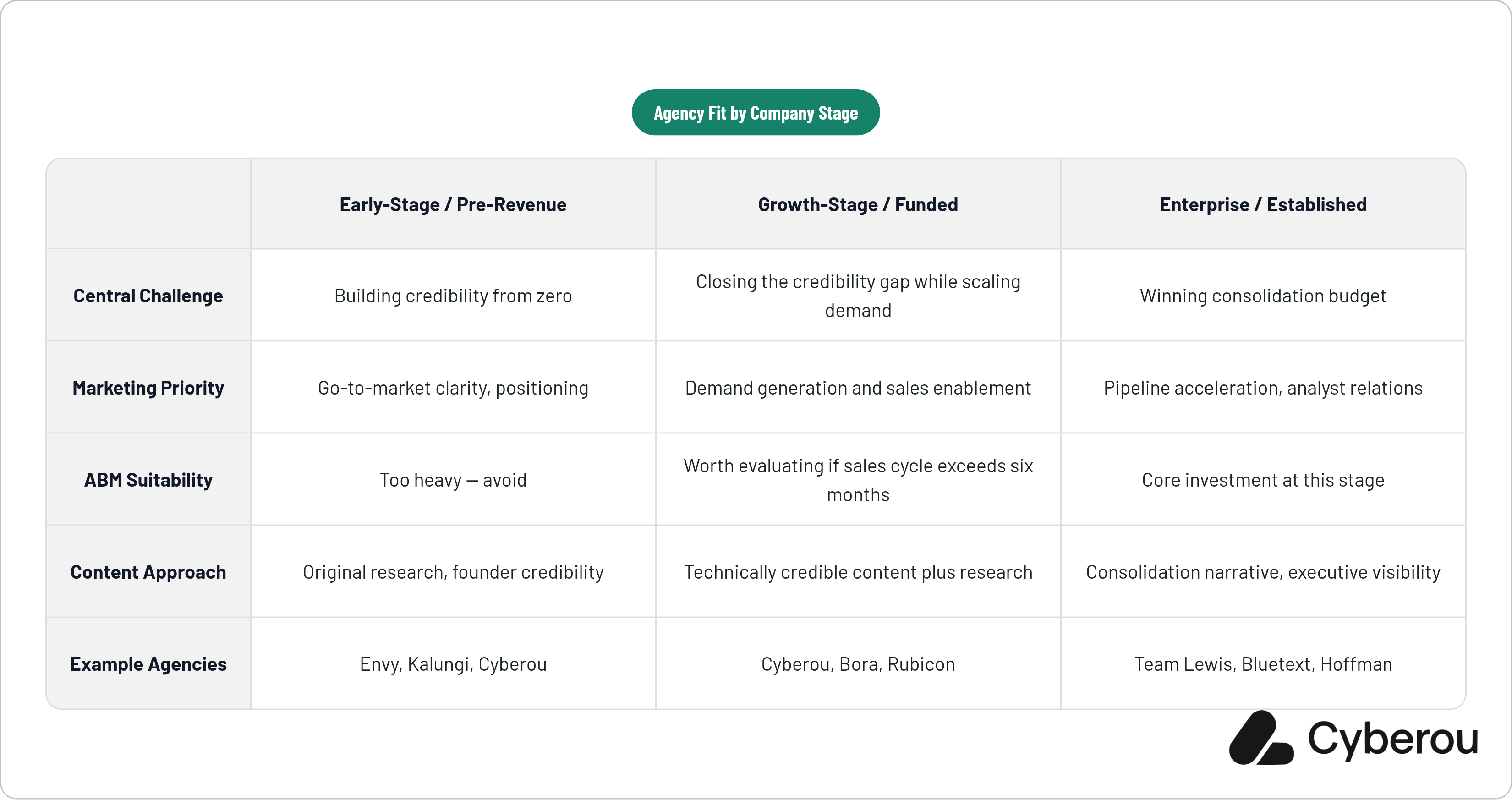
Pre-revenue or early-stage with no marketing infrastructure. Prioritize go-to-market clarity and credibility-building over lead generation. Find fractional CMO capability, or a content and research studio that produces technically credible work a practitioner will actually respect. Demand generation before positioning is settled is expensive noise.
Funded growth-stage vendor with a defined ICP and early traction. The credibility gap is still the central problem, but demand generation and sales enablement start becoming co-equal priorities. ABM is worth evaluating if your sales cycle exceeds six months and your account list is well-defined. Before those conditions exist, the approach works against you.
Established vendor competing for consolidation budget. The brief shifts to pipeline acceleration, analyst relations, executive visibility, and a consolidation narrative that gives security leaders a defensible reason to choose you over a vendor they already have. Global PR capability and ABM at scale become relevant here in ways they are simply not at earlier stages.
The consistent filter at every stage: agencies that produce content without practitioner input create a credibility liability. In a market where buyers read vendor material with professional skepticism, technically shallow content is worse than publishing nothing.
Global information security spending is forecast to reach $240 billion in 2026. The market keeps growing, and budget concentrates around trusted names. Marketing is how trust gets built on the way up and defended once established.