Evaluating a Cybersecurity Marketing Agency RFP Response
How to spot whether a cybersecurity agency truly understands your challenge.

Evaluating a cybersecurity agency proposal is different from evaluating a generic marketing pitch. The standard is higher, the stakes are more specific, and the signals are easier to miss if you don't know what you're looking for. Here's the thing most people skip over entirely: the RFP response is the first piece of content the agency produces for you. Before a blog post, before a campaign, before anything gets built, you have this document. A real practitioner read your brief and applied judgement to it, or someone pulled a template from a folder, swapped your company name in, and hit send. That distinction is usually visible before you read past page three.
There's also a practical reason to take the document seriously at a structural level. RFP responses frequently get incorporated into contracts and statements of work. What the agency writes, it's committing to. Vague language in the response becomes vague contractual obligations later. Overpromising in section two becomes a dispute in month six.
The one question you're trying to answer when reading any response: did this agency understand the problem behind your questions, or answer only what you literally asked? Answering the questions is filling out a form. Understanding the problem behind them is the work of a strategic partner. Think of it this way: one agency is handing you a map of the roads you asked about, while the other is figuring out where you actually need to go.
How to Read the Domain Expertise Section Without Being Misled by Fluency
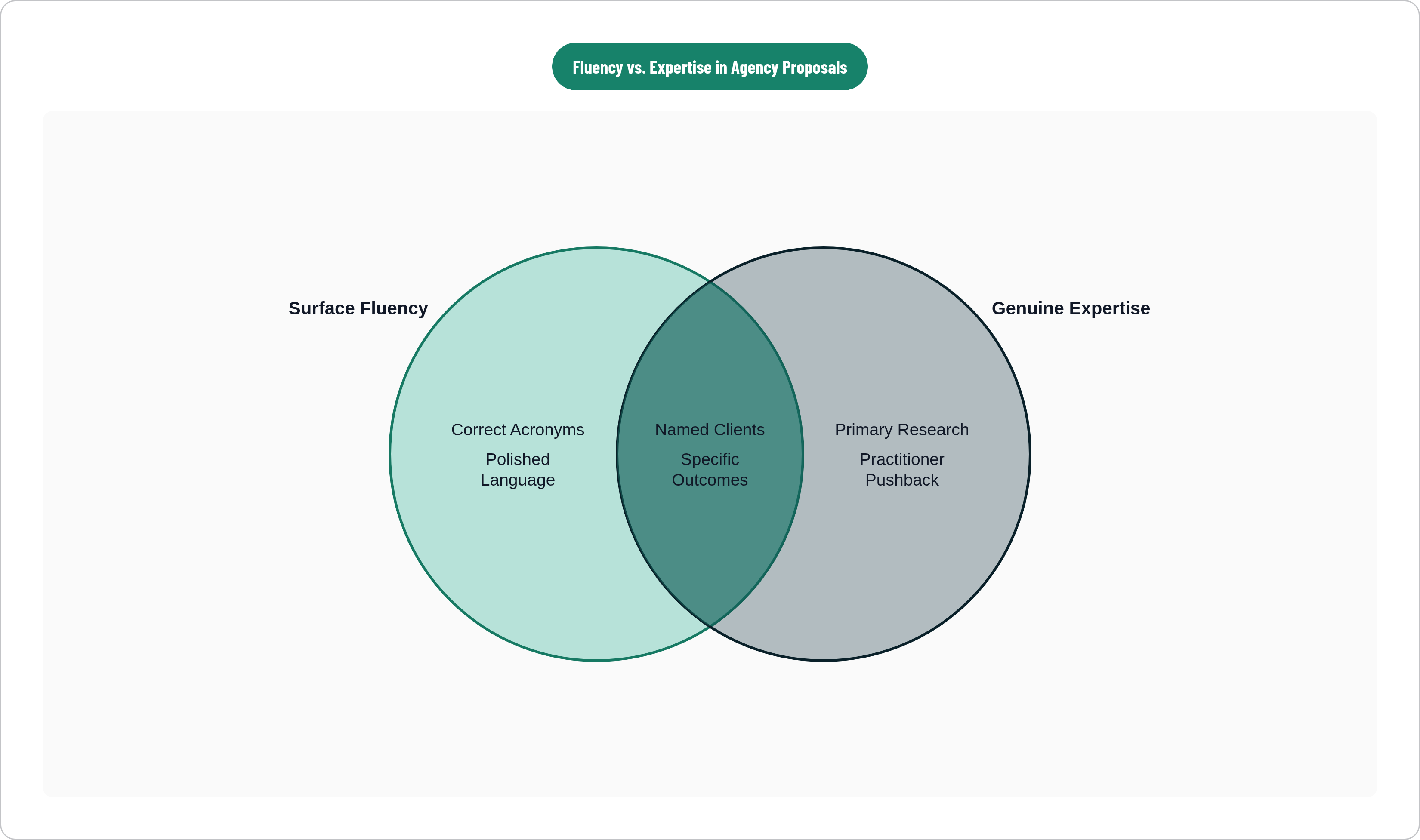
Fluency and expertise are distinct things. That's the central trap in this section.
A good writer can produce three pages that sound authoritative about MDR, ZTNA, and zero-trust architecture without actually understanding any of them. The language is available. The acronyms are searchable. The problem is that security practitioners read that content and immediately know the difference. They've been reading vendor content for years. They can tell within one paragraph whether the writer actually understands the space. And because security buyers are well into their research process before they ever contact a vendor, agency content that falls short of that standard of depth is invisible.
Here's what to actually look for:
Persona differentiation. A strong indicator is whether the agency treats the security leader persona as one monolithic audience or distinguishes within it. A security leader at a 200-person Series B company has different priorities than one at a large enterprise. An agency with real fluency knows this. One without it will give you a confident-sounding answer that collapses both into the same thing.
Specific market references. Genuine expertise shows up as a specific reference to how the crowded EDR market is affecting messaging decisions, not vague gestures toward "the evolving threat landscape."
Evidence of primary research. Strong agencies do customer and prospect interviews before proposing tactics. If the response jumps straight to a deliverables menu with no evidence of that kind of grounding, the strategy is guesswork dressed up as methodology.
And here is the easiest check of all: look at how the agency describes itself. If the proposal uses phrases like "industry-leading," "next-generation," or "AI-powered" to describe their own services, that's a live demonstration of the problem. Security audiences dismiss that language in seconds. If the agency uses it on itself, it will use it on your buyers.
What Verified Proof of Cybersecurity Work Looks Like, and What It Does Not
"We have worked with Fortune 500 security companies." That sentence appears in a lot of proposals. It is a non-answer and should be treated as one.
The minimum acceptable bar for proof of cybersecurity work is named clients from the past 24 months with specific, documented outcomes. You need names and numbers, not just a category or a revenue tier.
If NDAs prevent client naming, the agency should still be able to introduce at least three references directly. An inability to do even that suggests the client list is thin. References should be arranged as part of the evaluation, not deferred.
What does strong proof actually look like? Think in terms of specificity. Named clients with documented traffic growth, pipeline generation, or media placement outcomes are primary evidence. A concrete example of what that bar looks like: the WormGPT investigation, discovered by researcher Daniel Kelley while he was working for SlashNext, was later covered by The Wall Street Journal and remained core brand intellectual property through SlashNext's acquisition by Varonis. That piece of work has a name, a publication, and a verifiable outcome that outlasted the original campaign. That's durable, technically credible output. It qualifies as primary evidence.
Awards and third-party recognition are secondary evidence. Worth noting, but not proof.
When you read any case study in a proposal, ask three questions:
What was the baseline?
What changed, and over what time period?
Who at the client can confirm this?
A case study without a confirmable contact is marketing the agency produced for itself, and carries no evidentiary weight.
Reading the Team Structure to Find Who Will Actually Do the Work
The pitch team is rarely the work team. This is the most common and most preventable source of agency disappointment in this category.
A common pattern: the senior strategist who presents on the discovery call clearly knows the security market, says all the right things about security leader buying behaviour and analyst relations, and leaves the room with everyone nodding. The person managing your account day to day is frequently a generalist with six months of B2B experience and a content calendar template. The senior expert is the face on the brochure; the junior generalist is the engine under the hood — and the brochure doesn't tell you which engine you're getting.
This isn't cynicism. It's a structural reality of how most agencies are built. Senior people sell. Junior people deliver. The proposal needs to make that impossible to obscure.
What to look for in the team structure section:
Named individuals for delivery roles. A name, not "our senior team" or "an experienced account manager." Then verify it on LinkedIn. Look at their actual background in cybersecurity and how long they've been at the agency.
Account load. Anything above eight active accounts per day-to-day contact is a yellow flag for most engagement levels. If the proposal doesn't address this, ask directly.
Seniority in delivery, not just in the pitch. A smaller agency with practitioners in delivery roles will outperform a larger agency where all the security knowledge sits at the top and gets distributed downward through people who don't share it.
If the proposal doesn't name the delivery team, treat it as an opening for a bait-and-switch. Ask for the names before you advance. If the agency hesitates, you have your answer.
Whether the Proposed Strategy Addresses Your Actual Problem or a Generic Version of It
This is where proposals reveal their real quality. And most fail it.
Here's the failure mode you'll see constantly: the first 90 days of the proposed engagement is a blog calendar and a channel audit. The agency calls this "building the foundation" or "getting aligned." What it actually is, is the agency warming up. They don't yet know your buyers well enough to produce anything useful, so they produce things that look like output without requiring them to.
The first 90 days should look different. From a proposal that has actually engaged with your problem, you should expect positioning clarity, a content strategy built around your actual buyer's decision process, and an initial round of output that reflects both. These are testable expectations. Put them in the brief. Look for them in the response.
A few other things to check:
Does the strategy address your actual problem? Weak positioning requires repositioning work, not a paid media programme. Pipeline volume at mid-funnel requires bottom-of-funnel execution, and a thought leadership content strategy will take time to reach it. The proposal should map tactics to your stated problem, not hand you a menu of services and let you choose.
Does the agency mention analyst relations? Gartner Magic Quadrants, Forrester Waves, and IDC MarketScapes shape how enterprise buyers make vendor decisions. Operating credibly in the analyst channel requires direct analyst relationships. Ask directly whether the team has existing relationships with named analysts.
Does the strategy account for peer channels? Security leaders verify vendors through private peer networks, ISACs, community chapters, and practitioner podcasts. These are channels where a large portion of B2B cybersecurity buying decisions actually form. A strategy that ignores them is targeting the right audience through entirely the wrong channels.
How to Assess the Metrics and Reporting Section Before You Sign Anything
The reporting section tells you what the agency believes success looks like. Read it that way.
If the proposed metrics lead with impressions, sessions, and deliverable counts, that is the agency's definition of success. Those numbers measure activity, not whether marketing is working for the business.
Strong agencies report in pipeline terms. Net new ARR. Sales-qualified leads. Pipeline value generated. These connect marketing activity to the commercial outcome a cybersecurity vendor actually cares about.
Here's a useful framing to apply: look for whether the proposal addresses pipeline return relative to retainer spend at all. If it doesn't, put the question to the agency directly before you advance. Ask them what pipeline return they're proposing to generate against the retainer. The way they respond tells you a lot. An agency that answers confidently and specifically has thought about this. An agency that pivots to brand value and awareness metrics hasn't.
For context on what engagements in this category actually cost: B2B agency retainers generally run from around $10,000 to $50,000 per month, with demand generation work running higher. Those aren't small numbers. The reporting section should reflect that the agency understands the return expectations that come with them.
One more thing worth flagging. If the proposal leads with a pure performance pricing model, look closely before getting excited. Sales cycles in cybersecurity run long. Average contract values are large. Attribution is genuinely complicated. Agencies offering pure performance pricing typically cap their exposure heavily or restrict it to lower-funnel activity where attribution is cleaner. That's not inherently bad, but the model shares less risk than it sounds like on first read.
Five Patterns in a Proposal That Should Stop the Evaluation
Any one of these is a yellow flag. Two or more together is a pattern that no strong references or impressive case studies should override.
1. Percentage-of-spend pricing. This model rewards the agency for spending more of your budget, with no direct tie to results. The incentive is structurally misaligned from day one. A good agency makes money by delivering outcomes efficiently, not by running up media spend.
2. Long lock-in contracts with no performance milestones. A capable agency earns continued engagement through results, not through 18 months of guaranteed revenue. Long contracts with no accountability checkpoints remove the pressure that keeps delivery honest. Push back hard on this before you sign anything.
3. Senior pitch team, junior delivery team. Covered above, but worth repeating because it's by far the most common pattern in agency disappointment in this category. The proposal should name the delivery team explicitly, or the question should be forced before signature.
4. Reporting built on vanity metrics. Impressions, sessions, follower counts. These measure activity. Articulating pipeline contribution is a baseline requirement for the B2B cybersecurity sales cycle. That's just the reality.
5. No pushback anywhere in the response. This one is subtle but important. A proposal that agrees with everything in your brief, validates every assumption, and adds no challenge or friction is an agency trying to close. Practitioner judgement pushes back. It says "we think your framing of this problem is slightly off, and here's why." The absence of any friction signals a team operating without real judgement. You want the agency that gently tells you something you didn't expect to hear.
Building a Scoring Approach That Applies These Criteria Consistently Across Multiple Responses
Here's the honest reason most multi-vendor evaluations go sideways: the team falls in love with the best presenter and retrofits a justification for the best proposal. Scoring criteria applied after the fact ends up retrofitting a justification for a decision that was already made in the room. It happens all the time.
The fix is to build the scoring framework before the proposals arrive and apply it to the written document before anyone presents.
A few principles for doing this well:
Assemble a cross-functional evaluation team. Security, marketing, and commercial perspectives each catch different things. A security practitioner will spot loose technical language the marketing lead misses. A commercial lead will notice when the pipeline reporting section is thin. This also mirrors the buying committee the agency will eventually need to influence, which is a useful test in itself.
Weight criteria by what the engagement actually needs. A seed-stage vendor with no clear positioning needs heavy weighting on strategy and domain fluency. A Series B vendor with a defined ICP and an active sales motion needs heavier weighting on pipeline-oriented execution and reporting. The weights should reflect your situation, not a generic scoring template.
Score categories by evidence in the response, not by impressions from the presentation. The five categories worth scoring are:
Domain expertise and buyer fluency
Verified proof of cybersecurity work
Named delivery team and seniority
Strategic fit with your stated problem
Pipeline-oriented reporting
Each one should be scored on what is in the document, based on evidence rather than presentation confidence.
For marketing leaders running this evaluation seriously, looking for agencies that operate as content and research studios working exclusively in cybersecurity, with a human practitioner process rather than an automated platform, provides a useful reference point for what genuine domain focus looks like in a proposal.
The final check before any decision. Ask each agency one domain-specific question that requires genuine practitioner knowledge to answer. Something current, specific, and technical enough that a genuine practitioner would answer it differently than someone who has just read about the space.
The unscripted answer reveals what you're actually buying, where a polished deck cannot.