How Cybersecurity Marketing Agencies Differ From General B2B Agencies
Security buyers rely on peer insights and technical credibility, not vendor marketing hype.
Start with who you are actually trying to reach, because a lot of vendors get this wrong. The damage is quiet and slow.
Security practitioners read constantly. Threat reports, conference talks, vulnerability disclosures, implementation guides from vendors they actually trust. They consume material at a pace most marketing teams underestimate, and they filter at the same pace. Generic messaging gets dismissed on contact by this audience. The delete reflex is fast, well-practiced, and completely unsentimental. Bad content gets buried before anyone reads past the second sentence.
Gartner's 2024 research found that most security leaders rely on peer recommendations and analyst insights, not vendor marketing. That should change how you think about what your content is actually supposed to do, and who it needs to convince before a sales conversation ever starts.
Enterprise deals make this more complicated. The buying committee keeps expanding. Vendors are not writing for a single security leader. The buying committee includes IT directors, compliance officers, CFOs, and sometimes a CEO, and each stakeholder needs to hear something different. Technical buyers want precision. Executives want risk reduction framed in terms they can defend to a board. These are two completely different content registers running simultaneously across a deal that often spans many months.
Forrester's research shows the vendor who adds value earliest in the research journey wins disproportionately. Buyers complete most of their decision-making before they ever talk to a sales rep. They are reading, comparing, and forming opinions long before a demo gets scheduled. Content that cannot survive a technical read does not survive at all. This audience has both the knowledge to catch imprecision and the habit of discarding anything that smells like it was written by someone who picked up the vocabulary last week.
What a generalist agency does when handed a cybersecurity brief
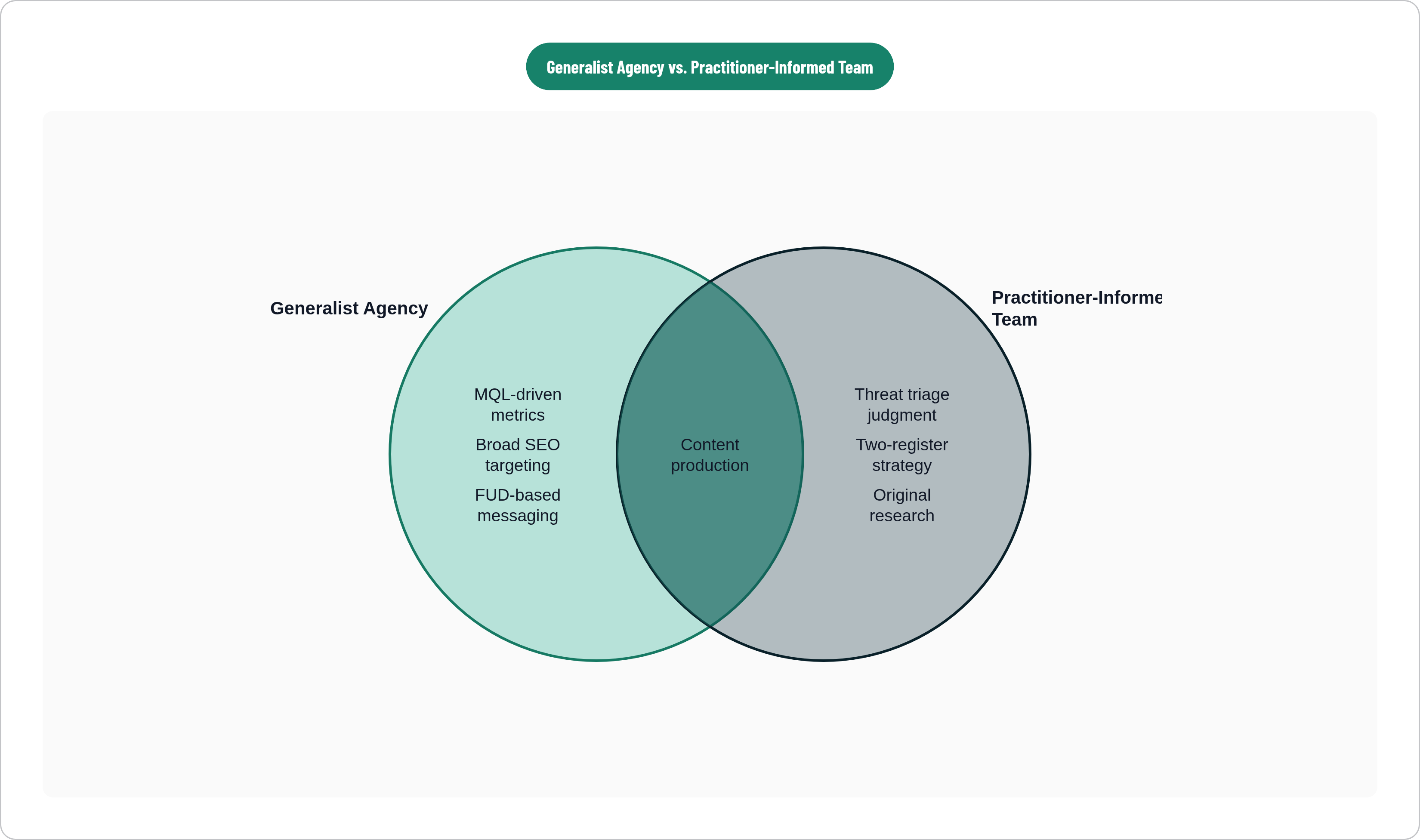
Generalist B2B agencies are built to generate MQLs. Clicks, gated downloads, contact form fills. Those metrics reflect how the agency's internal model works, not how security buyers actually move.
Here is what happens in practice when content production runs without practitioner knowledge. You get explainers that are accurate enough to publish but not credible enough to hold a security architect's attention for more than thirty seconds. The writing is clean and the information is technically present, but it reads like it was written for a general business audience rather than the practitioners you need to convert.
FUD-based messaging is the other common output. Catastrophic breach scenarios deployed to manufacture urgency. That approach had a shelf life, and the shelf life has passed. The experienced security buyer has developed near-complete immunity to fear-based framing. At this point, heavy FUD signals to practitioners that the vendor's actual product claims will not hold up under scrutiny. Threats became Tuesday.
Keyword strategy is where the technical gap becomes quietly damaging over time. Generalist teams target broad terms because those terms register as high-value in standard SEO tooling. Those terms are owned entirely by large incumbents and analyst firms with years of domain authority. A practitioner-informed team has the context to find specific, intent-driven queries that reach someone at the exact moment they are researching a real problem. Finding those queries requires knowing what questions a security architect actually types when they are trying to solve something, context a generalist team rarely carries.
Compliance messaging is another example. Attracting buyers who need to check a box is fine as a door-opener. But a team without sector knowledge does not know to use compliance as an entry point and then shift the conversation toward genuine security outcomes. The result is a pipeline full of buyers who churn when the compliance deadline passes.
These failures follow directly from a team lacking real knowledge of the landscape.
The operational difference that practitioner knowledge creates in topic selection
Ask any two content teams how they pick topics and you will learn everything you need to know about which one will actually serve you.
A generalist team asks what ranks. A practitioner-informed team asks what a security architect needs to understand right now, and whether anyone has said it clearly yet.
That difference shows up fast. Vulnerability disclosures, threat actor activity, and regulatory changes move the content agenda in cybersecurity constantly. A team without threat landscape awareness will always be one news cycle behind. By the time they have processed a major disclosure and written something about it, the practitioners who matter have already read three better pieces and moved on.
Practitioner judgment means knowing which disclosures deserve a content response, which ones are noise, and which represent a genuine opportunity to publish something useful before competitors do. That triage requires someone who reads the same threat intelligence feeds as the audience and acts on them before receiving a brief.
The cost of poor topic selection is credibility damage. Publishing on the wrong thing, or publishing on the right thing two weeks late, signals to technical readers that the vendor does not understand its own domain. In a category where trust is the main currency, that signal has a real price.
How technical credibility shapes content production from briefing to publication
Security practitioners are not casual readers. They attend DEF CON talks, read threat reports cover to cover, and review implementation guides with real scrutiny. When they pick up a vendor blog post and it reads like it was written for a general business audience, they put it down. The credibility problem runs through the whole piece.
The practitioner-informed answer is a two-register content strategy. Technical depth for security architects and engineers: threat analysis, detection logic, integration documentation, real implementation detail. Risk-reduction framing for CFOs and executives who need to understand business impact without drowning in technical specifics. Running both registers at once is harder than it sounds. It requires a team that genuinely understands what belongs in each lane and keeps them distinct.
Producing technical content also requires a review process that can actually catch errors before they publish. A generalist production workflow lacks any mechanism for this. An editor reviewing a detection engineering post can only catch errors when they already know what correct looks like.
Original research is the highest-leverage asset in this category. A well-designed threat report or original dataset can drive sustained pipeline activity over many months because practitioners cite it, share it, and reference it in real conversations. But producing that research requires methodological rigor and the judgment to identify a question the market does not yet have a clean answer to. Both of those things require knowing the field.
The WormGPT investigation is a useful example here. Daniel Kelley, researching for SlashNext, surfaced findings that later earned coverage from The Wall Street Journal. That coverage happened because the finding itself was the story. It had genuine intelligence value. The work remained core brand intellectual property through SlashNext's acquisition by Varonis because original discovery is not replicable. Nobody can go back and find it first again. That is what practitioner-led research produces when it is done well, and it demands a team that already understands what the product does.
Where the buying journey demands content a generalist team cannot produce
Enterprise cybersecurity deals are long. The research phase alone runs for months before any vendor conversation begins, and most of it happens without you in the room. Buyers are reading, comparing, and filtering. The content they find during that period shapes the shortlist. Vendors that show up credibly in that research make the shortlist; those that do not are filtered out before any conversation begins.
When a deal reaches shortlist and proof-of-concept stages, the content requirements get specific in ways that expose knowledge gaps fast. Battlecards need enough technical precision to hold up in a side-by-side comparison. Security questionnaire responses need to be accurate and complete. Compliance-aligned collateral for frameworks like SOC 2, ISO 27001, or FedRAMP needs to reflect how those frameworks actually operate, not a surface-level summary that falls apart the moment a technical reviewer reads it closely.
Analyst inclusion is a shortlist accelerator in cybersecurity in ways that most other B2B verticals simply do not experience. Being named in a Gartner, Forrester, or IDC report changes how buyers perceive a vendor before any conversation happens. Specialist teams understand what evidence analysts evaluate and how to build an analyst relations program around that evidence. Moving the needle on analyst relations depends entirely on understanding what analysts care about.
Conference presence at RSA, Black Hat, and DEF CON is also different from a conventional brand awareness exercise. These events are practitioner trust signals. The conversations a vendor has in those environments, the content they present, the positions they take. All of it gets scrutinized by the same people evaluating their technology. Showing up without something technically credible to say sends a negative signal that travels.
Account-based marketing in cybersecurity is the default motion for reaching risk-averse enterprise buyers with long cycles. It requires knowing which signals indicate active evaluation and how to enter an account's research process in a way that reads as credible rather than intrusive. That is a judgment call, and judgment calls require context that generalist teams lack.
What to look for when evaluating whether an agency actually has the knowledge it claims
Every agency claims to work with cybersecurity clients, and every agency offers content strategy and demand generation. The real question is whether their people know the threat landscape well enough to catch an error in a detection engineering post before it goes live.
A few things that indicate genuine practitioner knowledge:
- Staff backgrounds in security research, incident response, or security journalism. Not just B2B content experience at a large company.
- A portfolio of named cybersecurity clients with technically credible, published work you can actually read yourself. Ask for it. Read it with scrutiny and see if it holds up.
- A clear, specific explanation of how they handle vulnerability disclosures. An actual answer about how they triage, decide, and respond.
Things that suggest the knowledge is claimed but not actually there:
- Heavy FUD framing throughout their own agency content. If they use fear to market themselves, they will use it to market their clients.
- Inability to discuss specific threat categories without significant ramp-up time.
- A portfolio that looks polished but reads thin the moment you bring any real technical scrutiny to it.
The most direct test is straightforward: ask how they approach a major vulnerability disclosure. Do they triage its relevance to the client's specific audience and brief accordingly within hours, or do they wait for instruction? That answer reveals whether they operate from knowledge or from process.
Analyst and media coverage connected to their research work is a verifiable signal as well. Coverage earned because a finding had genuine intelligence value looks different from coverage generated by press release distribution. The difference is usually apparent on a close read.
The goal is to find an agency whose team reads the same material as the buyers. Topic selection, content quality, timing, analyst relations, and conference positioning all depend on that knowledge being in the room when the work gets done.