Cybersecurity Marketing Agencies for Seed and Series A Startups
Why the wrong agency choice torpedoes your cybersecurity startup's first year.

Picking the wrong marketing agency at seed stage doesn't just cost you money. You lose time. And in cybersecurity, where the average enterprise buying cycle stretches close to a year, losing that time is a competitive injury you will not recover from.
Here's the situation. According to Pinpoint Search Group's 2025 report, 63% of cybersecurity funding rounds in 2025 were seed and Series A deals. That means most companies operating in this market right now are early-stage. They have limited budgets, no brand recognition, and no library of customer proof points. Meanwhile, a small number of mega-rounds above $100 million captured nearly half of all the capital deployed, despite representing only 8% of deals. The conventional marketing playbooks being written about and sold in this industry are built on that capital, not yours.
The agency choice determines whether your first 12 months build real credibility with technical buyers or produce a lot of content no one in your ICP ever reads twice.
The Cybersecurity Buyer Is One of the Hardest Audiences in B2B
Let's start with who you're trying to reach, because most generic marketing advice breaks down right here.
An enterprise security purchase typically involves six or more people. The CISO. IT security engineers. Legal. Risk and compliance. Procurement. Finance. Each one is evaluating through a completely different lens, and each lens has to be satisfied before a deal moves.
The security leader lens is the trickiest. Security leaders are trained to be sceptical. Their entire job is to not be deceived. They receive somewhere between 50 and 100 vendor outreach emails per week. They have developed, out of pure necessity, a very sharp filter for content that wastes their time.
Fear-based messaging, feature lists, and what people in the industry used to call "threat theatre" no longer pass that filter. Security leaders already know threats exist. What moves them now is a clear, measurable story about how a product reduces risk in a way that fits their existing ecosystem.
The 2025 Edelman-LinkedIn B2B Thought Leadership Impact Report put numbers to this. 73% of decision-makers evaluate companies based on thought leadership rather than product collateral. 86% said they'd be more likely to invite a company to bid if it consistently produced high-quality thought leadership.
Read that second stat again. 86% more likely to invite you into the conversation. That's the whole game at seed stage. Thought leadership earns you the right to be in the room.
What this means for agency selection: the agency you hire needs to understand the specific signals that build trust with security buyers, beyond content formats and SEO mechanics. Because generic demand-gen playbooks were not designed for this buyer, and they misfire in ways that are hard to diagnose from the inside.
Undifferentiated Positioning Is a Death Sentence at the Seed Stage
IT-Harvest tracks over 4,000 cybersecurity vendors. There are more than 11,000 products in the category. A buyer evaluating a new entrant has no default reason to pay attention to you over the other options.
This matters because a product failure and a positioning failure have very different consequences. A product failure surfaces quickly; a positioning failure plays out slowly and quietly. The company just never gains traction, and the post-mortem usually attributes it to the wrong cause. Industry data suggests the majority of cybersecurity startup failures trace back to marketing and positioning problems, not technical ones. The product worked. Nobody knew why it mattered.
Enterprise cybersecurity customer acquisition is also genuinely expensive, in a way most early-stage teams underestimate. Enterprise cybersecurity customer acquisition costs can reach $100,000 per customer, compared to a few hundred dollars in typical B2B software. Misallocated spend at seed stage isn't a rounding error. It's a real constraint on how many attempts you get.
At seed and Series A, the goal is credibility with a very specific audience, earned fast enough to produce first reference customers before the runway runs out. Technical buyers grant credibility to original research, practitioner-authored content, and analysis genuinely tied to the product's domain rather than polished brand copy or thought leadership written by someone who has never touched a SIEM.
That brings us to the problem almost no agency pitch deck will admit to.
Most Agencies Cannot Actually Close the Technical Writing Gap
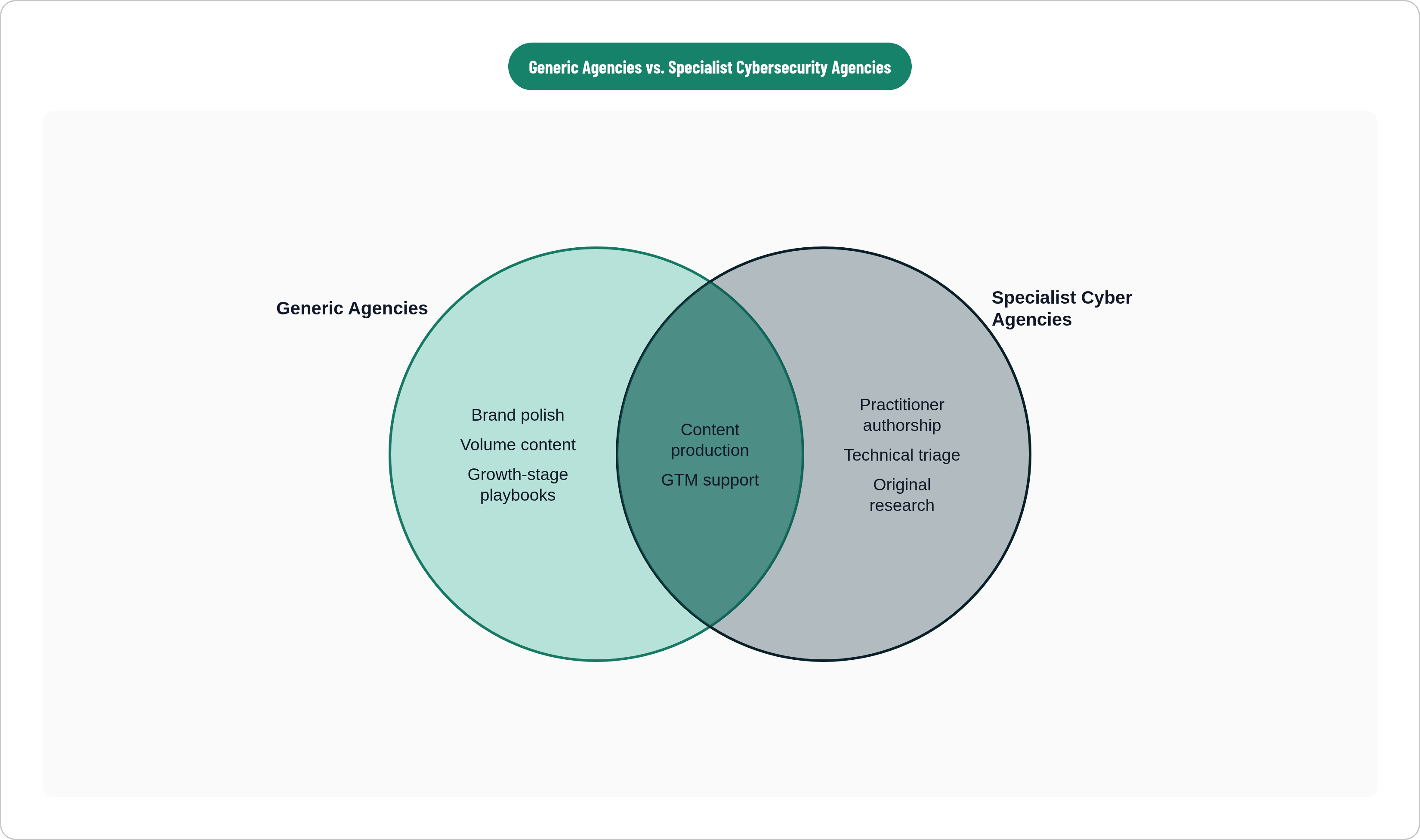
Writers who can credibly cover endpoint detection and response, identity security, cloud misconfigurations, or zero trust architectures are rare. They earn significantly more than general B2B writers because supply is genuinely thin. The skill is hard to fake, and security practitioners know when someone is faking it.
The failure mode here is actively damaging content. A technically incoherent piece on lateral movement or cloud security posture signals to the security engineer reading it that the vendor does not understand the problem they are claiming to solve. That signal persists. It's harder to undo than silence would have been.
Most agencies bridge this gap with general B2B writers who receive a brief on cybersecurity terminology before they start writing. Some are very good at approximating the surface. But approximation gets caught by the practitioner reading the draft before an RFP, or the security lead who forwards a piece to their team with a single-word verdict.
What to look for instead: does the agency employ people who have actually worked in security operations, threat research, or security engineering as the people producing the work, rather than as consultants or advisors?
Some agencies build their model explicitly around this, starting with practitioner triage of what is worth publishing, meaning someone with an actual security background decides whether a piece is credible before it goes out. The authorship survives a technical read because the authors have the background to warrant it. One example that illustrates the stakes here: the WormGPT investigation was discovered by Daniel Kelley while researching for SlashNext. It was later covered by The Wall Street Journal and became core brand IP that remained with SlashNext through its acquisition by Varonis. That's what original security research, produced at the right moment, can do for a seed-stage company's credibility. Not every client gets a Wall Street Journal story. That outcome is only available to agencies that produce real research rather than polished summaries of what others have already published.
The Six Criteria That Actually Determine Fit
Early-stage cybersecurity companies should evaluate agencies on these six criteria rather than case studies from growth-stage clients, follower counts, or awards.
Technical depth of the content team. Can they write a credible threat analysis independently? Is that capability in-house, or outsourced to freelancers briefed at the start of every engagement?
Stage fit. Has the agency worked with companies that had no brand recognition, no case studies, and no pipeline to defend? Growth-stage playbooks do not transplant to seed. The assumptions are different, and an agency that doesn't know that will apply the wrong ones without realising it.
Go-to-market orientation. At seed and Series A, the objective is often ICP validation and first reference customers rather than scaled demand generation. Does the agency understand that distinction, or does it default to a pipeline metrics framework that doesn't apply yet?
Budget compatibility. What does a realistic monthly engagement actually cost, and can the model flex as the company moves from seed to Series A to growth? A rigid retainer built for a later-stage company will create problems the moment your priorities shift.
Buyer channel knowledge. Security practitioners read specific places. Practitioner communities. Specialist publications. Conference-adjacent content. Dark Reading reaches a different audience than LinkedIn impressions. Does the agency know where your ICP actually builds trust, or is it optimising for metrics that look good in a monthly report?
Research capability. Can the agency produce original intelligence or analysis that gives a journalist, analyst, or security leader a genuine reason to engage, or does it only repurpose what already exists?
How the Main Specialist Agencies Compare
Most agency comparisons in this space read like vendor descriptions pulled from their own websites. So let's be direct about what each option actually is and isn't.
Bluetext is a Washington D.C.-based agency known for large-scale rebrands and enterprise web builds, particularly where cybersecurity intersects with government. It's a premium brand infrastructure option with a project floor to match. Not the right fit for high-volume iterative content or seed-stage companies that need to validate messaging before they invest in brand architecture.
Magnetude Consulting runs a full-service B2B practice with a strong cybersecurity track record, including clients like Skybox Security and Reveald. Their engagement model is genuinely flexible: fractional, project-based, or full retainer. Pricing is in a range that's accessible to early-stage companies where budget and scope need room to evolve. Worth evaluating if you want full-service support that can grow with the company.
Merritt Group has been around since 1996 and has worked with brands like CrowdStrike and Venafi. Their strongest differentiator is federal market access. If your ICP includes Department of Defense or civilian agencies, they belong on your shortlist. If it doesn't, that differentiator doesn't transfer as cleanly.
Eskenzi PR is a Queen's Award-winning cybersecurity PR agency based in London, with experience guiding more than 25 cyber companies through IPOs. They're the clearest choice for UK and EU market entry, or for companies whose primary goal is analyst and media relations in those geographies. Less obviously right if your ICP is primarily US enterprise.
Noir Dove is a boutique GTM agency positioned explicitly for cybersecurity startups, covering MDR, threat intelligence, cloud security, and endpoint. Their model is oriented toward building compounded go-to-market systems with pipeline predictability as the stated goal. Companies reportedly start seeing pipeline movement within the first 60 to 90 days of engagement. A practical option for early-stage companies that need structured go-to-market support without enterprise-agency overhead.
Bay Leaf Digital focuses on early to growth-stage cybersecurity SaaS, building pipeline through SEO and paid channels. Demand generation is the core offering. A fit for companies where organic search and paid media are the primary acquisition channels.
Cyberou is a content and research studio built specifically for cybersecurity vendors. The model centers on practitioner-triaged intelligence, specialist authorship, and original security research. Their work is connected to more than 300 tier-one media features. The format is fully asynchronous with no onboarding calls, and each membership is configured around the client's actual stage and gaps. Built for companies that understand what technically credible content needs to look like and know that getting there requires more than a content calendar.
None of these agencies is the universal right answer. The right answer depends on whether the fit actually matches your stage, your ICP, and what you actually need to accomplish in the next 12 months.
What Early-Stage Companies Consistently Get Wrong
The most common mistake is hiring for brand polish before the company has established a credible technical voice. A sophisticated website sits on top of content that a security practitioner still reads as shallow. The practitioner forms an opinion before the sales team ever enters the conversation.
The second mistake is choosing a large generalist agency as a form of risk reduction. The logic is understandable: big agency means more resources, more accountability, safer choice. In practice, it usually produces content that could describe any vendor in the category, compounding the differentiation problem you were trying to solve.
Third: optimising for volume. More blog posts. More social content. More touchpoints. The instinct makes sense in markets where frequency builds familiarity. In cybersecurity, a smaller number of credible, specific, technically sound pieces outperforms high-volume generic content with the buyers who matter.
Fourth: treating the agency choice as permanent. The agency that helps you validate ICP messaging at seed will likely need to change by Series B. Expect the model to change. Build that expectation in from the start, and don't let a long-term contract lock in assumptions that only apply today.
Fifth: ignoring stage fit entirely. An agency built for growth-stage vendors will import growth-stage assumptions. They'll talk about nurturing existing awareness, leveraging brand equity, and accelerating an established pipeline. Those assumptions are wrong for your stage. The mismatch stays hidden through the pitch and surfaces in month three.
Sixth: not asking who actually writes the content. The person who sells the engagement and the person who drafts the content are often different people, and technical credibility belongs entirely to the drafter. Ask specifically. Get names. Ask about their background.
How to Evaluate Any Agency Before You Sign
Before you sign anything, run through these questions. The answers will tell you more than the pitch deck.
Ask for examples of content written for a company at a comparable stage, setting aside flagship case studies from well-known brands that reflect an entirely different context. You want to see what they produced when the company had no brand recognition and no pipeline.
Ask who actually writes the content and what their security background is. A credible agency can name the people and describe their practitioner experience without hesitation. Vague answers about "our team of experts" should raise a flag.
Ask how they decide what's worth publishing. This question reveals whether there is a real editorial or intelligence process behind the work, or whether they produce content on request with no curatorial judgement. A genuine editorial process builds credibility over time; pure on-request production generates volume.
Ask how technical review works. Do practitioners read drafts before delivery, or does technical accuracy depend entirely on the writer? Both models exist. Only one of them reliably survives a technical buyer's reading.
Ask what success looks like at 90 days for a company with no existing brand presence. The answer distinguishes agencies that understand early-stage constraints from agencies that will import growth-stage metrics into an early-stage context. A 90-day answer centred on impressions and traffic signals that the agency is importing growth-stage metrics.
Probe the engagement model. Can scope and budget evolve as the company's stage changes, or does the contract fix assumptions from day one?
The final consideration is the simplest one. Before you sign, ask yourself whether the work this agency produces would survive being read by the CISO it was written to reach. Consider whether it earns their attention, respects their intelligence, and gives them a reason to keep reading, as well as whether it is accurate.
That standard cuts through most agency positioning faster than any other question you can ask.