What Cybersecurity Content Marketing Agencies Actually Produce
Practitioners demand technical depth and original research, not vendor-voiced keyword content.

This is the question most vendors skip, and it explains why so much cybersecurity content lands flat.
The buying committee has gotten bigger. We're talking an average of eight-plus stakeholders now, up from around six just a few years ago. That's a CFO who needs to justify the budget line, a CISO defending the architecture decision, and a security engineer who will actually integrate the thing. That last person will notice immediately if your content gets a technical detail wrong. Writing for all three at once is like trying to tune a radio to three stations simultaneously. You get noise.
Here's what makes it worse. Gartner's data shows that 70% of security leaders trust peer recommendations and analyst insights over anything a vendor produces directly. And 62% of cybersecurity buyers consume multiple pieces of content before talking to sales, most of it on third-party sites. Agencies producing only content for the vendor's own website are already behind before the buyer ever shows up.
Security leaders are among the most vendor-saturated buyers in enterprise tech. They have seen every format, every framework, every "five pillars" blog post. Generic content doesn't get skimmed. It gets closed in the first sentence.
The credibility bar isn't set by your marketing brief. It's set by the practitioner reading the piece on a Tuesday afternoon between incidents. Every format covered below has to pass that filter. Most don't.
Blog content and what separates a practitioner post from a keyword-stuffed article
Blog and organic search content is the highest-volume output across cybersecurity agencies. It's also the category with the widest quality gap.
The keyword map in cybersecurity isn't flat. It splits into roughly three intent tiers:
- Problem keywords — engineers in research mode trying to understand a threat or failure mode
- Category keywords — buyers in evaluation mode who understand the problem and are mapping solutions
- Comparison keywords — late-stage buyers deciding between two or three vendors
An agency running a blog program without this map produces traffic. Just not traffic that converts. Avast, McAfee, and Palo Alto Networks built keyword authority through editorial programs that answered specific practitioner questions at each of these tiers. That didn't happen by accident. It happened because someone made a deliberate decision about which questions were worth answering and for whom.
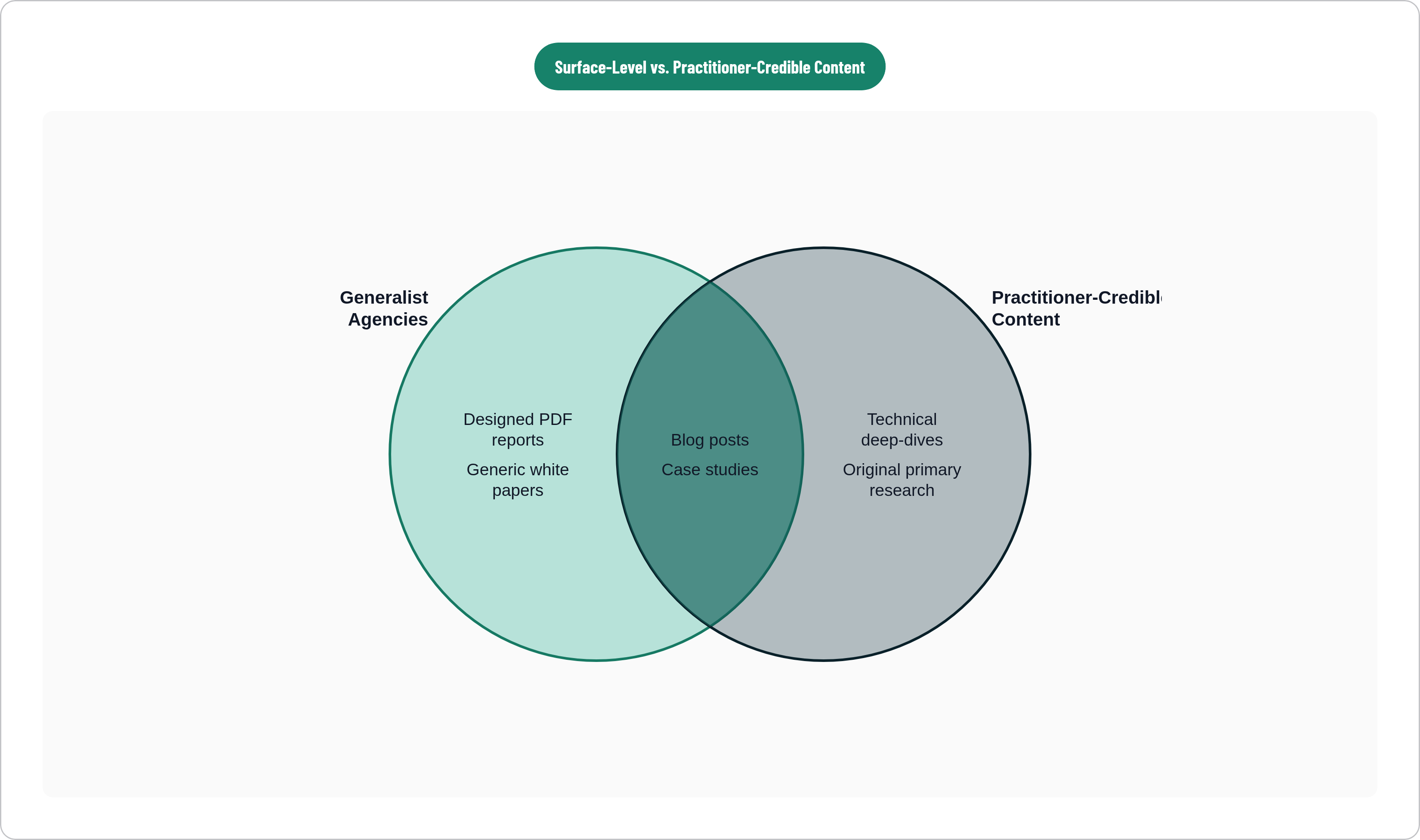
The quality split comes down to two things: who decided what to write, and who actually wrote it. Surface-level blog content is keyword-structured, vendor-voiced, and produced by generalists who spent an hour researching the topic before writing. Practitioner-credible content assumes a technical reader, cites primary sources, and is authored or reviewed by someone with real hands-on security experience. These are structurally different products. Calling them both "blog posts" is a little like calling a grocery list and a lease agreement both "documents."
Snyk's agency-supported SEO campaign is a useful proof of concept. The team added pain-point content like "How to Fix Vulnerable npm Packages" and generated a 20% engagement increase, 380 new user accounts, and 30 product demos through content-driven calls to action. That happens when content answers a real question a real practitioner is actually asking. Content written only to satisfy a keyword brief doesn't produce those results. The numbers make that clear.
Technical deep-dive content — where most agencies stop producing and practitioners start paying attention
Technical deep-dives are the category most agencies quietly skip because they genuinely cannot produce them. And they're the category where practitioners actually slow down and read.
The formats here include:
- Code walkthroughs
- Configuration examples
- Attack chain analyses
- Detection engineering posts
- Vulnerability disclosure write-ups
What defines this category is that it assumes a reader who would catch a mistake. These pieces don't oversimplify for a mixed audience. They include artifacts a practitioner can use or verify. They're written or reviewed by someone who has actually done the work, not someone who summarized three existing blog posts and added a subheading.
The failure mode for generalist agencies is producing content that reads as technical to a marketer and fails immediately with a security engineer. The engineer reads one sentence, spots an oversimplification or a bad command syntax example, and closes the tab. That's not just a missed impression. That's a negative brand signal, and it sticks longer than a positive one.
Agencies with former practitioners, security researchers, or vetted technical writers on staff can produce this category. Agencies without them cannot. You cannot write your way around that gap with better prompting or a more detailed brief. The gap is structural, which means no amount of editorial polish fixes it.
For vendors in a technical market, this category is not optional. If it doesn't exist in your content program, the practitioners you're trying to reach have nowhere to go. And they notice.
Original research and threat reports — the format with the longest commercial half-life
Original research has the best return on investment in cybersecurity content. It's also the format most agencies cannot actually deliver, even if they say they can.
The commercial case is straightforward. Original data cannot be replicated by a competitor. It gets cited in analyst reports. It drives press coverage without requiring a pitch. It supports sales conversations across a six-to-twelve-month window after publication. A single strong research report can cost tens of thousands of dollars to produce, but it generates value across launch press coverage, a blog series, webinar content, and sales enablement assets. All drawn from the same underlying data.
MQL-to-SQL conversion rates for research reports in cybersecurity run considerably higher than for generic ebooks. The gap is not subtle, and it's why the format keeps showing up in the content programs of companies that actually know their numbers.
CrowdStrike's Global Threat Report is the clearest example of what the format can become. It's a reference document practitioners cite regardless of their vendor relationship. Brand authority followed from the content's credibility. That's a specific sequence worth noting. The credibility came first.
What agencies actually do in this category varies sharply. Some conduct genuine primary research: surveys, proprietary telemetry, red-team findings. Others repackage publicly available threat data into a designed PDF and call it a report. Experienced buyers know the difference on page two, usually page one.
The WormGPT investigation, discovered by Daniel Kelley while researching for SlashNext, is a useful reference point. That research connected to more than 300 tier-one media features and was retained as core brand intellectual property through SlashNext's acquisition by Varonis. Original security research producing durable commercial value across multiple years and a corporate transaction. That's the standard worth measuring against.
When evaluating agencies here, ask directly: who conducts the research, what is the primary data source, and who reviews it before publication. Vague answers mean a vague report.
White papers and long-form gated assets — what works and what gets downloaded once and forgotten
Every cybersecurity agency produces white papers. That's not a differentiator. Producing white papers worth downloading is.
The highest-performing white papers in this space share a few traits. They're authored or co-authored by named practitioners. They're grounded in specific technical scenarios rather than generic frameworks. They're outcome-specific rather than capability-general. "Here's what happens when you deploy this in a hybrid environment with legacy Active Directory infrastructure" outperforms "here's why our platform provides comprehensive coverage" every single time. That's not a small gap.
The credibility barrier for gated assets is a pre-download judgment call. A practitioner reading the title and abstract decides in about ten seconds whether to give you a work email. If the abstract signals generic content, they don't. Agencies like Bora specialize in white papers specifically for information security vendors because a generalist writer cannot reliably produce a document that passes a CISO's read. That specialization isn't stylistic. It's structural.
The honest question for any vendor evaluating a white paper their agency produced: is this a genuine technical reference, or is it a reformatted blog post in a nicer template? You probably already know the answer. Most people do, which is what makes it awkward to say out loud.
The filter that matters is simple. Does this document contain something a security practitioner cannot find elsewhere? If the honest answer is no, it shouldn't be behind a form.
Case studies — the most influential format and the one most vendors produce badly
Research from TechnologyAdvice ranks customer case studies as the single most influential content type in B2B technology purchasing decisions, cited by 63% of buyers as a top influence. This is the most powerful format available. It's also the one most vendors produce badly, which is a strange combination when you think about it.
The failure mode is generic outcomes. "Improved security posture." "Enhanced visibility across the environment." "Streamlined incident response." These phrases produce no measurable engagement lift. They also don't tell a practitioner anything they couldn't have guessed without reading the case study. Which means they've spent two minutes reading something that gave them nothing. Not a great experience.
Specific outcomes with real numbers outperform consistently. Time-on-page and form completion data both show it.
The production constraint in cybersecurity is real. Most customers won't allow naming. But many will agree to an anonymized version with specific metrics intact. An agency that treats case study production as a binary choice (named reference or nothing) is leaving usable evidence on the table.
What separates a credible cybersecurity case study:
- Named or clearly described threat scenario
- Specific environment context: cloud, hybrid, regulated industry, scale
- Measurable outcome with a real number attached
- A practitioner-legible explanation of how the result was achieved
Agencies that produce case studies as marketing copy rather than technical narrative lose the trust signal that makes the format valuable in the first place. A practitioner reads a case study to understand whether your product will work in their environment. They need the technical specifics to make that judgment. Take those out and you've written a press release with a customer logo attached.
Video, webinars, and interactive formats — growing in volume, uneven in technical depth
Video has moved from supplementary to core in cybersecurity marketing programs. LinkedIn and YouTube algorithms favor it. Security leaders increasingly prefer it for technical learning. The volume is up. The depth is uneven.
LinkedIn generates meaningfully higher engagement for cybersecurity content than most other platforms. Short-form video for thought leadership and longer technical walkthroughs on YouTube serve different audience intents. The strongest video programs layer both:
- Short LinkedIn posts for authority and top-of-funnel awareness
- Longer YouTube pieces for technical depth
- Webinars for demand generation with a live Q&A component
- Customer story videos for late-stage sales enablement
Agencies like Cyberwhyze specialize in video as the primary format, helping vendors explain product differentiation to prospects. That's a legitimate specialization. The honest limitation is that video-first agencies don't cover the written technical formats that practitioner buyers rely on when they're deep in evaluation mode, reading in a browser tab with seventeen others open at 11pm.
Webinars work when a practitioner speaker carries the credibility. They fall apart when the speaker is a vendor marketing rep reading from prepared slides. That's a speaker problem, and no format adjustment will fix it.
Interactive tools and risk assessments are worth attention. Assessments that surface a prospect's specific vulnerability profile generate qualified leads while demonstrating technical judgment in the product itself. That's a format doing double duty, which is harder to pull off than it sounds.
The quality question for video and interactive formats is the same as for written content: who is providing the technical substance, and does the production team have the security background to shape it accurately? If the answer to both is "not really," the format doesn't matter.
Ghostwritten executive content and third-party placements — how agencies extend reach beyond the vendor's own channels
Agencies in this category produce ghostwritten articles for C-suite executives placed in outlets like Forbes, Dark Reading, and HackerNoon. The output is authored content. The channel is third-party. The credibility depends entirely on whether the executive's genuine technical perspective actually shows up in the piece.
Getting security writers to work with subject-matter experts and ghostwrite for practitioner outlets is one of the more effective content outreach techniques in this space. The publication's editorial standards provide external credibility validation that a vendor blog cannot provide on its own. That's the value of the channel.
The failure mode is predictable. Ghostwritten content that doesn't reflect the executive's actual technical view reads as vendor marketing wearing a byline. Security practitioners identify it quickly. They have finely tuned nonsense detectors. They have to. The byline gives the content an authority signal, but the content still has to earn it independently. Borrowing a signal you haven't actually earned doesn't go well.
The WormGPT research connected to more than 300 tier-one media features. Those weren't placements. They were coverage. Journalists covered the research because the research was genuinely useful, not because a pitch deck showed up in their inbox. That distinction matters more than most vendors want to admit.
Content syndication on platforms like BrightTALK and TechTarget is related but distinct. Agencies manage the placement, but syndication programs typically run as separate budget items from content production.
The distinction vendors should hold onto: some agencies produce content credible enough to attract external coverage. Others primarily manage distribution of content that would not earn coverage on its own merits. These are very different services. They carry very different price tags for very different reasons.
How to read an agency's output map against what your audience will actually find credible
The output categories above exist on a credibility spectrum. Blog posts and video are accessible to any competent agency. Technical deep-dives, original research, and practitioner-authored long-form require specific structural capabilities that most agencies don't have. That's a production reality that doesn't change because an agency's website lists every format under "services."
The multi-stakeholder buying committee compounds this. A committee with different technical backgrounds and different content needs means a single-format agency will cover some of the committee and leave others with nothing relevant to read. A CFO-friendly ROI white paper doesn't help the security engineer evaluating integration depth at midnight. And that engineer is, in fact, evaluating integration depth at midnight.
The evaluation questions that actually matter when assessing an agency:
- Who writes the technical content, specifically?
- What is the primary research process, and where does the data come from?
- How is editorial accuracy checked before publication?
- Can the agency show output that has survived a practitioner read in a comparable security category?
The surface signal to watch for is an agency that lists every format category on its website but staffs generalist writers. The production map looks complete until a technical reader encounters the content. Then it becomes obvious pretty fast.
The practical question for any vendor is which formats the agency can produce at the credibility level your specific audience uses as a baseline for trust. That question, more than anything else, tells you whether the investment will actually work.