Cybersecurity Content Marketing for the Mid-Market Buyer Segment
How to reach mid-market security buyers caught between breach reality and false confidence.
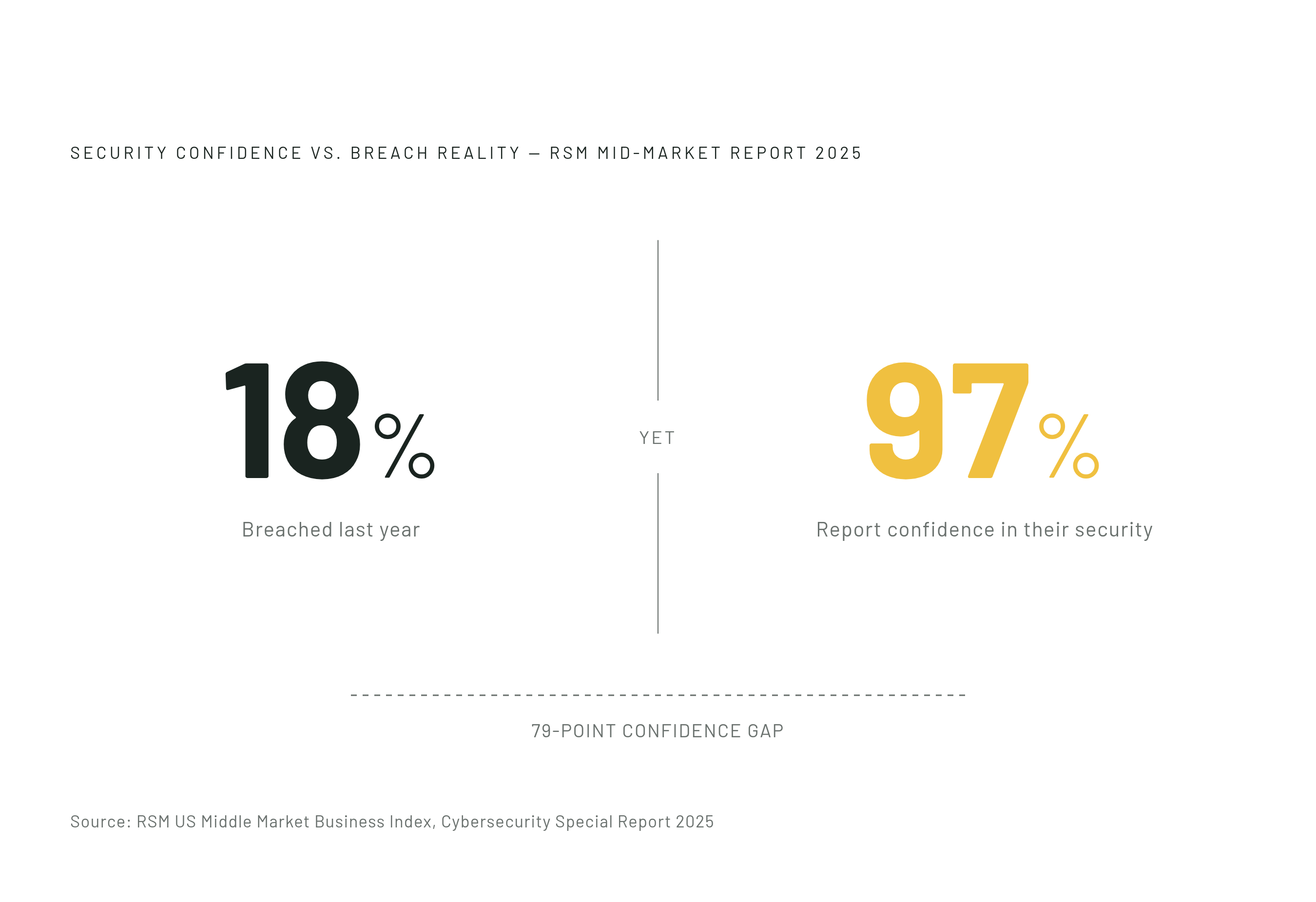
18% of mid-market organizations got breached in the last year, according to RSM's 2025 report. Ask those same executives how they feel about their security, though, and 97% say they're confident. That gap right there, between what's actually happening and what people think is happening, is the whole story of this article.
Let's sit with that for a second, because it's a genuinely strange number. Nearly one in five companies got hit, and almost everybody still gave themselves a gold star. That's a company telling you it doesn't smoke while holding a cigarette.
And the exposure isn't evenly spread, either. Larger mid-market firms, the ones pulling $50M to $1B in revenue, got breached at twice the rate of their smaller mid-market peers: 24% versus 12%, per RSM. A quarter of all mid-market companies reported a ransomware attack or demand in the past year. So size buys a bigger target, not safety.
Here's why this matters for anyone building content aimed at this buyer: IBM's 2025 Cost of a Data Breach Report puts the global average breach cost at $4.44 million. For a Fortune 500 company, that's a bad quarter. For a 500-person manufacturer or regional healthcare network, that's the kind of number that ends the company. Mid-market buyers know this, even if their survey answers say otherwise. Which means the vendors who win their trust show up with something specific enough to be useful to a buyer who already suspects the fire alarm might be broken.
What "mid-market" actually means in security terms, beyond a revenue label
Nobody agrees on what "mid-market" even is, and that's the first problem. Intruder's Security Middle Child Report defines it as companies with at least $50M in revenue and somewhere between 400 and several thousand employees. RSM splits it differently: lower-revenue companies for the smaller tier, $50M to $1B for the larger one. Two credible sources, two different maps of the same territory. If you're writing content for "mid-market," you're already targeting a moving definition, and most vendors never stop to notice.
The more useful way to think about it is the squeeze.
Intruder found that 46% of mid-market security leaders think enterprise platforms assume more staff, budget, or complexity than they actually have. Meanwhile 29% say the SME tools they started with have outgrown their usefulness. Put those two numbers side by side and you get the "security middle child" problem in full: too big for the training-wheels tools, too small for the enterprise suite. Some 42% of mid-market teams describe themselves as stretched, overwhelmed, or perpetually behind.
Most mid-sized companies don't have a full-time security leader, let alone a team. It's usually an IT department wearing five hats: managing user access, running infrastructure, handling incident response, and producing compliance reports, often all before lunch. That's why 51% outsource cybersecurity risk and compliance management, per RSM. This isn't a company failing to staff up. It's a company making a rational call given the hand it's holding. A third of mid-market respondents run their data security and privacy function with five or fewer employees; among the larger mid-market tier, 36% report six to ten.
None of this means the buyer needs a security 101 refresher. They know why security matters better than most people writing content for them. What they need is help figuring out what to fix first with the people and budget they actually have, not the fantasy team a vendor's deck assumes they employ.
How mid-market security budgets are actually allocated and what that signals about buying intent
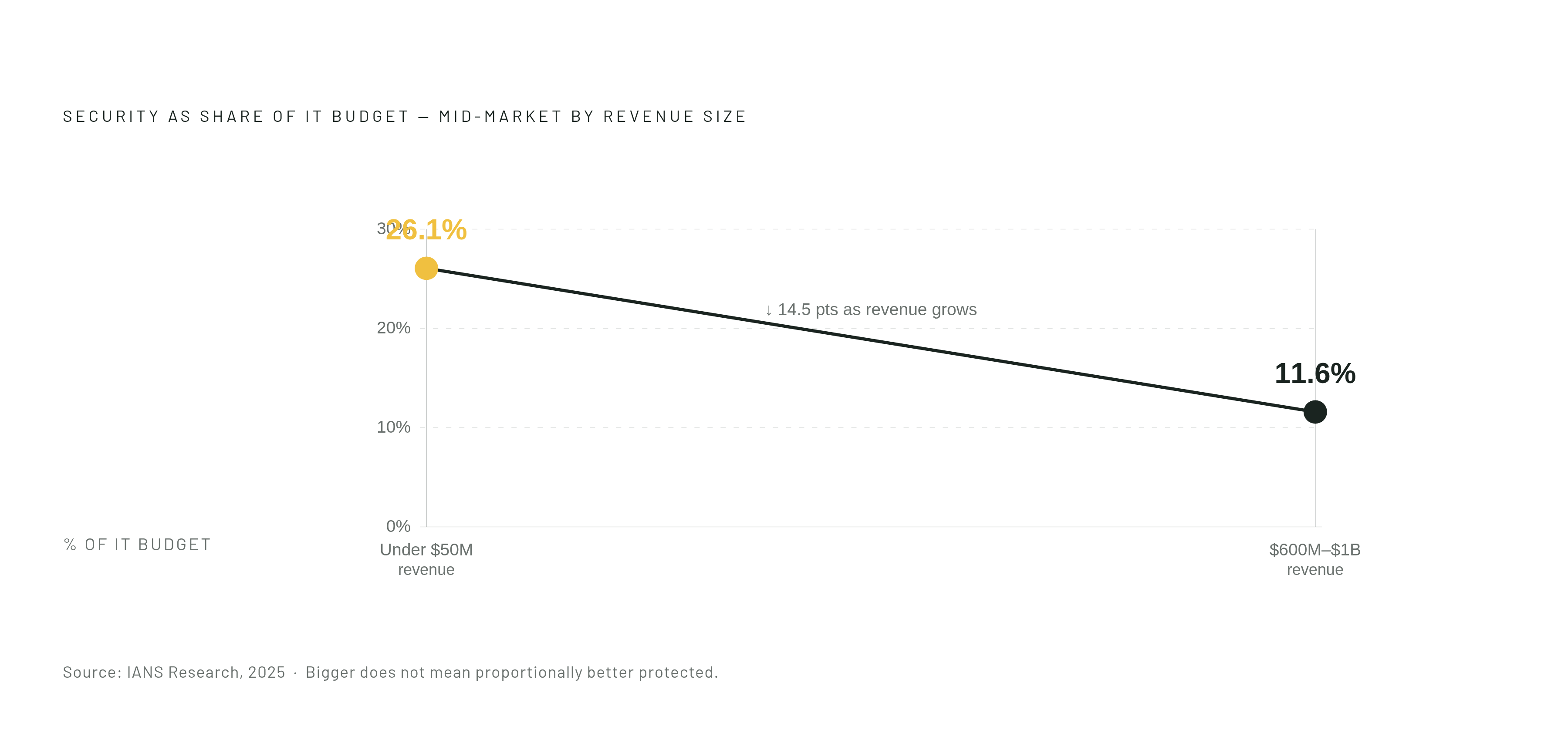
Here's a number that flips the usual assumption on its head. Security spend as a share of IT budget averages 26.1% for companies under $50M in revenue, according to IANS Research's 2025 data. That number drops to 11.6% once you get to the $600M to $1B range. Smaller mid-market companies aren't spending less on security proportionally; they're spending considerably more.
Look at it relative to revenue and the pattern holds. Smaller companies spend north of 2% of revenue on security; larger mid-market firms spend closer to 0.6%, per the same IANS data. Small and mid-market firms average $3,800 in security spend per employee. So within this segment, the data shows that bigger companies spend proportionally less on security.
There's also a split worth knowing if you're deciding what to write about. Companies in the smaller mid-market range are putting more dollars into cloud security tools. The larger mid-market tier, approaching $1B in revenue, is spending more on-prem. That's not a footnote. It changes what kind of content lands. A cloud-first buyer is thinking about per-seat costs and scaling efficiently. A legacy-infrastructure buyer is thinking about the risk of ripping something out and replacing it. Lead with the wrong total-cost argument and you've lost the room before you finished the first slide.
The appetite for spending is also rising. In the 2025 ActualTech/FutureB2B Cybersecurity Buyers Report, 55% of respondents said cybersecurity would be a significant organizational focus in 2025, up from 44.8% the year before. That sounds like good news for anyone selling into this space, and it is, except it also means more vendors are chasing the same attention. Rising budgets make the competition louder.
One more figure worth sitting with: 72% of mid-market respondents said they're worried about direct financial losses from cybersecurity incidents. That's not a hypothetical fear. That's the buyer already speaking in ROI terms before you've said a word. Meet them there instead of starting from scratch.
Who is actually in the mid-market buying committee and what each seat needs from content
Buying committees have gotten crowded. The average number of stakeholders in a cybersecurity purchase grew notably from 2021 to 2024. More seats at the table means more chances for a deal to quietly die somewhere around month nine, which is exactly the kind of thing that happens on a 6-to-12-month sales cycle spanning 7 to 10 stakeholders.
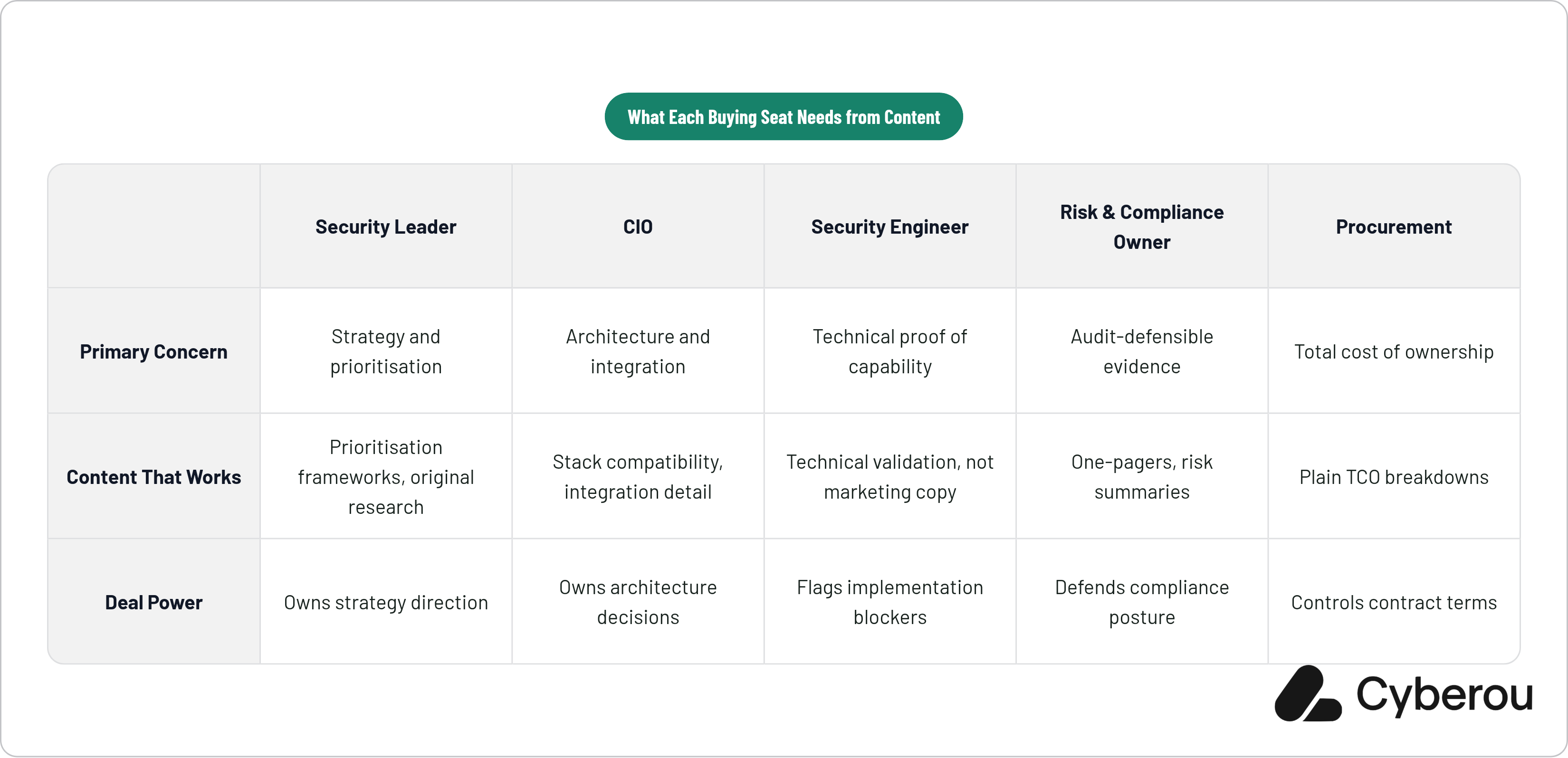
Five people usually hold real influence here. The security leader owns strategy. The CIO owns architecture. The security engineer needs technical proof, not marketing copy. Procurement and legal own the terms. The risk and compliance owner needs audit evidence they can defend later. Each one has a separate concern, and each one can say no on their own.
In smaller mid-market companies, this often collapses down to one person: the IT Director, who evaluates the tool, kicks off the deal, and then has to go ask for permission once the number gets big enough. That's an awkward position to sell into, because the person doing the technical vetting isn't always the person signing.
Here's a stat that should worry anyone writing enterprise-style business cases for this segment: only 9% of mid-market organizations discuss cyber risk at the board level, according to Intruder. Another 34% get it to executive leadership. More than half, 51%, keep the conversation entirely within security or IT. So all that beautifully crafted board-level content is landing nowhere, built for a room that exists in only 9% of mid-market companies.
Third-party validation matters more than most vendors want to admit. Nearly 70% of CISOs lean on analyst insights and peer endorsements when building a shortlist. And Cisco's research found that 60% of security leaders think vendors simply don't understand their real-world challenges. Vendors are publishing the wrong content, aimed at a buyer who doesn't exist in the building.
How mid-market buyers research before engaging a vendor, and where most security content misses them
By the time a mid-market buyer picks up the phone with a sales rep, they've already done 70% to 80% of the work, according to Gartner. Read that again: most of the decision is already made before anyone from your company says a word. Whatever they read in that research phase is doing the heavy lifting, and most vendors are still writing content as if the sales call is where persuasion starts, when the research phase is already over.
That research phase is sprawling, too. Buyers are engaging with more than a dozen content pieces across ten-plus channels before they buy. And mid-market teams don't have a dedicated research analyst doing this for them; it's the IT Director doing it themselves, probably at 11pm after the actual job is done for the day.
Here's the part that should reset how every security vendor thinks about content distribution: A growing share of B2B buyers now use large language models to synthesize research before they ever talk to a vendor. If your content isn't structured to be findable and quotable by an AI system doing that synthesis, you're invisible at a stage of the funnel that used to be entirely yours to control.
Familiarity is a hard gate. Research consistently shows that buyers tend to shortlist vendors they already know, and most end up buying from that initial shortlist. If you're not already a known name by the time research starts, you're not in the running, full stop. And the vast majority of buyers go looking for reviews before they finalize anything, which means vendor-produced content opens the door and creates the conditions for someone else to vouch for you, but peer endorsement closes the deal.
Then there's the switching trigger nobody talks about enough. Many B2B buyers look at new vendors because a competitor's product is more feature-rich, but a significant share also cite poor integration with their existing stack as the reason they're shopping around. A stretched IT team is looking for the tool that fits cleanly alongside the six other tools they're already juggling. Content that leads with a feature list and skips stack compatibility misses the question this segment is actually asking.
Content formats and arguments that actually move mid-market security buyers
Case studies win, and it isn't close. Research consistently finds that B2B buyers cite customer case studies as a top influence in tech purchasing decisions, ranking above other content types. For a mid-market buyer specifically, the case study that matters is the one where the customer looks like them: a lean team, a messy stack, real operational pressure, not a Fortune 100 logo with unlimited headcount.
Numbers convince where adjectives fail. "Blocked hundreds of thousands of malicious login attempts" lands. "Cut detection time dramatically" lands. A phrase like "robust threat detection" leaves a buyer without a large security team unable to translate that claim into what it means for their Tuesday.
Remember that board-communication gap, the one where only 9% of mid-market companies talk cyber risk at the board level? That's a content opportunity hiding in plain sight. Security leaders need help translating technical findings into financial language so they can make the case upward. Give them the one-pager that does that work for them, and you've made yourself useful in a way most vendors never bother to.
Prioritization frameworks beat threat-landscape overviews every time with this audience. Mid-market buyers need a framework for what to fix first when they've got two people and a Tuesday afternoon. Recycled industry stats read as noise to a practitioner living the problem daily.
Original research earns its keep here too. Real survey data, an original investigation, findings nobody else has, give a security leader something concrete to bring into an internal meeting to justify a decision. In a buying process with eight stakeholders, that's ammunition.
If you're stacking priorities, it goes like this: case studies with real operational metrics first, original research second, practical decision frameworks third, and product-led content last, placed only after you've earned the right to talk about yourself.
What cybersecurity vendors producing content for mid-market buyers consistently get wrong
Most vendors do one of two things, and both miss.
Some take enterprise content and shrink it down. They strip out the complexity but keep every assumption baked in: dedicated security staff, a formal procurement process, a budget cleared without multiple sign-offs. All of that breaks for a 600-person company where one IT Director is quietly running the entire show.
Others go the opposite direction and scale SMB content up. Bolt on a compliance checklist, toss in a paragraph about ransomware, call it "mid-market ready." This misses the actual texture of the segment: real regulatory exposure, supply chain risk that an SMB never has to think about, and the partial-CISO reality where nobody owns security full-time but everybody's accountable for it.
Then there's the tone problem. Alarm-based messaging, the "hackers are coming for you" school of copywriting, falls flat on a buyer who already told RSM's researchers they're 97% confident in their current setup. You're there to help them put out the fires they already know about.
Volume makes it worse. The average CISO reportedly wades through 50 to 100 vendor emails a week. If your content doesn't deliver something operationally useful in the first paragraph, it's dead on arrival, deleted before the second sentence gets read.
Plenty of vendors also write only to the security leader and forget the other four people who can kill the deal: the CIO, the risk and compliance owner, procurement, the engineer who has to actually implement the thing. Miss any one of them and you've built a beautiful piece of content that's functionally useless in a room with eight decision-makers.
Treating outsourcing as a weakness to fix, when 51% of mid-market companies have made it a deliberate structural choice, is its own kind of tone-deaf. So is talking up feature richness while saying nothing about integration, when poor stack fit is the number-one reason 51% of buyers go looking elsewhere in the first place.
How to build a content programme that earns consistent trust with mid-market security buyers
Start with the buyer's Tuesday, not your roadmap. Content that opens with "here's what your team is up against" beats content that opens with "here's what our platform does," every single time, because the second assumes the reader already cares about you, and that trust has to be earned first.
Map your content to the seats at the table instead of writing one piece and hoping it works for everybody. The security generalist wants operational specificity. The CIO wants architecture and integration detail. The risk and compliance owner wants audit evidence they can hand to an auditor without flinching. Procurement wants total cost of ownership laid out plainly. Each job needs its own asset.
Commission your own research instead of recycling the same three industry stats every competitor already cited this quarter. Original data gives a buyer something to bring into their own internal conversation, and it gives analysts and journalists a reason to cite you back. That's a much better position than being the fifth vendor this month to quote the same Ponemon number.
Practitioner-written or practitioner-reviewed content is the credibility test this audience actually runs. Someone who has lived the problem can spot fake operational texture in about four seconds, regardless of the byline or credentials listed underneath it. So can your reader.
Build the board layer deliberately: one-pagers, financial translations of technical findings, quick risk summaries a security leader can forward upward without rewriting it themselves. Given that only 9% of mid-market organizations get cyber risk in front of the board, that's the missing tool in a lot of security leaders' kit, and handing it to them for free is how you become the vendor they trust when the budget conversation finally happens.
Measure the right things: shortlist appearances, deal-stage velocity, inbound interest from companies actually the right size. Raw traffic cannot tell you whether the people reading are your buyer or just curious.
That means practitioner triage on what's worth publishing, specialist authorship, and original research, built for exactly this reader: the stretched IT Director who's seen every vendor playbook already and can tell within a paragraph whether you understand their Tuesday or you're just guessing.