Video and Podcast Content Production for Security Brands
Security leaders trust practitioners with war stories over polished pitches masquerading as insight.
Sixty percent of security leaders say vendors don't get their real-world problems. That's the whole story of why so much security video and podcast content falls flat on its face. Fixing the camera, the mic, the lighting, all of it, matters far less than whether the guest actually knows what lateral movement looks like on a real network.
Security leaders wade through 50 to 100 vendor emails a week. A slick video that sounds like one more pitch gets filed the same way as email number 73: deleted, unwatched, unheard. Practitioners are trained skeptics who catch shallow threat language almost instantly, and a rough recording with one genuinely sharp insight outperforms a polished video full of "sophisticated attackers" talk every time. The bar is whether the person on screen actually knows the thing they're describing.
What security leaders actually watch and listen to, and why
Executives like video. Most say they'd rather watch something than read it, and a lot of them check work-related video on business sites weekly. The format works fine for this audience, but the content on the screen is where things go wrong.
Practitioners tune into security podcasts for peer intelligence, plain and simple. They want to know what threats are moving right now, what decisions their counterparts at other companies are making, and what a vendor's own engineers believe when nobody's pitching them anything. That hunger is for peer intelligence: live threat data, peer decisions, and unguarded practitioner views.
LinkedIn gets a different kind of attention from this crowd than YouTube does. Somebody scrolling LinkedIn on a Tuesday afternoon between meetings is in a different headspace than somebody scrolling YouTube on a Saturday morning with coffee. Intent changes how content should get built and where it should live.
Here's something that gets missed a lot: a big chunk of security leaders brief their boards regularly, which means they're fluent in two registers at once, technical and executive, sometimes in the same afternoon. They can spot instantly when a video is aimed wrong, written for practitioners but pitched like a boardroom deck, or the other way around. Format has to start with what the viewer is actually trying to learn, regardless of what's cheap to shoot this quarter.
How guest selection determines whether a security podcast earns practitioner attention
A guest earns the room through what they've actually done: incident response scars, original vulnerability research, red team background, a name other practitioners already recognize from threat intel work. Title alone is worthless; practitioners ignore credentials that have no weight behind them, however grandly labelled.
Put a VP of Marketing on a "cybersecurity" podcast and have them talk in frameworks and buzzwords instead of specifics, and you'll watch the practitioner audience leave in real time, like a fire alarm went off and nobody told them it was a drill.
The best security podcasts sound like two people who already know the material, arguing about the parts that are actually interesting. The host has to know enough to push back, challenge assumptions, and press for specifics.
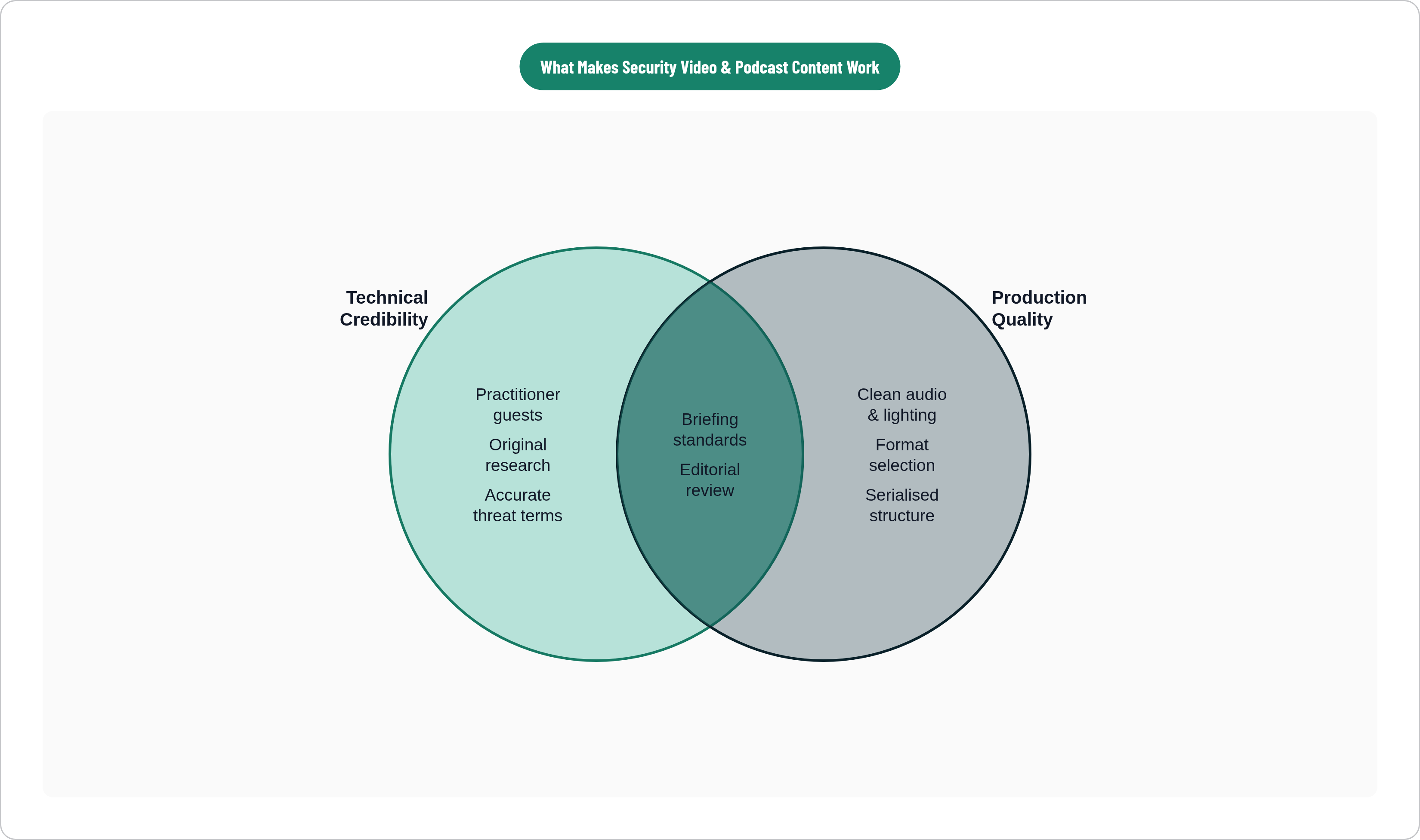
Guest selection is topic selection, whether producers treat it that way or not. A practitioner-credible guest shows up with one specific problem they've actually wrestled with, grounded in a real war story over a company narrative, and the pre-interview briefing determines whether that problem reaches the recording. Guests who haven't worked through a concrete example beforehand drift into generalities the second the red light comes on, and practitioners catch it immediately, every time, no exceptions. The best formats make that structural choice explicit, putting guests in the room as practitioners sharing what they've learned, which tells the audience exactly who the show is for.
Scripting and briefing standards that hold up under a technical read
A script written by someone without domain fluency shows up on tape whether anyone catches it in editing or not: imprecise threat terms, wrong attribution, two related but distinct concepts mashed into one sentence. Practitioners hear all of it, the way a mechanic hears a knock in the engine that the rest of us would drive right past.
Accuracy is also about register. There's a real gap between saying "attackers used phishing" and naming the actual credential-harvesting method, describing the infrastructure behind it, and identifying who typically gets targeted. One is a headline, the other is analysis, and analysis is what holds up when a practitioner leans in.
IBM X-Force's 2025 report recorded an 84% increase in infostealer phishing emails during 2024. A practitioner-credible script builds its argument around that kind of figure, grounded in data and used because it strengthens the argument.
A solid briefing document lays out the actual threat context the episode is addressing, the specific claims the guest plans to make (and whether those claims hold up under scrutiny), the terms the audience already expects to hear, and the questions most likely to pull out something the guest hasn't said publicly before. Someone with practitioner judgment has to read that brief before recording starts and decide whether it's actually worth publishing, as one would scrutinise a written report before publication. A generic talking-points sheet simply does not survive that read.
Format decisions that serve technical content rather than production convention
Long episodes suit arguments that need room to breathe: complex threat analysis with layers worth unpacking one at a time. Short clips work when there's exactly one sharp insight and nothing else, and trying to stuff a fifteen-minute idea into a forty-minute container loses the audience long before the point ever lands.
Rapid-response video runs on its own clock. When a major vulnerability drops, practitioners go looking for real technical analysis within hours of the disclosure. A vendor who publishes a genuine breakdown fast earns attention that paid placements cannot match.
Explainer videos have a place too, mostly at the board and executive level, where the audience wants context more than depth. This works fine for a two-tier content plan, but it's weak as a stand-in for practitioner-grade material, and treating it as a substitute for practitioner-grade material is where a lot of budgets go to die.
The bigger risk isn't the budget line itself, since a well-shot video full of vague threat language costs both credibility and money, and credibility cannot be recovered with a reshoot. Serialisation gets ignored more than it should, too. A recurring structure, threat category, then attack chain, then defensive implication, trains an audience to come back, because the format itself signals that the work is being done consistently rather than opportunistically.
What original research does for audio-visual content that commentary alone cannot
Commentary is everywhere, and anyone with a webcam can react to somebody else's research. Original data is the one thing a competitor cannot replicate quickly.
Thales offers a useful model here. One proprietary dataset, roughly 3 million security incidents, turned into a content program featuring 18 supporting technical blog posts, webinars, and additional supporting assets. The research anchored the entire content program.
A strong original report typically runs $30,000 to $80,000 to produce, and it returns 5x–10x in multi-channel value across the life of the asset. Video and podcast episodes tend to be the highest-leverage pieces to come out of that spend, because they carry the researcher's actual voice, which a summary written by someone three desks from the data cannot replicate.
Methodological transparency is the tell practitioners look for: naming data sources, stating the collection window, admitting where the analysis runs thin. Fortinet and Hoxhunt both do this in their published threat intelligence, and that same discipline needs to show up in how a research-backed episode gets introduced on air. Vendors without a 3-million-incident dataset lying around aren't out of options, either. An original survey, fresh vulnerability research, or a systematic pass through public threat data does the same job. The standard is original thinking.
How production partners and internal teams either preserve or erode technical credibility
A general production studio hands you clean audio and a well-lit shot. Identifying a guest misdescribing lateral movement, or a script that mischaracterises a malware family's behaviour, falls outside what the studio is built to check, in the same way that a skilled chef is not the appropriate person to audit a restaurant's finances.
Marketing budgets in cybersecurity kept climbing, with 87% of firms planning increases in 2025. More money going into generic production leaves that 60% credibility gap untouched, and spending more on the wrong layer buys a pricier version of the same problem.
The two-tier buyer issue shows up in production too. Content aimed at security leaders needs domain fluency built into the editorial process itself, extending well beyond whoever is sitting in the chair on camera. Somebody with practitioner judgment has to be in the editorial seat.
Internal teams run into the mirror-image problem: deep technical knowledge, but no editorial muscle to shape it into something a practitioner will actually sit through without checking their phone. The real standard fits in one sentence: whoever reviews a script before recording should catch technical errors as well as typos. The right model pairs practitioner triage with specialist production, scoped to each client's actual threat context, and is built around clearing exactly that bar. The alternative is hiring a domain expert and a content studio separately and hoping, somewhat optimistically, that the two of them end up speaking the same language.
The cumulative credibility effect of consistent technically grounded audio-visual output
CrowdStrike's Global Threat Report turned into a document practitioners cite regardless of whether they buy anything from CrowdStrike. That same compounding effect applies to a podcast or video series once practitioners begin sharing it with peers unprompted.
Mandiant's M-Trends report pulls over 50,000 downloads a year and converts into sales conversations at a 23% rate. That's the research-to-content pipeline doing exactly what it's built to do, and the same logic carries straight over into audio and video work.
Trust doesn't get built in one episode. It builds up slowly, across a consistent technical register held over dozens of pieces, and every single one either adds to that account or quietly drains it. There's a defensive upside, too: a vendor known for getting the technical details right is harder to wave off in a competitive deal, because practitioners arrive at the sales call already knowing how much that organisation knows.
View count is a weak measure of success. The real measure is whether practitioners cite the content, forward it to a colleague, or raise it unprompted during a sales conversation.