Technical Blog Programs for Cybersecurity Vendors
Buyers finish 70% of their research before talking to vendors, and they trust peers over marketing.

Security spending crossed $213 billion in 2025 and three-quarters of organisations are trimming the number of vendors they'll even talk to. Fewer slots, more people fighting for them, and a blog written like marketing copy just told a practitioner your thinking isn't something they'd trust with their infrastructure. So let's get into what actually clears that bar, and why most vendor blogs don't.
How cybersecurity buyers actually research before they engage a vendor
Buyers finish most of their homework before sales ever picks up the phone. Gartner puts the number at 70 to 80% of the decision journey done before that first call. Whatever your blog does, it's doing the heavy lifting in a room you're not standing in.
Demand Gen found cybersecurity buyers read at least three pieces before they'll talk to anyone, and the full journey runs closer to 13 pieces deep. That's a lot of reading, spread across a group, not one person skimming during a coffee break. Buying committees grew from 6.2 stakeholders in 2021 to more than eight in 2024; Gartner expects that number past 9 by 2026.
Which means one blog post has to land with the engineer who lives in the terminal, the architect thinking in systems, the security leader who answers to a board, and the procurement person who mainly wants assurance this won't blow up in six months. Writing for all four without turning the piece into oatmeal is the actual puzzle here, and most vendor content teams never solve it. Few even try very hard.
Why technical credibility is the specific trust problem a blog program must solve
Here's a number that should sting a little if you work in vendor marketing: 79% of security leaders say peer recommendations are the source they trust most, according to the ISSA and ESG Security Professional Insights Survey. Gartner's 2024 data says almost the same thing from a different angle, with 70% of security leaders leaning on peers and analysts over anything a vendor puts out.
That tells you exactly how the writing has to sound: like a peer sharing something they learned the hard way, with the tone of a brand narrating its own greatness left out entirely.
Fear-based marketing is losing its grip, too, that old "attackers are already inside your network" school of copywriting. The ActualTech Media 2025 Cybersecurity Buyers Guide and CyberRisk Alliance's 2024 End-of-Year Report both describe buyers in mature categories who've simply seen too much of it. It's the same reason nobody jumps at the fourth jump scare in a horror movie: you can only cry wolf so many times before the audience starts checking their phone.
Teaching wins instead. TechnologyAdvice found in 2024 that 92% of buyers are more likely to engage a vendor that taught them something first, before ever pitching them anything. That's the engine running underneath the whole program, whether the marketing team admits it or not.
What distinguishes a technical blog programme from a publishing schedule
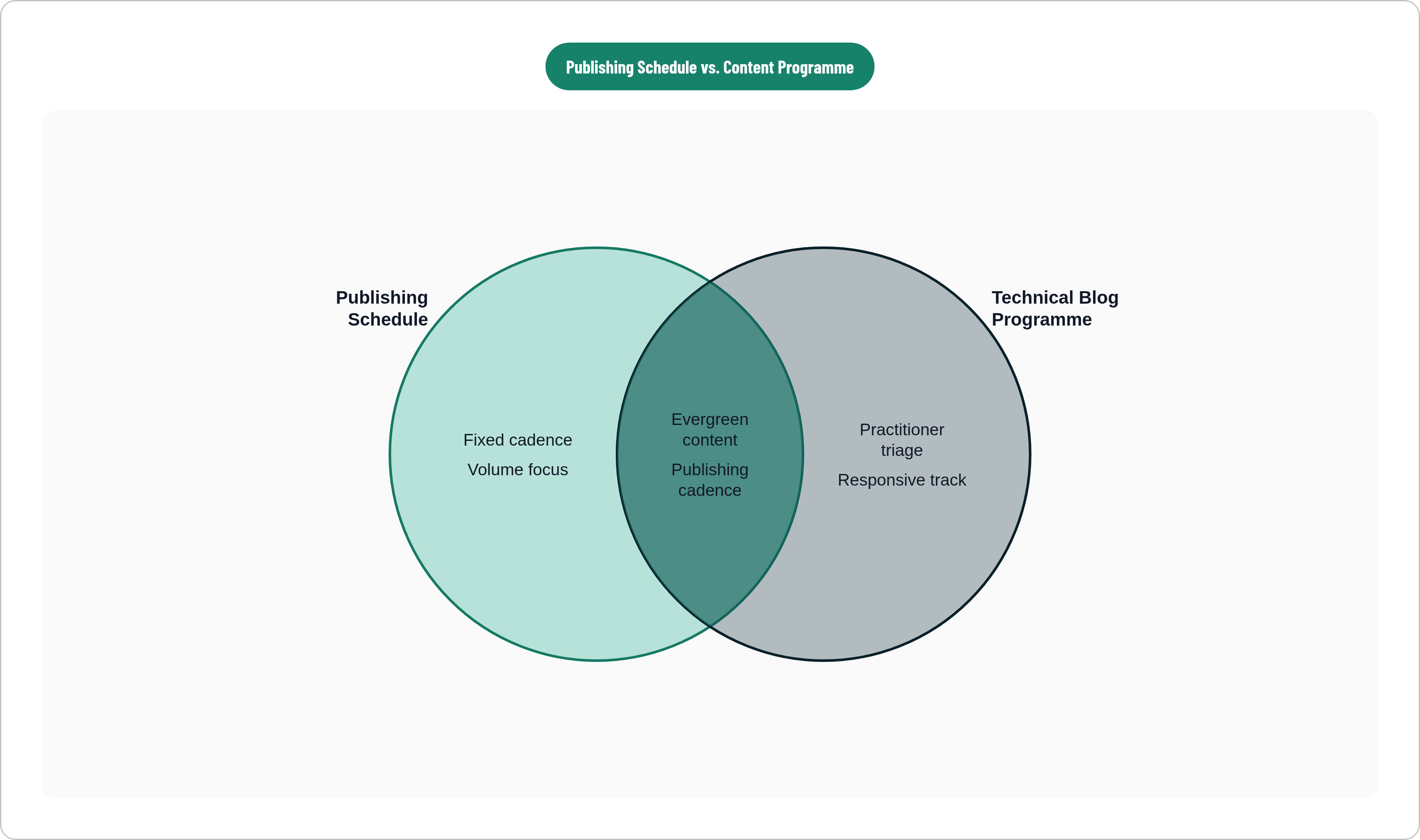
A schedule tells you when something goes live. A programme tells you whether it should exist at all. Sounds like a small distinction, but it isn't.
A programme needs three things moving at once: a way to decide what's actually worth covering, a production process sturdy enough to survive a practitioner reading it slowly and skeptically, and a way to keep both current as the threat landscape shifts underneath everyone's feet.
Almost nobody builds the first piece properly. Skip it, and the calendar fills with whatever's easiest to write that week, ignoring what the audience needs. Threats, meanwhile, don't wait for your quarterly plan. A new disclosure, a shift in how ransomware crews get initial access, a regulatory deadline landing in ninety days: these open short windows where a post actually matters, and a calendar locked in January misses every one of them.
The fix is two tracks running side by side. One is evergreen (architecture explainers, framework comparisons, the stuff still useful in eighteen months). The other tracks what's happening right now: breach write-ups, technique coverage, timely material with a shelf life measured in weeks. Mature programmes run both, on different clocks, and do not pretend one can cover for the other.
The editorial decision: how to identify what a practitioner audience will find worth reading
Here's a test worth taping above your monitor. Would a security engineer who already knows this domain learn something new from reading it? If the answer's no, would they at least find a genuinely rigorous take on something they know but haven't seen written up well anywhere else? Two no's and the topic doesn't get written.
Worth writing: a fresh disclosure with real exploitation detail, a documented shift in adversary technique backed by actual incident data, a regulatory change with consequences someone has to deal with Monday morning, or a question buyers keep asking that no vendor has bothered answering honestly. Weaker candidates: last month's competitor post with the names swapped, a rehash of industry consensus with nothing added, or anything built mainly to wedge a product mention into paragraph three.
CrowdStrike's Global Threat Report is the example people in this industry keep circling back to, and it earned that spot the hard way. Security teams who'd never buy CrowdStrike read it anyway, because the intelligence stood on its own. Palo Alto Networks' Unit 42 runs the same play: the blog works as a pipe for real threat intelligence, held to an editorial bar instead of tied to a launch calendar.
None of this happens without someone who can read a disclosure and judge, on the spot, whether it matters to the specific humans reading your blog. That judgment is the job, and you can't template your way past it, no matter how good the template looks in a slide deck.
The roles a technical blog programme requires to function
Four jobs need covering, however you split them across a team. Someone sets editorial direction and decides what runs. Someone supplies the actual subject-matter depth. Someone writes it well enough to survive a slow, skeptical read. Someone else reviews it, catching the errors and holding the line before it ships.
Most vendor programs collapse at the same joint: the subject-matter expert shows up at the very end to "approve" a draft a generalist already finished. By then the piece is baked at the wrong depth, and fixing it takes a rewrite dressed up as a review. Practitioner input has to sit at the topic and outline stage, not get bolted on after the fact. Bringing them in that late is like calling the inspector after the drywall's already up and asking them to just nod along.
Technical writing is its own craft, separate from general audience writing, and treating the two as interchangeable is how vendor blogs end up ignored by the people who'd catch a wrong protocol name in the second paragraph.
Editorial direction, someone with the domain knowledge and the nerve to say no to a topic, is the rarest of the four roles. Most marketing teams have half of that combination sitting somewhere in the building. Very few have both halves in the same person, which is probably why so few blogs actually sound like anyone in particular.
The content formats that earn practitioner trust and shortlist influence
Proof outperforms explanation. TechnologyAdvice's 2024 research shows customer case studies influence 63% of buyers, independent expert research 62%, and product reviews 59%. Generic blog posts do not appear on the list.
What earns a read: incident response case studies with specific outcomes (anonymized where it has to be), original threat research the vendor's own team fed data into, architecture explainers written by practitioners instead of about them, and framework breakdowns that let a buyer compare real options side by side instead of guessing.
Match the content to where the buyer sits in the funnel. Early on, address the specific threat or regulatory trigger that got them looking in the first place. In the middle, help them weigh SIEM against XDR or sort through zero-trust models, comparison work nobody wants to do alone at 11pm. Near the end, give procurement and the security leader ammunition to justify the call internally, because somebody upstairs is going to ask why this vendor and not the other three quotes sitting on the table.
A post with no original data, no named practitioner, and no concrete outcome is a hard sell to buyers already 70 to 80% through their research. Length matters more than people expect, too: SEOProfy's data shows posts over 2,000 words tend to outperform, against an average closer to 1,400. Depth reads as credibility to a practitioner and to a search algorithm alike, for slightly different reasons that happen to point the same direction.
How AI-synthesised research is changing what a technical blog must do to remain visible
Research habits shifted fast, faster than most content teams caught up with. 6sense's 2025 Buyer Experience Report found 94% of B2B buyers now use large language models to synthesise research before speaking to a vendor. Gartner's May 2026 survey found 45% used generative AI specifically to gather vendor and product information during a recent purchase.
AI overviews cite sources, and that mechanic decides everything downstream. A post with no original data, no named practitioner, and no specific technical claim gives the model nothing to point to, and it disappears quietly because there's nothing in it worth quoting.
Buyers still don't fully trust the machine, though. Sixty-nine percent go find a human sales rep to check whatever the AI told them, according to that same Gartner survey. AI visibility gets you onto the shortlist, but a person still has to close from there, which means the blog's job actually ends at getting cited, not at converting anyone directly.
This calls for a higher entry price, more than a new format. Specificity, originality, and a real practitioner standing behind the claims are table stakes now. Posts built on proprietary data or documented expertise get cited. Posts that restate the obvious sit there, unread and uncited, until someone finally deletes them from the CMS.
Sustaining the quality bar as the threat landscape shifts
The threat landscape doesn't check anyone's editorial calendar before it moves. New disclosures, new techniques, new regulations with real deadlines: these show up on their own schedule, and a program locked to a fixed publishing cadence can't respond fast enough.
That lag carries a higher cost than it appears. A post about a vulnerability that broke six weeks ago tells a practitioner you weren't paying attention, and they notice. They remember it the next time your name comes up in a vendor shortlist meeting.
Two rhythms need to run at once here: a planned track for the architecture and framework content that doesn't expire, and a responsive track keyed to whatever's breaking in the news this week. The responsive track lives or dies on triage, someone who can assess a new development quickly and answer: does this change anything for the target audience, and what exactly changes? No algorithm makes that call; a person has to.
Quality also needs someone with actual authority to reject a draft outright instead of waving it through just to keep the calendar full. Skip practitioner input for a few cycles, hand editorial direction to people without domain background, and the blog drifts toward safe, forgettable topics. It happens slowly enough that nobody notices, until one day the blog hasn't said anything worth reading in months and everyone's quietly wondering why traffic looks fine but nothing gets shared.
What options exist for building and running a technical blog programme
Three real paths exist here, and each one has its own particular way of going wrong.
Building in-house works when you've got a practitioner who can hold both editorial direction and actual writing at once, plus a marketing org willing to protect that person's calendar from every other fire drill in the building. For a vendor under a few hundred people, finding that combination is a bit like finding a parking spot right in front of the building: possible, but don't count on it.
A generalist content agency runs into the same wall most in-house teams hit anyway: subject-matter input shows up too late, generalist writers produce at the wrong depth, and the "approval" step quietly turns into a rewrite nobody budgeted time for. Nobody plans on that outcome, but it happens reliably, almost every single time.
A specialist studio built around practitioner triage handles it differently, baking judgment into the process at the start instead of tacking it on at the end. The quality bar gets set when the topic gets picked, not when a draft lands in someone's inbox for a last look before it ships. Cyberou runs this model as a content and research studio for cybersecurity vendors, with human-led practitioner triage rather than an automated filter doing the sorting. The research happens before anyone writes a word, so the people deciding what's worth publishing are the same people who can tell whether it actually matters. The firm's work sits behind more than 300 tier-one media features tied to its research, across more than 30 cybersecurity vendors, for whatever that's worth as a data point rather than a pitch.
Whichever path you pick, there's one question that actually sorts the options: does practitioner judgment show up before the writing starts, or only after a draft already exists? Everything else is detail.
How to evaluate whether a technical blog programme is working
Traffic is the wrong metric, and there's no gentle way to say that. The real signal is whether the people you wrote this for are reading it, sharing it, citing it, or handing it to a colleague mid-deal because it actually helped them argue for something.
Worth checking beyond that: is the content getting picked up by outlets like Dark Reading, SC Media, or Infosecurity Magazine? Is it showing up inside AI-synthesized research answers when someone asks a chatbot about your category? Are sales reps using it as a leave-behind because buyers actually trust it, not because marketing told them to attach it to every email?
Content Workshop's 2024 Cybersecurity Content Marketing Report found companies investing more in content were 2.5 times more likely to say their strategy beat expectations. That tracks with quality over volume; publishing more posts and earning more trust per post are two entirely different exercises, and only one of them shows up cleanly on a content calendar.
The cheapest test costs nothing: hand three recent posts to a security practitioner who doesn't work at your company, and ask if they learned anything, or if they just found the whole thing kind of forgettable. Their gut reaction, delivered in about thirty seconds, tells you more than a month of dashboard-watching ever will.
If the honest answer is that posts go out to keep the calendar moving rather than because each one earned its spot, that's the tell right there. Fix the editorial decision process before the next post ships, not after the fifth one nobody read.