CISO-Targeted Content That Drives Engagement
Security leaders filter vendor noise by trust and peer credibility, not marketing claims.

Vendor content aimed at security leaders runs into a $213 billion problem that hides behind a very simple filter. Worldwide information security spending hit that number in 2025, up from $193 billion the year before, and Gartner has $240 billion penciled in for 2026. Every dollar of that is chasing a buyer who's been trained, by sheer volume of noise, to ignore almost everything sent their way.
Security leaders sit where technology, risk, and board accountability collide. They control budgets in the millions and decide which vendor relationships live or die. Forrester found 90% of security and risk leaders expected budget increases in 2025, but boards want proof that money did something, and that combination, big budgets, rising scrutiny, is exactly why a security leader's inbox looks like a landfill of undifferentiated PDFs nobody opens. The prize is huge, but so is the pile of content that never got read.
How security leaders actually filter the content that reaches them
Security leaders run everything through three checks, in this order: trust, relevance, and fit, and they do it fast. The boldness of a claim or the length of a feature list barely moves the needle.
Merritt Group found 64% of cybersecurity and risk leaders get the information shaping their buying decisions from conversations with industry peers. That's the trust mechanism now, full stop. Analyst reports are relied on by just 9% of security leaders, a steep enough drop that attention has shifted toward practitioner-authored and editorial sources instead.
The filter starts with identity. A piece that reads like it was written by someone who's never sat through an incident response call at 2 a.m. gets tossed before the second paragraph. Content that reads like it came from inside the community earns a second look. Voice is screened first; subject matter comes second.
Where security leaders go to find content they trust
Trade publications still run the show. Krebs on Security, Dark Reading, CSO, and SC Magazine beat mainstream business press because they go deeper on the technical detail and stay narrow. The Wall Street Journal lacks the technical depth security leaders need on a ransomware strain's lateral movement pattern.
Vendor-agnostic platforms carry weight too. TechTarget's SearchSecurity and Security Week work as news outlets and reference material at the same time, and their articles link out to deeper sources constantly, which stretches their reach well past the original click.
Xtra-Mile's 2023 research puts it plainly: 80% of security leaders start their research with Google and peer recommendations, so search and peer referral make up the whole front door. There's a newer wrinkle, too: 72% of buyers now run into Google's AI Overviews during research, and 90% of those people click through to the source. Getting cited inside an AI-generated summary reaches a disproportionate slice of active researchers, whether the vendor planned for it or not.
Then there's the part vendors can't buy their way into: invite-only CISO groups, summit networks, private Slack-style communities. Buying decisions get talked through in those rooms, and content that circulates there earned its way in; nobody placed it there for a fee.
What the engagement data actually shows about format preference
A 2025 CISO Engagement Study pulled behavioral signals from more than 2 million subscribers across 38 ISMG properties, tracking roughly 500,000 daily interactions across more than 300 topics. It's the largest behavioral dataset on this audience that exists, and the results don't leave much room for argument.
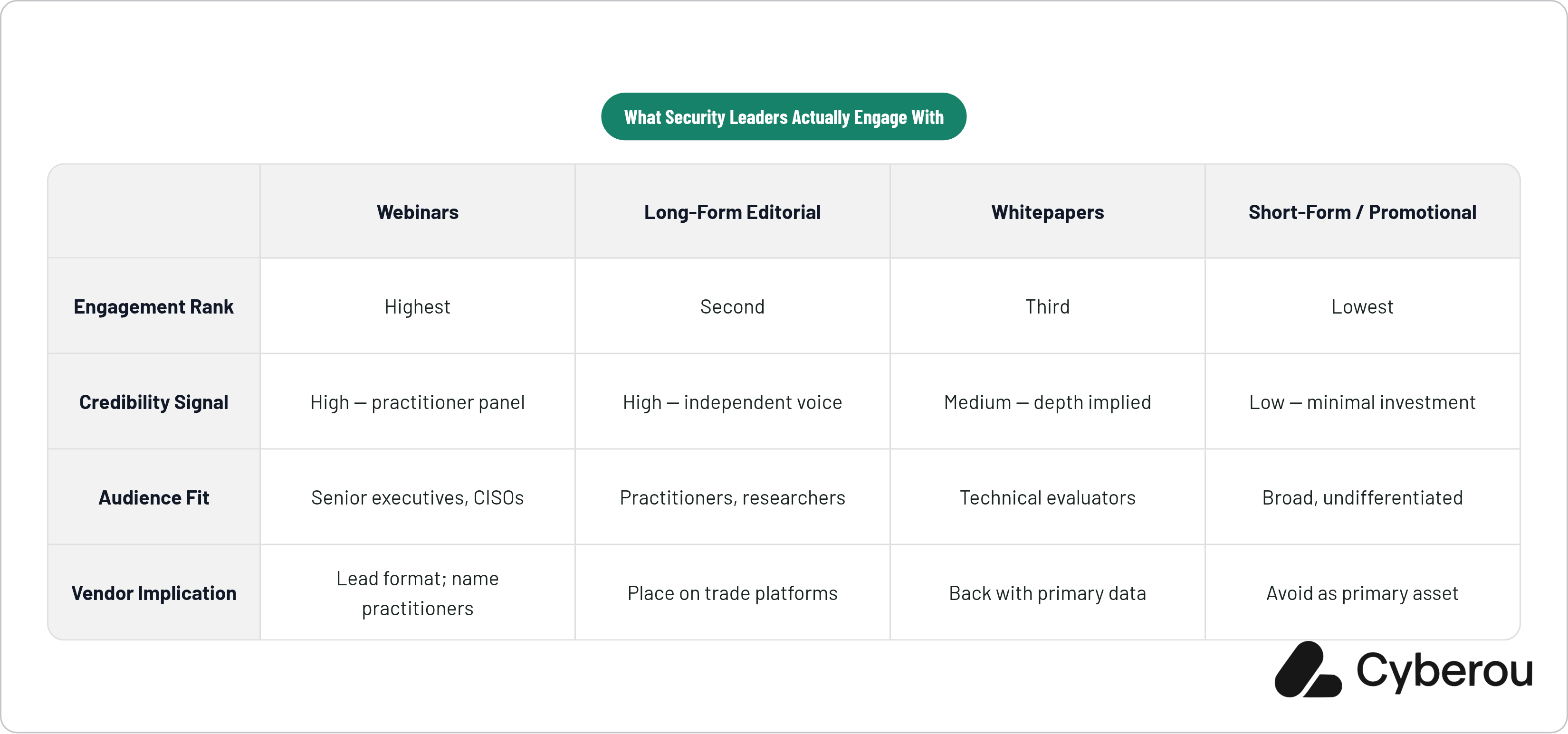
Webinars topped the list for CISO and senior executive engagement. Editorial long-form came second, whitepapers third, short-form and promotional assets trailed the pack every time. On Security Operations topics specifically, 73% of total engagement went to editorial and non-sponsored content. Most attention flows toward material that reads like independent editorial, and the margin is substantial.
Ask practitioners directly, though, and plenty will say short-form video and audio are eating into their whitepaper time, even though that self-reported answer doesn't line up with the click data. People say one thing and do another, and that happens in every part of life, cybersecurity included.
Credibility is the variable that determines engagement, independent of length. A 45-minute webinar with a practitioner on the panel and a substantial editorial piece both signal that someone put real work in. A two-minute promo video and a gated one-pager signal low investment, regardless of graphic design quality.
The topics security leaders are actively seeking out right now
AI dominates attention right now by a wide margin. The same engagement data shows a majority of users engaged with AI and machine learning content between Q4 2024 and Q1 2025, ahead of every other topic by more than 20 points, with AI content volume growing sixfold between 2022 and 2024.
Volume of interest is separate from whether vendors have anything useful to say about it.
Gartner's 2025 Leadership Perspective Survey, covering more than 1,100 security leaders, named cyber resilience the top priority. That's a real shift, and content built around operational continuity and recovery lands better than another pitch for prevention. On spending, Evanta and Gartner found 43% of security leaders planning investment in IAM, MFA, and Zero Trust; 39% in data loss prevention (up from 33% the year before); and 35% in generative and traditional AI tools.
There's a gap worth naming. Editorial content on OT security jumped 51% year-over-year in 2024, while sponsored OT content in that same window dropped 53%. Readers want it, but vendors have gone quiet on it, probably because the deal sizes look smaller on a spreadsheet. That's an open lane sitting there for anyone willing to actually write about operational technology instead of skipping it.
Looking to 2026, more than 1,600 security leaders across Gartner's communities named three top initiatives: enabling and protecting AI, managing cybersecurity risk, and optimising the tools they already own. That last one matters more than it sounds. Nearly half of security leaders report flat budgets, and content that helps them defend existing spend to a board is more useful than content arguing for another purchase. Nobody wants to walk into a board meeting asking for money they cannot justify line by line.
How the buying journey shapes what content needs to do at each stage
Buyers reach out to vendors earlier than they used to. 6sense's 2025 Buyer Experience Report found first contact moving from around 69% through the buying journey in 2024 to 61% in 2025, roughly six or seven weeks earlier. Sounds like good news for anyone chasing pipeline.
Except nearly 80% of those conversations are still buyer-initiated, and the vendor contacted first wins the vast majority of deals. That flips the usual story. The piece that closes a deal matters less than the accumulated presence that put a company in a CISO's head before they were even actively looking.
CISO buying is a group project involving technical evaluators, finance stakeholders, and board sponsors. They all consume content at different depths, for different reasons, and one asset almost never moves a deal by itself. A body of work built up over months carries that weight.
The job of any single piece of content is staying present and credible in a security leader's mind before the trigger event happens: a competitor's breach, a new compliance mandate, a board review, a budget suddenly freeing up. The piece's job is being remembered when the trigger event arrives.
What makes a piece of content survive a practitioner read
Strategic depth beats feature promotion, every time, once you check the data. Content built around risk strategy, executive accountability, and outcomes consistently outperforms content built around what a product does. Practitioners want to know what happens to their job if they get this wrong, not product specifications.
Specificity is the tell. A claim backed by named threat actor behaviour, a real incident, or a sourced vulnerability disclosure reads like it came from someone who has actually done the work. A generic list of risks is marketing copy dressed as security content.
Jargon inflation gets caught fast. Security leaders spot decorative use of terms like "zero-day," "advanced persistent threat," or "AI-powered" from a mile off, and using those words loosely, or incorrectly, is the quickest way to signal a lack of practitioner credibility.
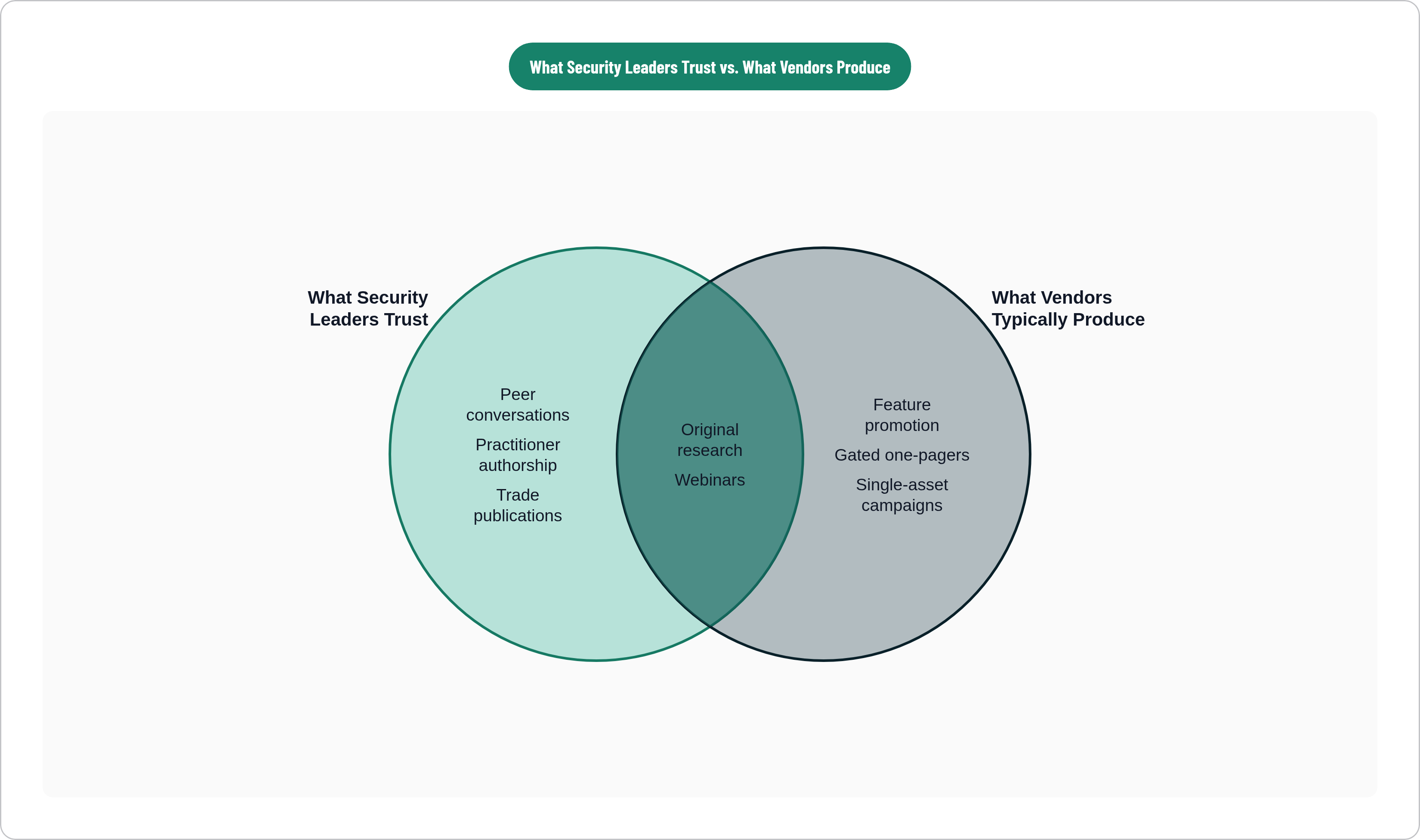
Original research is the strongest credibility signal a vendor has, because primary data belongs exclusively to whoever gathered it. A competitor can lift the same analyst deck everyone else is quoting, but primary data stays with its source. Credibility carries a price tag: a 2024 study found roughly 60% of decision-makers said strong thought leadership makes them willing to pay a premium to a given supplier. That's margin sitting on the table, a hard commercial outcome rather than a soft benefit tucked into a slide somewhere.
The event halo effect and what it implies about content sequencing
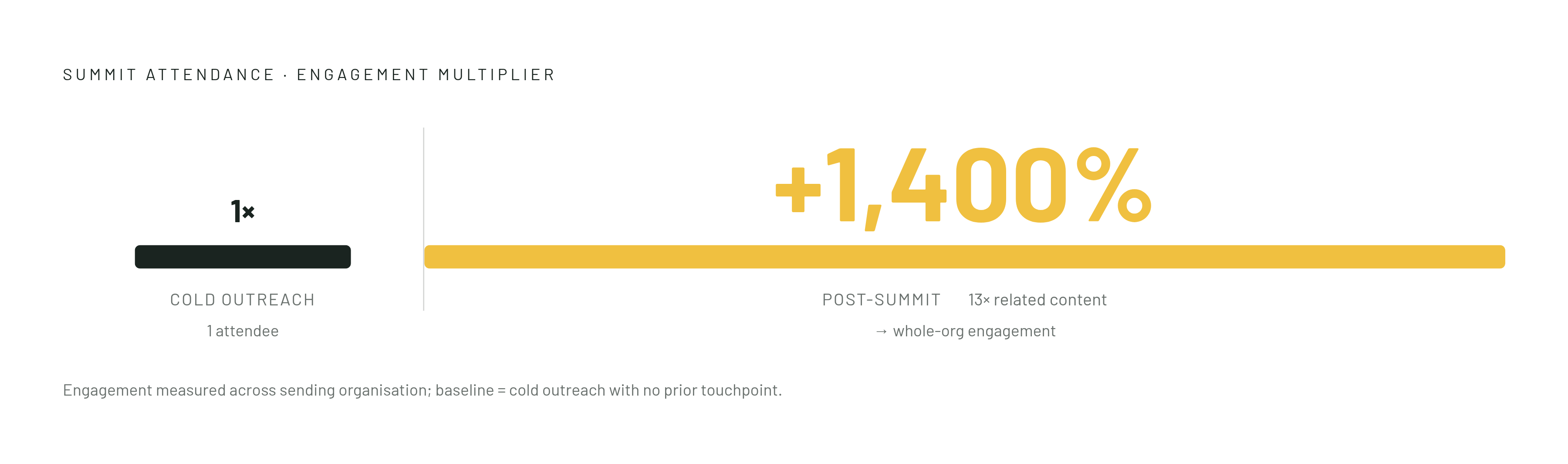
Something strange happens after a summit. The same study found that when even one person from an organization attends, overall content engagement across that whole organization jumps by an average of 1,400%. Organizations with a summit attendee show 13 times higher engagement with related content afterward.
What it actually shows is that one high-trust touchpoint primes an entire account to pay attention in a way cold outreach, regardless of follow-up email volume, cannot match.
Content sequenced around that window (pre-event briefings, post-event deep dives, insights pulled from the peer network) catches engagement while the door's still open. Content published outside that window returns to competing for attention in an indifferent feed.
The same logic holds outside of events. A competitor breach or a fresh compliance mandate creates its own priming effect, and vendors who already have content indexed on that exact topic benefit right away. Everyone else scrambles to write something after the moment has passed, arriving too late to benefit from the heightened attention.
What vendor content consistently gets wrong
Labeling something editorial when it reads as promotional is the most common mistake, and CISOs have gotten sharp at spotting it. That 73% non-sponsored engagement share on Security Operations content is a deliberate workaround. Readers have learned to route around anything that smells sponsored.
Publishing on AI purely because 56% engagement is a big number, with nothing original to say about it, is obvious from a mile away to a practitioner audience. Topic selection driven by demand data alone, with no substance behind it, damages credibility faster than silence.
Citing an analyst's framework as a substitute for original thinking has lost its purchase, with only 9% of security leaders now relying on analyst reports.
Single-asset campaigns built for a single decision-maker miss the structural reality of CISO buying entirely, since it's a committee sport. Content aimed only at the technical evaluator leaves the finance stakeholder and the board sponsor with nothing to read, and one of them is going to ask a question nobody prepped for.
Volume is still mistaken for presence. A large archive of short-form promotional posts occupies shelf space while the trust that brings a buyer to call first goes unbuilt.
How to build a content programme security leaders will actually read
Start with practitioner authorship, or at minimum, visible practitioner involvement. That's the identity signal that gets past the first filter, and it remains the primary one.
Pick formats that signal real investment: webinars with named practitioners, long-form editorial placed on trade platforms, research-backed whitepapers. These line up with the credibility CISOs are actively screening for, regardless of length on its own.
Map topics to what's actually on the CISO's agenda (cyber resilience, AI risk, IAM, justifying spend to a board) rather than the product category you'd like to own. They are distinct lists, and conflating them sends good content to the wrong audience.
Build for the stretch of time before active buying intent even exists. The vendor contacted first wins 8 out of 10 deals, and that advantage comes from sustained, patient presence maintained across months rather than a quarterly campaign burst that shows up loud and disappears.
Sequence content around high-trust moments (events, trigger events, compliance deadlines) so you catch the engagement window while it's open, publishing ahead of the moment rather than after it.
This logic runs through the most effective vendor content programmes. Practitioner triage decides what is worth publishing in the first place, specialist authorship produces work that holds up under a technical read, and the research process, original investigation included, generates the primary data that gives the resulting content its credibility, proprietary to the vendor and unrepeatable by competitors.