Content Marketing Funnel Stages for Cybersecurity Vendors
Align content to enterprise security's nine-to-fourteen-month buying cycle.

Nine to fourteen months. That's the average enterprise security deal, and the bigger platform buys run longer than that. If your content calendar looks like a quarterly sprint plan, you're going to be disappointed with what it produces, because you're planning for a race that runs far longer than that.
Gartner has found that B2B buyers get through most of their decision before a sales rep ever says hello. So if your whole strategy assumes the sales call is where you win someone over, you entered the race well after most of it was already run. Add to that a buying committee that keeps growing: data cited by marketer.co, sourcing Gartner, puts the average number of stakeholders in a cybersecurity purchase at around six in 2021, climbing past eight by 2024. TechnologyAdvice's 2024 research found the CEO and CFO are often deep in the detail, actively scrutinising the decision rather than simply signing off a budget line. A firewall purchase is a company decision that extends well beyond the security team.
Walk through who's actually sitting at that table. The security leader owns the strategy, while the CIO owns the architecture. A security engineer wants the technical proof, architecture diagrams, and real specifications, and procurement and legal own the contract terms. Someone in risk and compliance needs an audit trail before any of this goes anywhere. Five people, five sets of questions, and most vendors try to answer all of it with one PDF, which puts everyone at a disadvantage.
6sense's 2025 Buyer Experience Report turned up something that should worry any team optimizing purely for late-stage conversion: the vendor who wins the deal had earned a shortlist position before active evaluation began. Vendors who appear only during active evaluation arrive after the shortlist has already formed. The same report found a large majority of B2B buyers now run their research through large language models before they talk to a human at a vendor, which means showing up inside an AI-generated answer matters as much as ranking on page one of Google now. Foundry's research puts the number of content touches before a buyer reaches out at somewhere between three and seven, often more. Each one either builds something or wastes the trip.
What top-of-funnel content must do for buyers who are problem-aware but vendor-agnostic
At this stage the buyer knows something's wrong, whether that's a breach, a new regulation that just landed on someone's desk, or an attack surface that quietly tripled because an engineer spun up forty new cloud services without telling security. That last one happens more than anyone wants to admit. The buyer still lacks a category name for the fix and a shortlist.
Top-of-funnel content has one job: be useful enough that the buyer remembers who wrote it six months from now.
What earns that memory: threat research (CrowdStrike's Global Threat Report is the one everyone in the industry points to), compliance guides mapped to the specific rule the buyer is legally on the hook for (NIS2, DORA, CMMC 2.0, SOC 2), blog posts built around one named attack technique instead of a vague category, and newsjacking while a breach headline is still warm. A 2025 CISO engagement study found AI and machine learning content pulled the biggest share of engagement across ISMG's whole network. Every CISO wants to know what AI means for their job and their attack surface, usually in that order.
Persona-specific content drives 40% higher engagement than the generic stuff, even this early. A post written for "IT decision makers" in the abstract loses to one written for a healthcare CISO staring down a HIPAA audit, which is a good reason to segment now, not just once the deal gets serious.
Fear-based marketing is losing its grip, and it's about time. The ActualTech Media 2025 Cybersecurity Buyers Guide says so directly, and the CyberRisk Alliance's 2024 End-of-Year Report backs it up: old-school fear, uncertainty, and doubt tactics are losing their effect. Security buyers have built entire careers on being professionally afraid; scare tactics bring them nothing they haven't already processed. What actually moves them is brand credibility and content that treats them like the expert they already are.
Where does this content live? Organic search, LinkedIn posts from a named practitioner with a genuine point of view, published under their own profile, earned media tied to original research, and increasingly, the original research and authoritative sourcing that earns citation inside AI-generated answers. Security buyers filter out promotional copy on instinct, and original research is what earns their attention.
Middle-of-funnel content and the multi-stakeholder problem it must solve
By now the buyer knows what category of solution they need. They're comparing vendors, building an internal business case, and looping in the rest of that eight-person committee.
This is where the multi-persona problem stops being theoretical. The CISO wants strategic depth, while the security engineer wants architecture diagrams that actually show the architecture in full technical detail. Procurement wants commercial terms and risk exposure, and the board wants business impact translated into plain English. One whitepaper will fail all four jobs, regardless of how polished the design is.
DemandGen's 2024 research found roughly half of buyers think vendor content is too generic, and about the same share say there are too many hoops to jump through just to read it. That second stat should worry anyone running a gating strategy: gating your best whitepaper behind six form fields and a phone number trains the buyer to skip it. TrustRadius's 2024 research points the same direction from another angle: most B2B buyers say they prefer vendors who teach them something before pitching them anything. Weave the product into the story from the start, so it earns its place before any call-to-action appears.
For a CISO specifically, the same CISO engagement study found webinars, long-form whitepapers, and substantive articles land in roughly that order of engagement, with webinars punching above their weight here. Someone who attends even one security summit or virtual event shows noticeably higher engagement with related content afterward; the event is the spark, the nurture sequence is the fire.
Building five separate micro-narratives for five separate personas sounds like a lot of extra work until you remember it's the floor, not the ceiling, for a deal with eight stakeholders attached. This stage runs through webinars, email nurture, account-based paid LinkedIn campaigns, retargeting off intent data, and analyst briefings, all narrow-cast at specific accounts. Account-based marketing fits cybersecurity especially well, given how long these cycles run and how big the target accounts are. Reaching four stakeholders inside the same account with coordinated messaging, at the same time, is a structural edge that generic broadcast content cannot provide.
Bottom-of-funnel content and removing the last obstacles to a decision
By bottom-of-funnel, the shortlist exists. The buyer has already reached a conclusion internally and now needs ammunition to bring back to their own stakeholders and defend that decision.
TechnologyAdvice's 2024 research found customer case studies are the single most influential content type in B2B tech buying, full stop. Quantified outcomes beat descriptive claims every time, so the numbers in a case study matter as much as its existence. "Blocked hundreds of thousands of malicious login attempts in Q3" beats "significantly improved security posture," because a precise number earns credibility where vague language only gestures at it.
Gartner's 2024 research throws in a wrinkle that should reshape how vendors think about proof: most security leaders trust a peer's opinion or an analyst's writeup over anything the vendor says about itself. Third-party validation carries more weight than vendor self-description, which makes sense in a profession where scepticism is a job requirement.
What actually moves the needle: named case studies with real, verified numbers, cultivated reviews on G2 and Gartner Peer Insights, a spot in a Forrester Wave or Gartner Magic Quadrant report, documentation ready to paste straight into a security questionnaire, and board-ready risk-reduction reporting.
That last one matters more than it used to, ever since the SEC's cybersecurity disclosure rules landed in 2023 and started biting in 2024. Security leaders now have to explain their posture to a board in plain business terms, and a vendor whose product spits out a clean, board-ready dashboard has a genuine edge in that meeting.
Here's the catch: Gartner's research shows most buyers shortlist only vendors whose names they already recognise. Bottom-of-funnel content can't manufacture familiarity that top and middle-funnel content had six to ten months to build. Vendors who reach the shortlist stage without prior brand recognition are excluded before evaluation begins, regardless of their case studies. And once a buyer shows real intent, a demo request, a trial signup, responding within twenty-four hours is the threshold; missing it meaningfully hurts conversion. Great content paired with a slow sales team loses the deal after the content has already done its job.
The post-purchase stage most vendors treat as an afterthought
A customer describing specific, quantified results carries more conviction than vendor self-description. Yet post-purchase content is usually the first line item cut when budgets tighten, a decision that squanders the compounding value built during the purchase cycle.
The real playbook: customer success stories, formal reference programs, peer community content, and business cases built around renewal and expansion. All of it compounds.
Those G2 and Gartner Peer Insights reviews that carry so much weight at bottom-of-funnel come from existing customers. Cultivating those relationships is post-purchase work with a direct pre-purchase payoff, making it one of the rare marketing activities that pays twice for the same effort.
There's a bigger shift underneath this too. Ad costs keep climbing, third-party cookie data keeps eroding, and cybersecurity marketers are drifting toward channels that compound instead of channels you have to keep feeding money into forever. An engaged customer community works as a distribution channel and a research source at the same time. Brand-led growth, built on thought leadership, peer reviews, and customer advocacy, is quietly taking over from traditional lead generation as the operating model for anyone selling on a long cycle. It takes longer to build and resists overnight replication by competitors.
Where most cybersecurity content programmes break down structurally
The most common failure: dozens of top-of-funnel blog posts for every one or two bottom-of-funnel case studies. Traffic climbs while revenue stays flat. That gap is the whole problem, shrunk down to fit on one chart, because the bottom of the funnel can't close a deal alone if nothing upstream ever built trust.
Only 57% of companies actually implement data-driven marketing, even though a much bigger share of leadership will tell you, with a straight face, that it matters. Most programmes stall at the gap between acknowledging data-driven marketing and implementing it, usually around month six.
There's a distribution problem hiding in most budgets too. Plenty of teams pour their spend into production and starve distribution, leaving the finished piece unread by the accounts that matter. A well-distributed piece that reaches the five people who make up the buying committee beats a beautifully designed archive with no audience, so flip that ratio around.
Then there's the patience problem. Cybersecurity content compounds over twelve to twenty-four months. Cut a programme at month six and you have ended it at the point where compounding returns were beginning, which is a bit like quitting the gym the week before you would have finally seen the difference in the mirror.
And one more thing: a security leader fielding dozens of vendor pitches a year filters out "next-generation AI-powered" language in about three seconds flat. What earns attention is technical depth, original research, and proof that survives a skeptical read. Buzzwords fail that filter every time.
Gong's 2024 research found single-threaded deals, meaning only one person on the buying committee ever actually engages with the vendor, end in no-decision at a high rate. A content programme that addresses only the CISO, leaving the engineer, the CFO, and procurement without relevant material, builds single-threaded deals by accident and wonders why they stall.
Matching content format to funnel stage — a working map for cybersecurity vendors
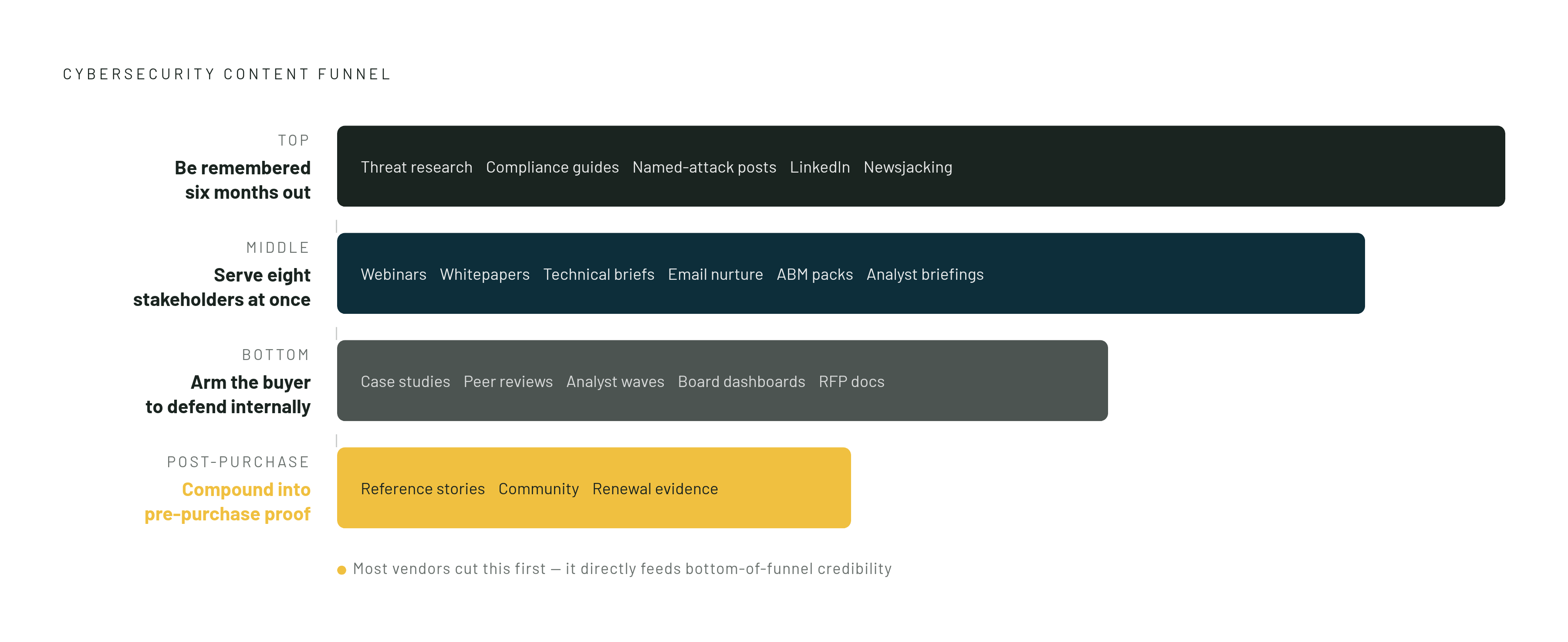
Put it all together, and here's the shape a healthy cybersecurity content funnel takes.
Top-of-funnel: threat research reports, compliance framework guides, content built around named attack techniques, LinkedIn posts from real practitioners, and newsjacking tied to breach news, all aimed at organic search and at getting cited in AI-generated answers.
Middle-of-funnel: webinars and virtual events, long-form whitepapers, technical briefs written for a specific persona, email nurture sequences, ABM content packs for multi-stakeholder accounts, and analyst briefing materials.
Bottom-of-funnel: named case studies with real numbers, cultivated G2 and Gartner Peer Insights reviews, a spot in an analyst wave report, board-ready risk and ROI dashboards, questionnaire-ready documentation, and trial or sandbox enablement content.
Post-purchase: customer reference stories, peer community content, expansion business cases, and renewal evidence packs.
Every format on that list lives or dies on the editorial judgment behind it: knowing which threat is actually worth writing up this month, which compliance angle lands with this particular buyer, and which number in a case study earns credibility instead of getting waved off as fluff. That takes someone who can read the raw technical material and tell a real finding apart from a rounding error.
The logic holds up once you see it laid out: the same original research that earns top-of-funnel attention (real threat investigations, real technical analysis, real vulnerability findings) is also what generates the media coverage that builds the brand recognition Gartner says buyers need before they'll even consider you for a shortlist. One coherent effort, two separate payoffs.