Cybersecurity Content Marketing for CISO Audiences
CISOs need content built around their impossible job, not your product pitch.

Global information security spending hit $212 billion in 2026, up 15.1% from the year before, and the money's clearly there. What's missing, most of the time, is content built for the person actually spending it, rather than the vendor hoping to get a slice. Cybersecurity CMOs report less confidence in hitting their KPIs than the average B2B marketer, and that gap comes down to who the content got written for in the first place — most of it still gets built around what the vendor wants to say rather than what the reader needs to know.
What's actually sitting on a security leader's plate when they open your content
Picture the person opening your blog post at 6:45pm, phone in one hand, coffee gone cold, third cup of the day already abandoned. Their job used to be "keep the bad guys out." Now, per Splunk's 2026 CISO Report, 96% of them also own AI governance and risk, a line item that showed up on the job description uninvited, like a roommate who moved in without asking.
Then stack on the fact that 78% worry about personal liability for security incidents, up from 56% the year before. That's "will my name end up in a deposition" stress. Nearly all of them name alert volume as a top burnout driver, and most say tool fatigue and false positives are wearing them down too. Forty-one percent can't tie ROI to actual risk reduction, so they're defending a budget using numbers they don't fully believe themselves.
Boardroom alignment fell hard between 2024 and 2025, and most security leaders now say the people signing their checks don't understand what they're paying for. So when a CISO opens your whitepaper, the bar is low and specific: make the next hour feel slightly less impossible. Ask them to work to find your point, and you lose them by paragraph one.
An old joke fits better than it should. A CISO walks into a doctor's office and says, "Doc, everything hurts," and the doctor asks him to point to where; he points at his inbox. That's the job now: everything at once, all the time.
How security leaders actually shop, and how late a vendor finds out about it
Here's a number that should rearrange how every security vendor plans content: nearly 70% of security leaders are open to a new job this year. CISOs move every few years, practically on schedule, and they take their trust in you with them the way they take their laptop bag. Win that trust once, and you've planted something that follows the person for a decade, long after the deal closed or didn't.
Enterprise cybersecurity deals run 12 to 14 months and get decided by committee, with multiple signatures required before anything closes. Write only for the CISO and you skip the architects, analysts, and finance people who also get a vote. By the time a CISO emails you, the deal's already halfway decided. The real research happened earlier, in Slack channels with peers, in trade press, increasingly through an AI assistant doing a first pass that bypasses the vendor entirely.
A strategy that waits for a form submission has already lost most of the people who mattered. CISOs expect you to already know their environment before the discovery call.
A mid-sized security vendor I worked with kept losing deals that their sales team swore were "almost closed." Turned out the champion inside the account had already read four blog posts, a whitepaper, and two LinkedIn threads before ever picking up the phone. Sales thought they were starting the race, but they were running the last lap, wondering why they felt so far behind. It's the oldest story in B2B: by the time you introduce yourself, the relationship's already been going on for months without you.
Why trust, and only trust, moves a security leader toward a vendor
Trust beats features every time. Studies on CISO decision-making keep landing on the same finding: trust, relevance, and fit outweigh whatever bullet points sit on your product page. All of that gets built, or quietly wrecked, months before the sales call.
A peer reference does more work than any brochure ever will. A case study about a hospital system means something to a hospital CISO; a vague "Fortune 500 enterprise" win means nothing to anyone, because it could be describing a company that sells shoelaces. Consider the stakes underneath all this: 76% of security leaders expect a serious cyberattack in the next year, and 58% admit they're not ready for it. Every security leader reading your content is trying to close a gap they already know exists.
Trust here behaves like a bridge under construction, plank by plank, holding weight before anyone's willing to walk across it. It builds slowly. Lead with a bold claim about your platform and you get skepticism, not curiosity. Show that you understand the specific problem keeping someone up at night, and you earn a second read, maybe a forward to a colleague. Get one technical detail wrong, though, and the damage runs deeper than a failed conversion; you burn credibility in a small, tightly networked community where everyone compares notes over coffee the next morning.
What formats and topics actually hold a security leader's attention
Webinars win, consistently, with articles and whitepapers close behind. That's a mindset signal. People show up to a live session to learn something, and cybersecurity webinars convert attendees to leads at nearly double the typical B2B rate for exactly that reason.
AI and machine learning dominate the topic list, pulling in most of the engagement and tripling in content volume over the past few years. It makes sense: everyone's racing to figure out what AI does to their environment before the board asks first and they're caught flat-footed.
Here's the stranger data point. OT security content from independent, editorial sources grew substantially year over year, while sponsored content on that exact same topic shrank. Vendors walked away from an audience actively asking for more, which is a bit like closing the lemonade stand on the one blistering afternoon everyone's actually thirsty. LinkedIn, meanwhile, outperforms other channels for cybersecurity by a wide margin, mostly because that's where practitioners and analysts already spend their idle scrolling time.
Format is a tell, one that shows up before anyone's read a word. Choose a webinar over a gated PDF, and you're signaling that you understand how this audience actually learns.
Why sponsored content loses the exact audience it needs most
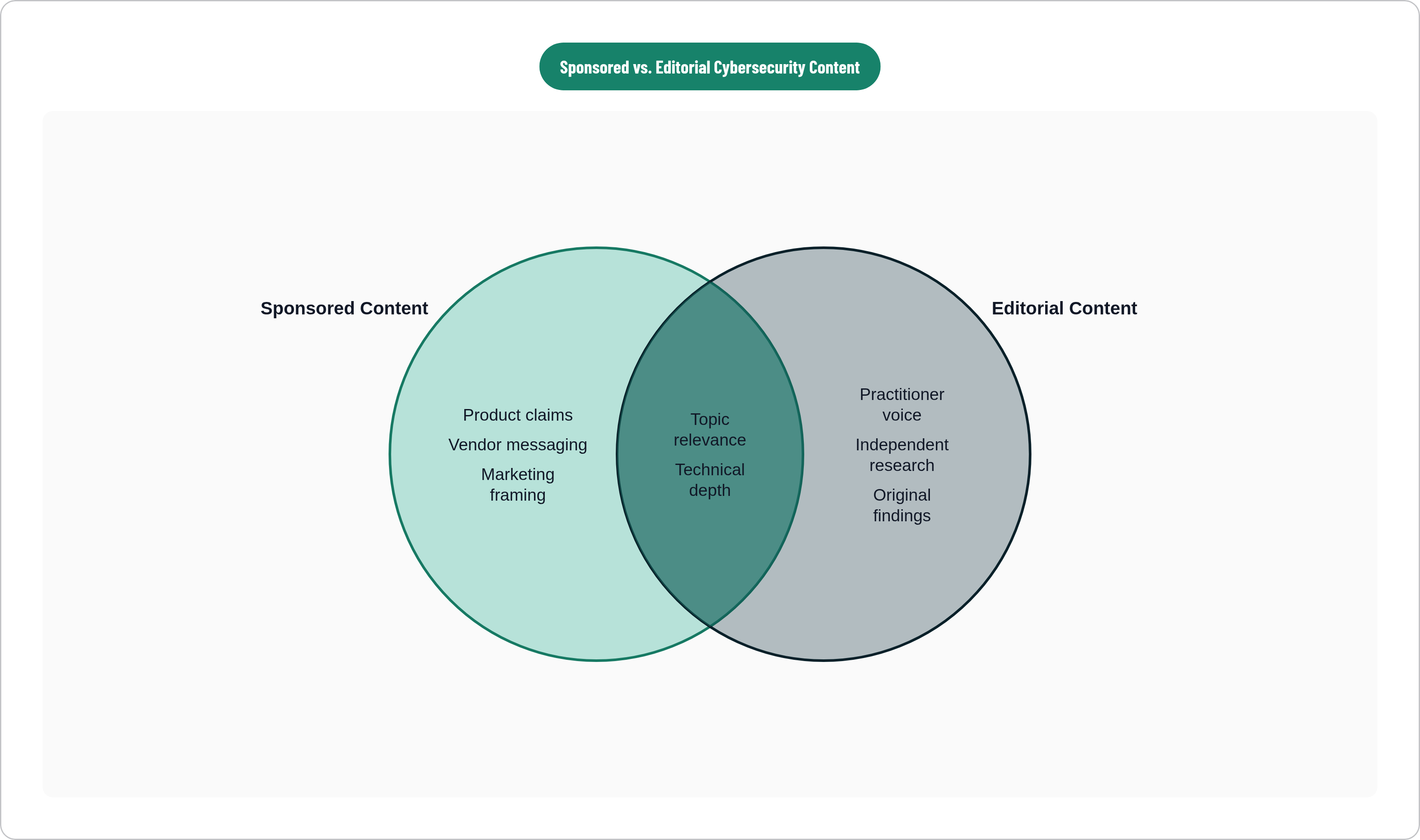
On security operations topics, most engagement goes to editorial content over sponsored material, and the gap is wide. One financial services organization tracked in that research saw non-sponsored content pull engagement at thirteen times the rate of its sponsored counterpart, a wall few vendors manage to clear.
Why? Security leaders have been pitched to for years and built a filter for it, a mental spam folder that flips on the instant something reads like marketing copy. Open with a product claim, and your argument gets filed under "ignore" before anyone gives it a fair hearing.
Vendor content just has to clear the same bar as everything else a security leader reads that day, whether that's a peer's LinkedIn post or an independent research report. Try this test: strip your company's name off the piece and ask whether it's still worth reading. If the answer's no, you've written an ad wearing a content costume.
What credible technical content demands that most marketing teams don't have
Security leaders read differently than most audiences. They spot an imprecise threat description the way a line cook spots a burnt sauce, instantly, without much patience for excuses. They notice when a control recommendation skips a common configuration, and they notice when a statistic has had its caveats quietly filed off to make it punchier for a slide.
Roughly a third of 2026 cybersecurity marketing budgets go toward brand-building work: PR, social, executive visibility, influencer programs. All of it rests on whether the underlying content survives scrutiny, and that's the part budgets can't fix. Marketing teams under deadline pressure reach for safe, generalized framing and borrowed stats; it reads fine to a general audience and thin to a practitioner, which happens to be the only audience that matters here.
Remember the stat about executives lacking cybersecurity fluency? The same security leaders flagging that problem internally are the ones getting handed vendor content written without a single practitioner anywhere near the draft, and they can tell. Credibility comes from a practitioner making editorial calls upstream, deciding what's actually worth saying versus what the audience already knows cold; a final editorial polish is secondary. Original research helps for a plain reason: a finding nobody else has is a finding worth forwarding to a colleague, and that forward is what makes trust compound instead of just sit there.
Building a content programme for the long haul, not the quarterly spike
Campaign bursts work for a buyer who stays in one seat. CISOs don't; they change roles every few years, so a program built around quarterly spikes loses the relationship right when it should start paying off. A steady, technically grounded publishing rhythm survives the job change because it followed the person across every role change.
Build around what's actually keeping a security leader awake — threat landscape shifts, board communication headaches, ROI they can't yet measure, burnout they haven't solved — ahead of your product roadmap. That's the direct route to the three things that move a buying decision: trust, relevance, fit. Everything else on the list matters less, and pretending otherwise just wastes a budget cycle.
Events matter more than most content calendars give them credit for, too. Organizations with even one person at a relevant industry summit see engagement with related content afterward at roughly thirteen times the baseline. Run events and publishing as one motion, with the two teams actually talking to each other, not filing separate reports nobody reads.
Sequence matters as well. Reach the engineers, architects, and analysts with genuinely technical material before going after the CISO directly, so that by the time the CISO shows up in the conversation, the credibility work inside that account is already finished. What separates a program that builds authority year over year from one that just makes noise is triage: a practitioner deciding what's worth publishing based on the actual threat landscape rather than the demands of next week's content calendar.
That means applying practitioner judgment against live threat intelligence instead of a content calendar built three months in advance, with specialist authors in place of generalist copywriters. A production process built to survive a technical read, beyond clearing a readability score, is part of the same approach. That approach sits behind more than 300 tier-one media features, across more than 30 cybersecurity vendors. Security leaders are a well-informed audience and a reachable one. Write like you already know the difference, and most of this takes care of itself.