Measuring ROI From a Cybersecurity Content Marketing Engagement
Define your content metrics before launch, not after the deal closes.

Measuring ROI on a cybersecurity content programme takes longer than most marketing leaders want it to, and it only works if you pick the metrics before anyone writes a word. Wait until the campaign wraps to decide what counts, and the quarterly review turns into a negotiation. Content loses that negotiation almost every time. Paid search shows up with a cleaner story, even a wrong one.
Boards now treat cybersecurity as a business risk, right up there with supply chain exposure or a regulatory mess, and that pressure rolls downhill to the CMO fast. Suddenly you're justifying content spend in pipeline terms, which is a different conversation entirely. The stakes of what's actually being sold here (ransomware, breach fallout, the stuff that ends up on the front page of the Wall Street Journal) are enormous. None of that weight leaves a paper trail back to the blog post that helped some buyer finally understand their own exposure. High stakes, slow trust, a buying committee scattered across three departments: that combination is exactly why measurement built after the fact falls apart.
Why attribution breaks down in a long, trust-dependent buying cycle
A cybersecurity sale can run the better part of a year, sometimes closer to two, from the first mention of your name to a signature on a contract. Measure attribution only at close, and the piece that mattered back in month two gets credited with nothing. That approach rewards whoever happened to be standing closest when the deal landed, ignoring the work that actually built the case for buying.
Most of the research that actually moves a security buyer happens somewhere you'll never see it. Peer Slack channels. Analyst calls. A hallway conversation at a conference. A thread on a practitioner forum nobody at your company will ever read. No pixel lives in any of those places, and no CRM field captures them, so when the buyer finally does something trackable (typing your brand name into Google, say) last-touch attribution hands all the credit to that search term. The real work happened five months earlier, somewhere no dashboard reaches, and the search box just gets to take the bow.
People call this the dark funnel and treat it like a tracking failure, but the anonymity is intentional by design. Security buyers stay anonymous on purpose for as long as they can, because avoiding early contact with a sales team is a deliberate goal. That's a rational response to how vendors behave, and it shows up regardless of how good your tagging setup is. Most marketers, across every industry, rank proving content ROI near the top of their list of headaches, and only a small slice actually feel good about how they're doing it. Cybersecurity just stacks a longer cycle and more private research on top of a problem that already existed everywhere.
Choosing metrics before the engagement starts, not after
The most common mistake is picking none, then scrambling at the quarterly review to build a narrative out of whatever numbers happen to be lying around. That's archaeology, and everyone in the room can tell the difference.
Metric selection belongs in the scoping brief, tied to whatever outcome the engagement is actually supposed to move. A vendor chasing category awareness needs different leading indicators than a team running a named-account push against fifty enterprise logos, and pretending those are the same exercise is how programmes end up measuring the wrong thing beautifully. Before anyone drafts a single headline, get answers to what success looks like in twelve months, who's actually judging it (CMO, CFO, board, all three arguing with each other), and what CRM or analytics access exists to track influence across the whole journey, including every touchpoint before the final click.
Skip that step and every quarterly review becomes an argument about what should even count in the first place. Content enters that fight at a disadvantage.
The distinction between strong and weak metrics in a cybersecurity programme
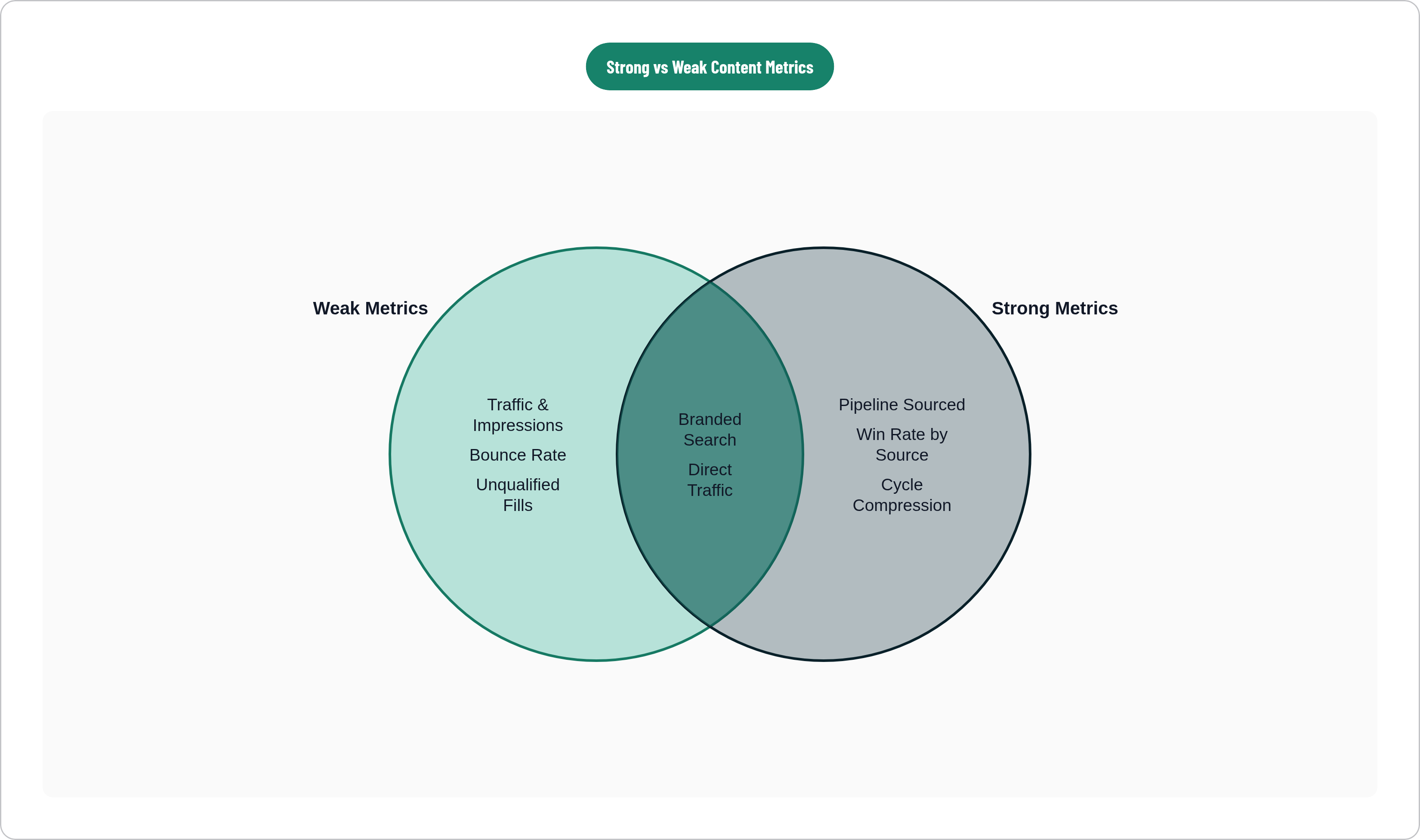
Some metrics are easy to report and tell you almost nothing. Traffic, impressions, bounce rate, unqualified form fills, you can inflate every one of these without doing anything that helps the business. The only question a CFO actually cares about is whether pipeline looks healthier this quarter than last, and those metrics leave it unanswered.
Strong metrics look different: pipeline sourced from content, pipeline influenced by content and logged against CRM touchpoints, sales cycle length for prospects who engaged with content versus those who didn't, win rate broken out by source. Branded search volume and direct traffic are imperfect proxies, but honest ones. When those numbers move, something in the market actually shifted underneath them.
Then there's the influence that lives entirely outside any lead source field. An analyst cites your report. A rep forwards a case study mid-deal because a prospect asked a technical question the deck couldn't answer. Security leaders trust a peer's recommendation over almost anything a vendor says about itself, and that kind of proof (case studies, community presence, third-party validation) carries real weight despite resisting clean attribution to a closed deal. Track it on purpose, qualitatively, and treat it as a legitimate input rather than an inconvenient gap. Get marketing and sales to agree on what counts before the programme starts, or the dashboard fills up with vanity metrics by default, because vanity metrics are always the path of least resistance.
A layered framework: connecting early signals to commercial outcomes over time
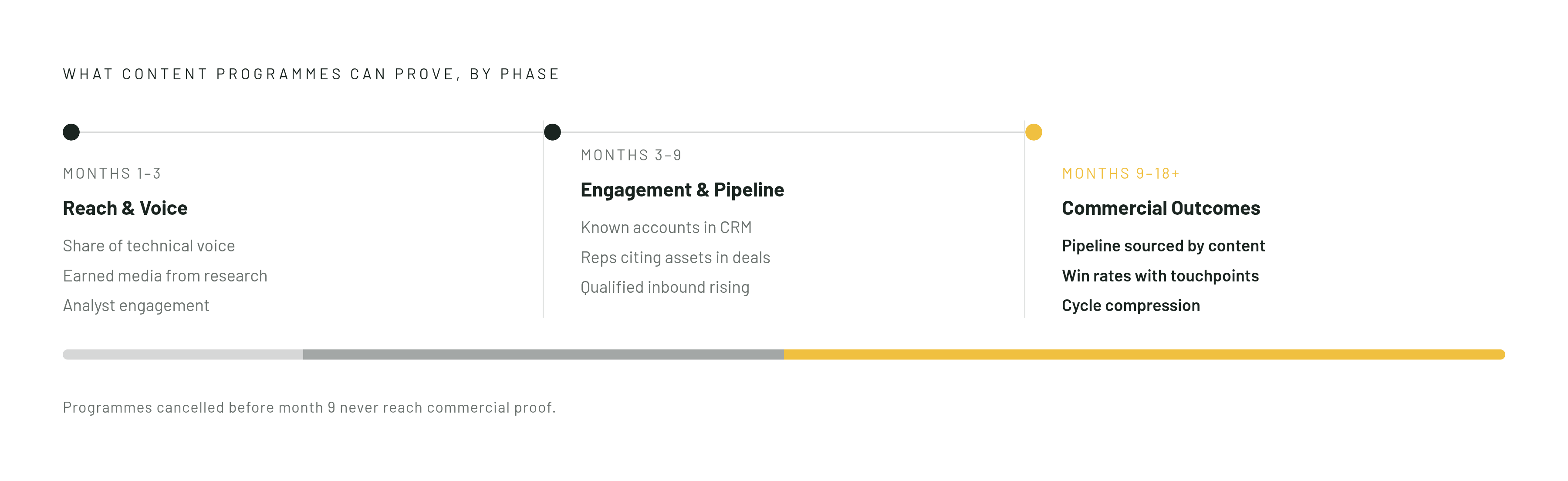
Three stages, stacked on top of each other over time, each one building on what came before.
Months one through three, it's reach and voice: share of technical voice on the topics you care about, earned media tied to original research, practitioners actually sharing your work, not a follower count quietly ticking up, analysts engaging with what you published.
Months three through nine, it's engagement and pipeline influence: known accounts consuming content inside your CRM, reps citing assets in live deals, "how did you hear about us" answers starting to roll in, a rise in qualified inbound from the specific channels your content actually lives on.
Months nine through eighteen and beyond, it's commercial: pipeline sourced or influenced by content, win rates among accounts with documented touchpoints, cycle compression against accounts with none, revenue where content shows up as a recorded influence rather than an assumption.
These stages bleed into each other constantly, and honestly, that's fine. A research report published in January can pick up an analyst citation in April and quietly help close a deal the following March, and nobody planned that timeline, it just happens. The framework buys you a defensible story at every point along the way, long before the CFO shows up demanding proof at the finish line. When clean attribution is impossible, which in this world is most of the time, correlation still counts. A research drop lines up with a jump in branded search? Write that down. It's a signal worth having even without a conversion rate to hang on it.
How content format affects what you can measure and when
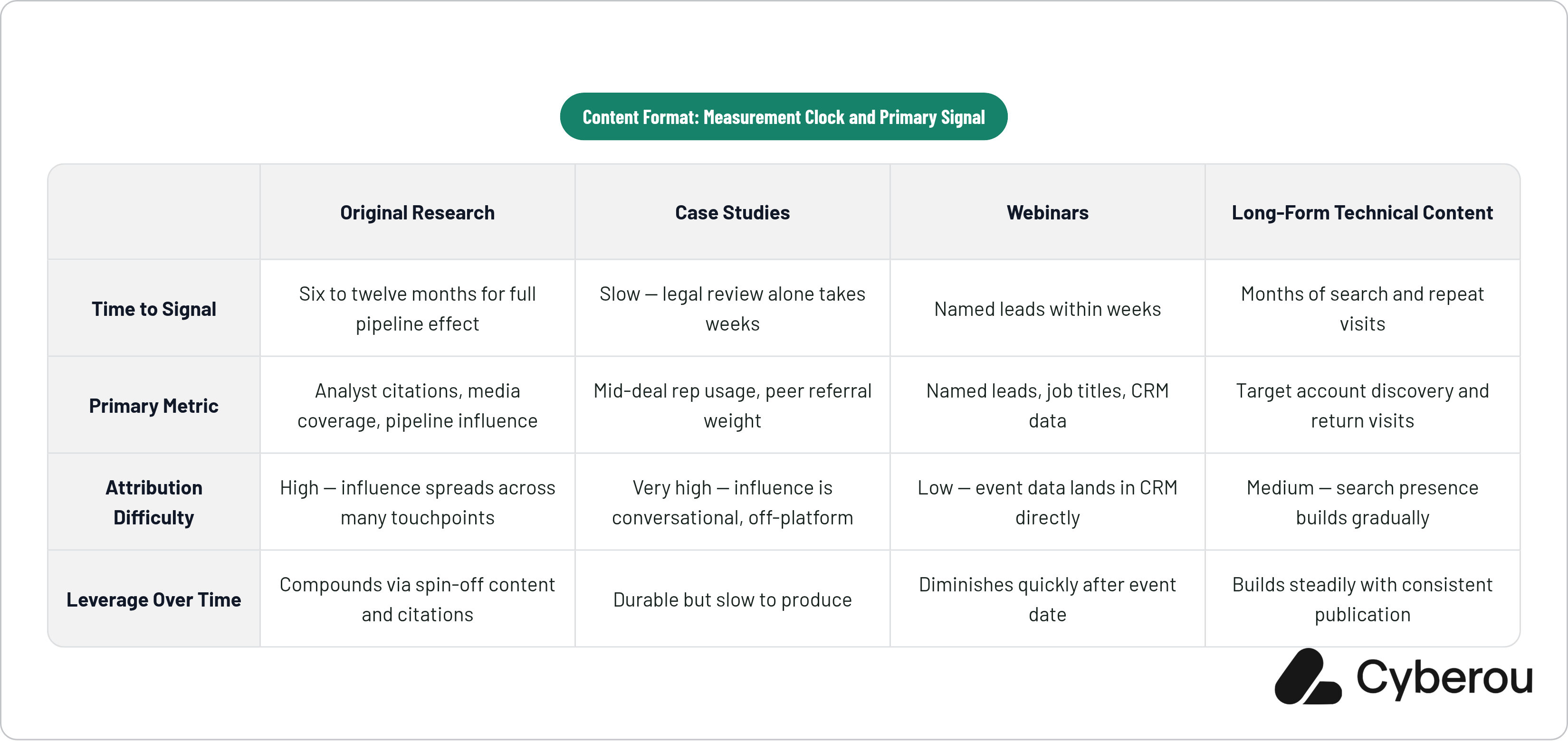
Different formats measure on different clocks. Mixing them without a plan is how a data pile turns into a data mess nobody wants to open on a Friday afternoon.
Original research is the highest-leverage format the industry has. It earns backlinks, gets cited by analysts, drives media coverage tied to the findings, and gives sales a credibility boost that keeps paying off a year later. One solid report can spin off a launch post, a blog series, a conference talk, a stack of enablement material, and each piece stretches the shelf life of the original work a little further out.
Case studies matter enormously, since peer proof beats a vendor's own claims every single time, but they're slow (customer legal review alone can burn a month) and their real influence shows up mid-conversation with a rep, well outside any traffic report. Webinars are the easiest thing to measure cleanly: named leads, job titles, and company data land in your CRM within weeks of the event. Long-form technical content, architecture breakdowns, vulnerability writeups, deep guides, builds search presence and practitioner trust slowly, and the metric that actually matters is whether the accounts you want are finding the piece and coming back to it later.
A webinar tells you something useful within a month. A research report typically takes six to twelve months to show its full pipeline effect. Know which format is doing which job before you brief the work, so you can explain the gap between them from the start rather than reconstruct it from a spreadsheet.
Attribution models worth using and the case for self-reported data
Last-touch attribution actively misleads you here. It hands full credit to the final branded search, discarding the eighteen months of content that made the buyer confident enough to type that search in the first place.
Multi-touch models, weighting first touch, lead creation, opportunity creation, and close, give a far more honest read on a sales cycle this long. Running one takes CRM discipline, but it's achievable for any mid-market vendor with a sales ops team that actually logs things instead of leaving fields blank. Then there's the simplest tool in the box, and the most underused one by a mile: a "how did you hear about us" field at the point of conversion, with real answer options like peer referral, AI tools, search, LinkedIn, direct. It sounds almost too basic to matter, but it's often the single most honest data point you'll collect all year, because the buyer is telling you directly what no pixel ever could.
Correlation analysis deserves more respect than it gets. A podcast appearance lines up with a lift in branded search or inbound quality? That's a signal, with or without a clickable path connecting the two dots. Judge these things quarterly, because a single month is mostly noise, and treating noise like signal is how good programmes get killed off early by someone who checked the dashboard on a bad week. A model that's consistent and sharpens as more touchpoints land in the CRM outperforms any search for a perfect attribution model, which remains out of reach for every vendor in every industry.
The technology layer: what the measurement stack actually needs to do
The CRM is the spine here. Without consistent, contact-level tracking of content touchpoints, the whole framework has nothing to chew on. HubSpot handles most mid-market needs fine, Salesforce tends to fit enterprise teams running messier deal structures, and either one only works if opportunities actually get logged. That last part is a people problem wearing a software costume, and more platform spend will not fix a sales team that skips fields.
Intent data tools can flag which target accounts are researching your topics before anyone raises a hand. Useful, but only if the data stays fresh and someone actually builds a workflow around acting on it; most teams buy the platform, skip the workflow, and wonder later where the ROI went. Account-based marketing infrastructure has become close to standard for a good reason: it lets you judge content performance at the account level instead of the session level, which matters a lot more when your buyer is really a committee spread across three departments arguing in a shared inbox.
A handful of more advanced teams have started tracking how often their brand gets cited when someone asks a large language model a relevant question, call it AI citation share. It's a rough proxy for authority in a channel that reports zero referral traffic, and it's early, unproven territory, but it's worth watching. A lean stack is enough. A mid-market vendor with clean CRM habits and a working self-reported field will consistently out-measure a competitor running an expensive intent platform with no process behind it.
What a realistic ROI timeline looks like for a cybersecurity content programme
Pipeline from content takes time to appear. The buying cycle guarantees a lag between someone reading your report and someone signing a contract, and every clever measurement trick still bends to that math, regardless of how badly a CFO wants otherwise.
Search visibility, practitioner engagement, and analyst mentions show up in quarter one. Mid-funnel influence, touchpoints inside live opportunities, self-reported attribution answers rolling in, becomes visible by mid-year. Commercial outcomes, sourced pipeline, win rates, cycle compression, need a twelve-to-eighteen-month window before you can judge them fairly. A programme cancelled at month six for underdelivering on revenue almost always got cancelled before its own measurement window even opened, which is a scheduling problem worth putting in writing in the brief so nobody acts surprised six months in.
Mature programmes, the ones pairing strong original research with steady distribution and a sales team that actually uses the material, compound over years rather than quarters. Pipeline keeps showing up long after the invoice gets paid, which is the entire point of doing this in the first place. A CFO conversation goes very differently when that CFO signed off on the twelve-month window at the start, versus one walking cold into a quarterly review wondering where the budget went.
How to structure the measurement conversation with a content partner
The first conversation with any content partner needs to settle three things: which metrics get tracked, who owns the data, and how often you're reviewing it. Anything looser than that is a handshake dressed up as a plan, and handshakes collapse in a budget review.
A partner who speaks fluently about pipeline influence, sales enablement value, and attribution methodology earns trust with the production work too, regardless of how polished their writing samples look. Those two skills travel together. The formats most likely to earn analyst citations, peer referrals, and real sales enablement value, original research, technically credible long-form work, pieces reviewed by actual practitioners, are exactly the ones whose pipeline influence becomes visible inside that twelve-to-eighteen-month window.
Before briefing a single piece, nail down the commercial outcome it's supposed to move, the CRM field or attribution mechanism that will record it, and the timeframe you'll judge it against. Skip that step and you're back to archaeology, guessing at value after the fact when you could have tracked it as it happened. Vendors who lock this agreement in early are the ones who can stand in front of a CFO and defend the spend with a straight face. More usefully, they're also the ones who actually know what to double down on when something works.