Agency-Led Thought Leadership Programs for Security Executives
Thought leadership keeps security buyers engaged long before they're ready to buy.

Most of your buyers aren't shopping right now, and that's the whole ballgame. At any given moment, the overwhelming majority of people who will one day buy a security product are just going about their week, not filling out RFPs. Thought leadership is how you stay on their radar until the day they suddenly are in-market and need a vendor list, fast.
The data backs this up in a way that should make security marketers sit up straight. The Edelman-LinkedIn 2024 B2B Thought Leadership Impact Report surveyed thousands of management-level professionals across seven countries and found that more than three-quarters of decision-makers said a genuinely good piece of thought leadership pushed them to research a product they hadn't previously considered. A product they had never previously considered. That's the entire value proposition in one stat.
And it's not just researchers clicking around. Nearly three-quarters of C-suite executives in that same study said thought leadership content actually influenced their decision to work with a company. That's board-level and C-level people, the ones signing off on six- and seven-figure security contracts, saying the content moved them.
Here's the part that makes this especially relevant for security specifically: buying committees have gotten bigger, with projections putting cybersecurity purchase groups above nine stakeholders by 2026. Most of those nine people read something about your category before anyone picks up the phone. LinkedIn's B2B Institute, working with Bain and NewtonX, found that a large majority of buyers said the product they eventually purchased was already known by everyone in the buying group before the process even started. That's called earning the "Day One" spot, and thought leadership is how you get there before the deal exists.
There's also a quieter group worth mentioning: the "hidden buyers" sitting in procurement, finance, and IT who never show up in your CRM but absolutely shape the decision. For security vendors, where deals often touch non-security stakeholders, this matters more than most people admit. These people are reading LinkedIn posts and industry roundups, forming opinions long before a salesperson knows they exist.
All of this is specific to security, not generic marketing territory. A security executive's credibility with a genuinely technical audience comes from the person, earned through demonstrated expertise. The brand gets to stand next to them.
Why most thought leadership programs fail to produce credible work
Here's an uncomfortable number: only 26% of B2B buyers rate brand thought leadership as high quality, according to the Dentsu 2024 B2B Superpowers Index, and that's down from 31% in 2022. Companies are publishing more than ever, and buyers are trusting it less. Something is badly out of sync.
The failure mode isn't subtle once you know what to look for. The content reads like it was written by marketing, for marketing, about marketing's idea of what a technical executive sounds like. Security buyers, in particular, run everything through a stricter filter than most audiences, because they're trained to spot when something doesn't hold up. A claim that's slightly off, a threat framing that's a year behind what practitioners actually deal with, a "best practices" list that could've been written in 2015: all of it registers instantly as noise, not signal.
Why does this keep happening? Usually because the agency skipped or rushed the part where they actually get to know the executive. Content gets built off a one-page brief instead of a real understanding of how this person argues, what they actually believe, and how they talk when nobody's editing them. Most programs treat the role as ghostwriting rather than translation, and that distinction is what separates forgettable content from credible work.
There's a second failure mode that's less obvious but just as damaging: publishing a lot, on schedule, without any editorial spine. Cadence without a point of view dilutes expertise. If an executive publishes twenty pieces that all say slightly different, slightly safe things, nobody remembers any of them.
Here's the silver lining, though: this gap between "content that exists" and "content buyers actually respect" is where the opportunity sits. If the bar is this low industry-wide, a security executive who clears it, even by a little, stands out by a lot.
What a well-structured agency programme actually looks like
Good programs start in a place most bad ones skip entirely: listening. Before a single word gets drafted, there should be recorded interviews, ideally two or three of them, aimed at surfacing how this executive actually thinks: their vocabulary, their pet arguments, the things they say in every panel because they genuinely believe them, not because they're supposed to.
That voice capture phase gets paired with a review of whatever the executive has already put into the world: recorded talks, internal decks, old interviews. The goal is finding the persona that already exists and giving it a bigger microphone.
From there, the program needs thematic pillars: three to five topics the executive can credibly own. Credibly is the operative word. The topics should sit at the intersection of their actual expertise, the company's positioning, and a gap nobody else in the market is filling well.
A good content calendar ties those pillars to things actually happening in the world: vulnerability disclosures, regulatory announcements, post-mortems on incidents everyone's already talking about, sector-specific threat trends. These give the executive a reason to publish now, rather than "because it's Tuesday."
Editorial review matters more in security than almost anywhere else. Someone with practitioner knowledge needs to check every claim before it goes out, because the technical accuracy bar here doesn't bend. A writer who can't tell a sound claim from a shaky one will publish something that gets torn apart in the comments by 9am.
Distribution should match where security buyers actually spend their attention: LinkedIn for reach, podcasts for depth, and original research for the kind of credibility that a blog post alone can't buy. CrowdStrike's Global Threat Report is the textbook example here. It was intelligence the industry genuinely needed, cited by practitioners who had zero interest in becoming customers. The brand won by earning an audience rather than chasing one.
One honest note on timing: this stuff takes months to build momentum, and pipeline attribution takes even longer. Any agency promising fast leads from thought leadership is describing a different mechanism than the one that actually works.
What the executive has to contribute for the programme to work
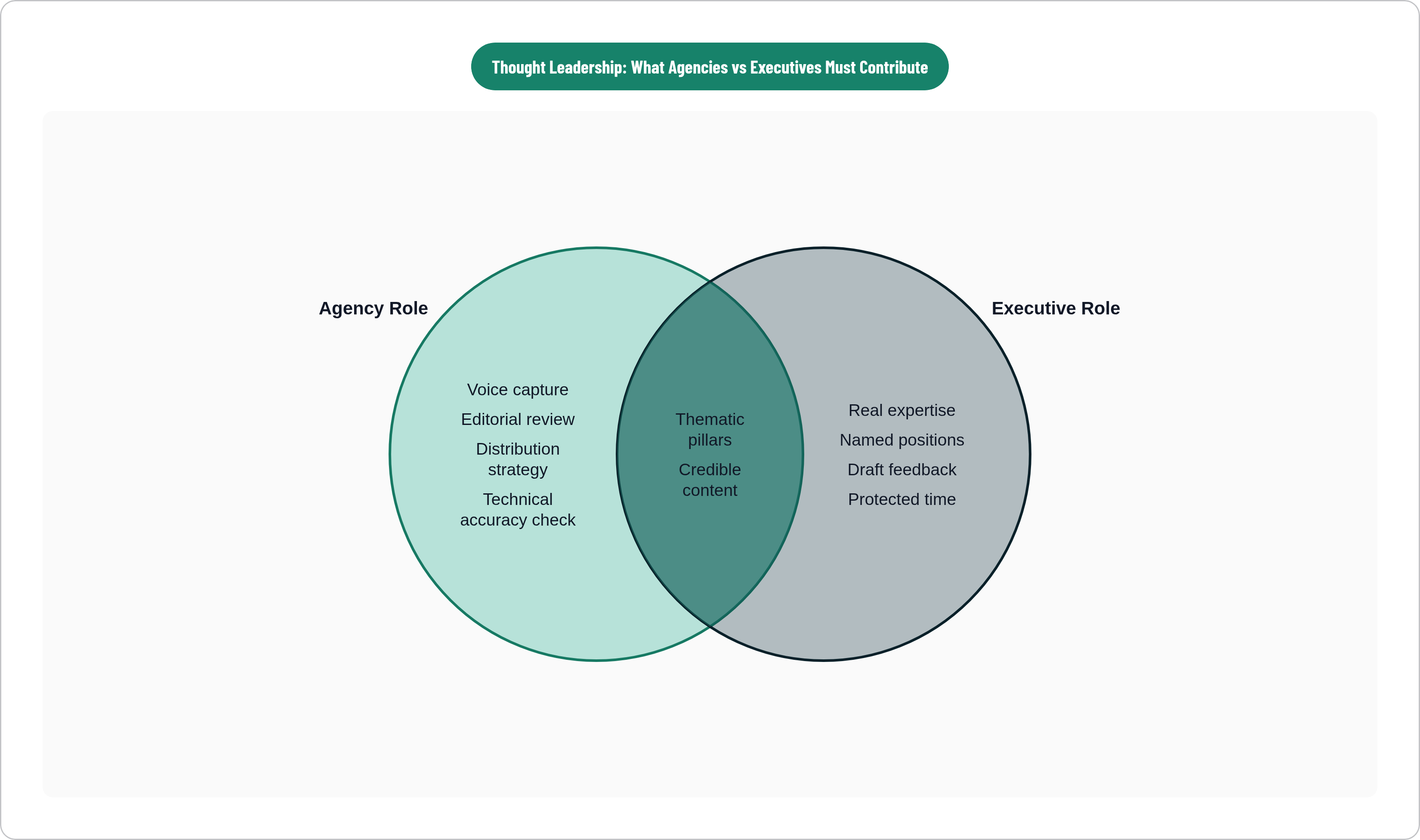
An agency can only translate expertise that is already there. Programs that try to substitute production volume for real input from the executive end up producing exactly the kind of hollow content buyers have already learned to ignore.
So what does the executive actually need to bring? At minimum: protected time for the voice capture sessions (not "whenever I have a free ten minutes"), genuine availability to review drafts and push back on anything that doesn't sound like them, and a willingness to take a real position instead of hedging into consensus mush.
That last part is the whole game, honestly. Specificity is what separates credible security thought leadership from the stuff nobody remembers. A named, specific stance on one particular problem, defended in public, builds a voice people recognize. A vague take on "AI risk" or "supply chain threats" blends into the thousand others already out there.
Executives also need to accept a bit of uncertainty. Not every piece lands, and some get five likes and a shrug. Programs that demand guaranteed outcomes before they start stall before they begin, because those guarantees are unavailable in any industry.
Practically, this means sitting down before production starts and agreeing on what "good" actually looks like: the audience, the tone, the editorial bar. Do that conversation after the first draft lands, and you're already fighting an uphill battle.
Where the executive brings real technical depth, the agency's job is to render that depth faithfully in a form regular people can follow, preserving its depth rather than reducing it to the same generic advice everyone else is publishing.
How to evaluate whether an agency can produce work that survives a technical read
Start here: ask to see published work the agency has done for other security executives, and read it like a practitioner would. Does it sound like someone who has actually done the job, or like marketing copy with a few technical words sprinkled in for seasoning?
Then ask who reviews for technical accuracy, and what their background actually is. A content team full of talented former journalists, however good their prose, will not catch the kind of error a working security practitioner catches in five seconds.
Look at how the agency's intelligence process actually works. Good content responds to live events like vulnerability disclosures and regulatory shifts rather than following a fixed calendar that produces the same topics regardless of what happened that week.
Ask how voice capture happens and how long it takes. An agency that offers to start producing content within days of signing has skipped the work required to sound like the executive.
Check for original research in their portfolio. Aggregated commentary differs fundamentally from proprietary data and original investigation; original investigation generates the media coverage tied to the client's own intellectual property. A WormGPT investigation, discovered by Daniel Kelley while researching for SlashNext and later picked up by The Wall Street Journal, is a good example of what a rigorous process produces when practitioner judgement drives what gets published, replacing the automated topic generator approach of producing headlines to fill a calendar.
Watch for red flags: an agency leading with projected follower counts, guaranteeing media placements, or handing you a content calendar before voice capture is finished. These are all signs the process runs in the wrong order.
The real question is which agency's process is most likely to produce something the executive would actually defend in a room full of security practitioners who have read one too many bad LinkedIn posts this week.
The financial case for investing in a structured programme
The numbers favor content over paid media by a wide margin. Per HubSpot's 2026 benchmarks, B2B content marketing produces leads at roughly $47 each, compared to $121 for paid advertising. That is a category difference in efficiency.
Mature marketing organizations already treat content this way. Gartner's 2025 data puts content and thought leadership at 20% to 30% of total B2B marketing budgets, which tells you this has become core infrastructure.
There's a widely cited figure putting thought leadership ROI at 156%, against 9% for conventional marketing, attributed to IBM's Institute for Business Value. It gets repeated often enough that it's worth verifying against the primary IBM source directly before you cite it yourself; the number is out there, but chase it to the origin.
Here's the stat that matters most for security vendors specifically: roughly 60% of decision-makers, per the same Edelman-LinkedIn 2024 study, said strong thought leadership makes them more willing to pay a premium to a given supplier. Security is a trust business first, and that number is the whole argument in one line.
Be honest about timing, though, because the honesty is what makes the pitch credible in the first place. Pipeline influence from thought leadership is real, but it's lagged. Programs that show results at six to twelve months need sustained investment to get there, which means picking the right agency matters more than picking the cheapest one.
For security vendors somewhere between a handful and several hundred employees, the build-versus-buy question is worth asking plainly. Building practitioner review, editorial rigour, and an intelligence process in-house is expensive, slow, and hard to reach the standard where a technical audience believes what you're publishing. For most companies that size, buying that capability gets you there faster, with fewer scars along the way.