Gated vs Ungated Content in Cybersecurity Demand Generation
Ungated content builds trust faster with skeptical security buyers who bounce forms.
Gating decisions in cybersecurity marketing deserve treatment as a trust problem, and cybersecurity has the lowest trust baseline in B2B. Get the gate wrong in this category and you confirm every suspicion the buyer already had about vendors.
Here's why that baseline matters so much. Security buyers can't test-drive a product before they need it to work, and buyers discover whether their EDR tool stops a breach only when a breach happens. So the whole purchase runs on trust signals instead of product trial, and only a small slice of organizations report full trust in their vendors, low even by B2B's already skeptical standards. Add in that the buyers are engineers and practitioners trained to smell a sales pitch from three tabs away, and you've got a room full of people who will bounce off a form faster than they'll bounce off a bad Wi-Fi connection. And that room has been getting bigger, with buying committees that have grown meaningfully over the past several years and are still climbing, which means more people have to like you before anyone signs anything. That's the lens for every gate/no-gate call in this piece: did this decision build or burn trust with a skeptical crowd that keeps inviting more skeptics to the meeting.
What the friction data actually shows about buyer tolerance for gates
Recent B2B buyer research found most buyers say flat out they'd rather get educational content without filling in a form, a preference stated with no exceptions offered.
A meaningful chunk of buyers have walked away from content entirely because of the form in front of it, and a meaningful minority just lie on the form instead — fake email, fake company, fake job title, whatever gets them through. Buyer research backs this up from two directions: roughly half of buyers say vendor content is too generic, and roughly half say there are too many steps to get to it. Different complaints, same root cause: content that falls short of the effort required to reach it.
Willingness to fill out forms began declining noticeably around 2020 and has not recovered since. Meanwhile, cold-traffic conversion on gated assets sits in the low single digits now, which is a problem when that same conversion rate is the thing marketing teams point to as proof the gate "works." A form fill tells you someone typed an email address, while leaving budget, timeline, and purchase authority unknown. The result is a spreadsheet that looks like pipeline and behaves like a phone book.
The part nobody measures is the cost that never shows up in a dashboard: everyone who hit the form and just left. That's a ghost in the data.
How ungated content travels through channels vendors cannot see
Most B2B content sharing happens in DMs, in executive Slack channels, in forwarded emails with "thought you'd find this useful" typed above the link. Research finds that standard attribution tools miss most of the modern B2B buying journey entirely.
Picture this: a CFO forwards a whitepaper into a private Slack channel with three other execs in it, and all three click through to your site over the next week. Every single one of those visits registers in your analytics as "direct traffic," as if they had typed your URL in from memory for fun. The asset that actually started the whole conversation earns zero attribution credit, despite doing the work.
This matters more than it sounds like it should, because 6sense's 2025 Buyer Experience Report found the vendor that eventually wins the deal is usually already the buyer's favorite before a salesperson enters the picture. The shortlist gets built quietly, anonymously, before a salesperson is in the picture. If your best thinking is sitting behind a form, it stays out of that Slack channel entirely, because readers require proof of quality before surrendering a work email. The sharing chain needs a spark, and a gate extinguishes it at the source.
Why AI search has made gating more expensive than it was two years ago
Two years ago, gating cost you leads you'd never see convert. Today it costs you something bigger: you disappear from where buyers are actually starting their research.
6sense's 2025 report found most B2B buyers now use large language models, ChatGPT, Perplexity, Google's AI Overviews, to do early research before they ever talk to a vendor. These tools pull from the open web, and they can't cite a page that's hiding behind a form, because they can't crawl it in the first place. Research into AI search behavior found gated content shows up substantially less often in AI-generated answers than open content covering the same ground. So the report your team spent three months building, if it's gated, is functionally invisible to the exact layer of the internet a growing share of your buyers now trust first.
Recent generative search analysis found AI Overviews now show up on a large share of B2B informational searches. That makes "can this be indexed" a front-line discoverability question, urgent enough to sit outside the content team's later backlog. And there's a compounding effect nobody talks about enough: open content earns backlinks, ranks in search, and gets pulled into AI answers, three channels running at once, feeding each other. Gated content misses all three channels, sitting technically published but sealed off from distribution.
What the best-known cybersecurity content has in common — and why none of it is gated
Security practitioners asked to name vendor content they genuinely respect cite the same handful of names repeatedly, none of which ask for an email address first.
The Verizon DBIR shapes procurement conversations across the industry every year. It's free, fully indexed, and forwarded constantly, because it hands practitioners raw, peer-verified attack data they can't responsibly ignore. The MITRE ATT&CK Framework rewired how the whole field talks about adversary behavior through sheer usefulness, with full open access from the start. The CrowdStrike Falcon Report changed board-level budget conversations by putting a number on adversary breakout time, backed by real telemetry and open to all.
What do these three have in common besides being free? Proprietary data, real practitioner utility, and full, direct access to the insight. Open access is what makes the forward button work. A 2025 CISO engagement study measured this directly inside one financial services organisation: non-sponsored editorial content earned 13 times the engagement of sponsored content. Topic selection compounds the effect: 2025 data found AI and machine learning topics led every other cybersecurity subject in engagement by more than 20 percentage points between Q4 2024 and Q1 2025, with 56% of users interacting with that content. Open, useful, and focused on what practitioners care about right now, that combination is the whole playbook.
Where gates still earn their place — and how to tell the difference
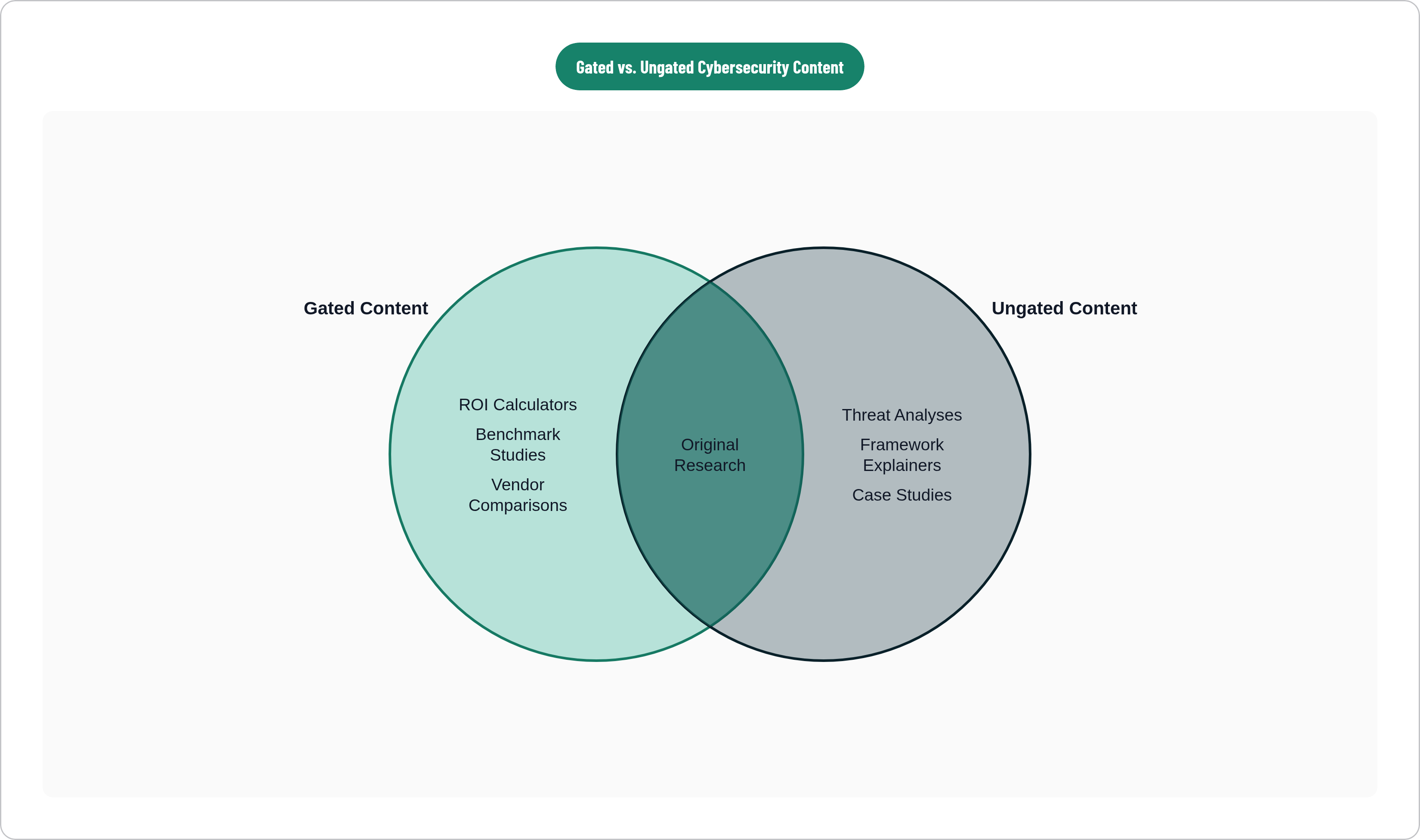
Gating everything and gating nothing are equal overcorrections, and both fail for the same reason: the decision has to start with the content itself.
Gates make sense when the content itself signals that the reader already knows what they're comparing and expects to trade contact details for real value in return. Original research, benchmark studies, detailed technical playbooks, ROI calculators tied to an actual demo, these are legitimate gate candidates. Gartner's research backs this up: buyers who go looking for deep, detailed vendor content are often already comparison shopping, and catching them mid-comparison has real commercial logic behind it.
One wrinkle worth knowing: Recent research into gated content behavior found the gap between when someone registers for an asset and when they actually read it has grown substantially. Sales teams calling five minutes after a form fill reach someone who has yet to open the PDF. Top-performing gated assets can still outperform cold-traffic averages, but only when the perceived value clears the friction bar by a wide margin too. That is the whole test: if the core insight behind the gate is something a reader could find via a quick search, the gate adds friction alone and the reader moves on. One high-return adjustment that recovers conversion without removing the gate entirely: trimming the field count recovers a meaningful share of drop-off.
A funnel-stage map for deciding what to gate in cybersecurity demand generation
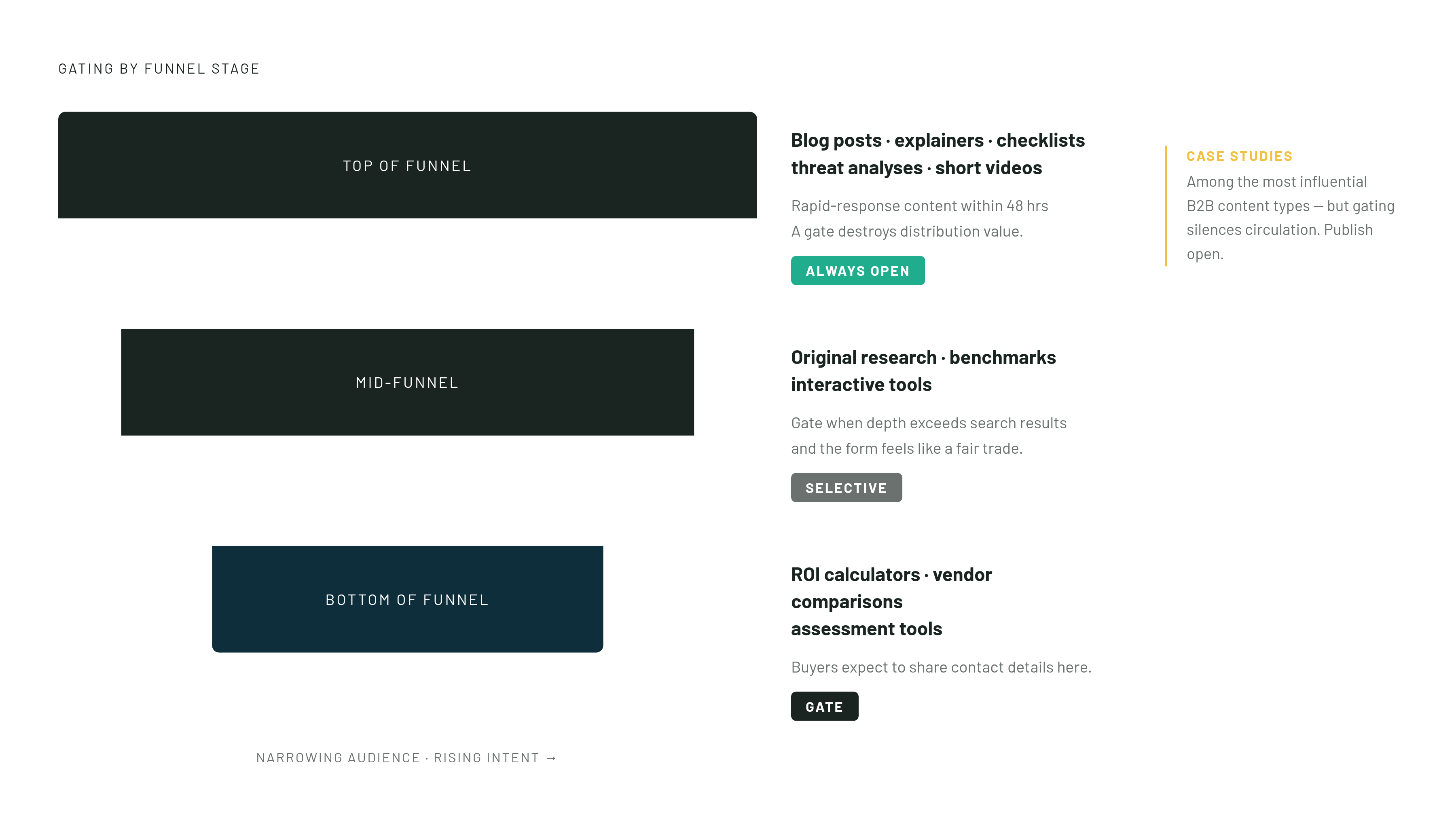
Top-of-funnel content should default to open, across the board. Blog posts, framework explainers, checklists, threat analyses, short videos, all of it. This is the stuff that earns backlinks, gets shared in dark social, and feeds the AI citation engine discussed above. Rapid-response content belongs here, always: publishing an analysis of a hospital ransomware attack within 48 hours of it breaking, then gating it, eliminates the one thing giving it distribution power, timeliness. Timeliness is the whole value, and a form destroys it.
Mid-funnel is where gating starts making sense, but selectively. Original research, benchmark studies, interactive tools where the depth genuinely goes past what a search engine returns. These are assets where a form feels like a fair trade rather than a tollbooth.
Bottom of funnel is where gates should show up with real intent. ROI calculators, vendor comparison guides, assessment tools, the stuff where a sales conversation is the obvious next step and the buyer expects that. Buyers expect to provide contact details at that stage.
Case studies get their own category, and they deserve special handling. Buyer research has consistently ranked customer case studies among the most influential content types cited in B2B tech purchases. That influence depends on circulation, so gating a case study silences your best salesperson. Webinar recordings sit in a gray zone: live sessions justify a registration form, sure, but a recording kept gated six months later becomes dead weight. Time-limit it, then open it.
Progressive and hybrid gating as a middle path — what works and what it costs
A growing share of B2B marketers plan to lean on hybrid gating approaches, and the logic makes sense once you've read this far. Open summary, gated depth, full read for a portion of the piece, then a form, delayed access instead of a hard wall up front.
Research on gating mechanics finds that delayed gating, letting a reader consume a portion of the content before the form appears, converts better than a hard gate on the same asset. Makes sense: the reader's already invested a few minutes, already trusts the writing a little, and the form feels like an unlock rather than a toll. The open-summary model solves the credibility problem directly too, because the buyer can judge quality before handing over real information, which reduces fake-email submissions.
None of this is free, though, since hybrid setups mean more content variants to build, more logic to wire into the CMS, more edge cases where attribution gets murky. And there's a trap hiding inside the whole approach: teams focus so heavily on optimizing the mechanism, the reveal timing, the field count, the delay window, that the content underneath still has to earn the exchange. A clever gate wrapped around thin content fails, because format is the easy part and substance is the actual job.
How cybersecurity vendors should audit their current content mix against this framework
Start with an honest inventory. Pull every gated asset you've got, list its conversion rate, its organic traffic, and whether it shows up anywhere in AI-generated answers. Most teams that do this exercise are unpleasantly surprised, because the pattern usually jumps out fast.
Each asset should be evaluated against one question: does it carry proprietary data or an actionable tool unavailable elsewhere on the open internet? If yes, it can remain gated. If no, it is a candidate to open. Then look at what's missing entirely from the open layer, because most cybersecurity vendors have this backwards: too much gated content chasing form fills, not enough free, practitioner-grade content earning the peer trust that actually moves deals. Research into security buying behavior consistently finds that most security leaders trust peer recommendations and analyst insight above vendor-produced content, which tells you exactly where the underinvestment is happening.
OT security is worth flagging specifically. Editorial coverage of OT security grew sharply in 2024, while sponsored vendor content in that same space dropped hard in the second half of the year. That's open ground right now, low competition, high practitioner interest, and a largely empty field. A vendor willing to publish real, open, authoritative OT content today is walking into a mostly empty room.
The harder truth underneath all of this: what matters is whether the content clears the bar a skeptical practitioner sets before they hit forward instead of back, and the gating decision follows from that. That is fundamentally a research and editorial problem, one that requires practitioner triage paired with specialist authorship to produce work that holds up under the scrutiny this audience applies by default. If you want a place to start this week: pick three or four gated assets you'd bet would earn peer sharing if the wall came down, take the wall down, publish one piece of original research with no form anywhere near it, and check back in 90 days on backlinks, AI citations, and direct traffic. The number will tell you more than any dashboard has told you so far.