Ghostwriting Executive Thought Leadership for Security Vendors
Security buyers trust peers over vendors, so your ghostwriter needs to sound like one.

Ghostwriting for security vendors only works when the writer can survive a technical read. That's the whole thesis. Everything else in this piece is just proof.
What security buyers actually read and why they distrust most vendor content
Security buyers aren't your average SaaS crowd, browsing G2 reviews between meetings. They're practitioners. They've configured the firewall, they've read the CVE, they've sat through the 3am incident call. When they read vendor content, they're checking your work.
Webinars and editorial articles beat other formats for engagement with senior security decision-makers, according to Cyentia's 2025 study on CISO engagement. Those two formats have something in common: they force you to take a real position and defend it. A slick graphic won't survive a 40-minute webinar Q&A.
Topic currency matters too, and it moves fast. AI and machine learning content pulled in 56% of user interaction between Q4 2024 and Q1 2025, more than 20 percentage points ahead of every other topic. Write about last year's threat landscape and you'll sound like you're still worried about Y2K.
Here's the part that should worry every marketing team: non-sponsored editorial content dramatically outperformed sponsored content with CISO audiences. The instant something smells like an ad, the reader's gone. Per Gartner's 2024 data, most security decision-makers trust peer recommendations and analyst insights over anything vendor-produced. So the content has to read like it came from a peer, with the pitch deck and promotional byline fully absent.
The result is brutal and silent. A buyer spots the telltale signs, vague claims, zero operational detail, a framework borrowed wholesale from somebody's conference slide, and they close the tab. There's no comment, no feedback form, no second chance.
What executive ghostwriting is and how the process actually works
Ghostwriting, stripped of any mystique, is simple: a writer pulls the executive's real opinions out of their head, shapes them into something publishable, and it goes out under the executive's name. The executive owns every idea, and they approve every word before it's live.
This solves a time problem. Most security executives I've worked with have sharp, defensible opinions rattling around; they just don't have four uninterrupted hours to turn them into 900 words of clean prose. That's fair. Nobody became a CISO because they wanted to become a content marketer on the side.
The real foundation is voice capture. That means recorded interviews, digging into the executive's actual positions, their vocabulary, the arguments they keep circling back to. It also means reading their old talks, old posts, old emails, hunting for phrases that sound like them and not like a LinkedIn caption generator.
Done right, one good interview session produces more than one asset. A byline, a few LinkedIn posts, a newsletter feature, maybe a quote that ends up in a sales deck six months later. That's the payoff for doing the extraction work properly the first time.
Content should also map to where the buyer actually sits in their decision. Early on, you want contrarian essays and frameworks, something that makes a CISO stop scrolling. In the middle, vendor-neutral playbooks. Near the decision point, case studies with real outcome numbers. None of this works as a series of disconnected one-offs; the strongest programs run a long editorial arc where each piece builds on the last, until the executive quietly owns a specific idea space.
The most common way this falls apart is the review cycle, where someone on the internal team "cleans up" the executive's phrasing into safe, generic corporate language. That moment kills the voice, and the credibility that made the whole thing worth doing goes with it.
Why technical knowledge is not optional for the ghostwriter
The extraction interview is where this entire exercise either earns its keep or falls flat. A generalist writer, no matter how talented, cannot push a security executive past their rehearsed talking points. They don't know what question to ask next, and they don't know a borrowed framework when they hear one recited back at them.
That's the real risk: a writer who can't tell when a claim is imprecise, or when a stated position quietly contradicts what the company's own product actually does. A technically literate reader catches that instantly, the same way you'd catch a typo in your own name.
Translation is its own separate skill, and people underrate how hard it is. You have to take a genuinely technical position and render it correctly for a senior buyer who isn't technical, without dumbing it down into nonsense. Get the translation wrong and you fail both readers at once, the practitioner rolls their eyes, and the executive buyer never understands the point to begin with.
Vocabulary is the whole game in this field. Mix up threat and vulnerability, or detection and response, or zero-day and simply unpatched, and you've told every practitioner reading that neither you nor your executive actually live in this world.
The content has to survive a technical read: a CISO on a buying committee, a journalist chasing a story, a peer who's known the executive for a decade and will absolutely notice if the "expertise" sounds off. Generic ghostwriters fail that gauntlet.
Staying current is equally essential. A ghostwriter who isn't tracking the threat landscape, the regulatory shifts, what competitors just published last week, can't tell an executive what's actually worth saying right now. Knowing what to write about is half the job. Maybe more than half.
LinkedIn as the primary venue and why the bar is higher than it appears
LinkedIn is where this audience lives. CISOs, CTOs, IT managers, they're on there checking out an executive's posting history before they ever take the sales call. It's the dominant signal channel in this sector, full stop.
Cybersecurity content pulls meaningfully more engagement on LinkedIn than elsewhere. That concentration cuts both ways, though: more eyeballs also means more scrutiny, and practitioners follow other practitioners closely. Post something that reads like marketing, or fumble a technical claim, and you'll either get corrected in the comments by someone who actually does this for a living, or you'll get ignored entirely. Neither builds the authority you were going for.
A steady posting cadence, mixing up format across the week, helps build audience expectation and gets you more algorithmic love. Consistency without substance, though, just means you're reliably mediocre on a schedule, which is its own kind of achievement, I suppose, just not the one anyone's aiming for.
There's a newer wrinkle too. A growing share of B2B buyers now start their research with an AI tool instead of a search bar. Content that's substantive enough to get cited in an AI-generated summary extends its reach well past the people who follow the executive directly. That's a new form of distribution, but it only rewards work that was already good enough to earn it.
The AI tool question and what it does and does not change
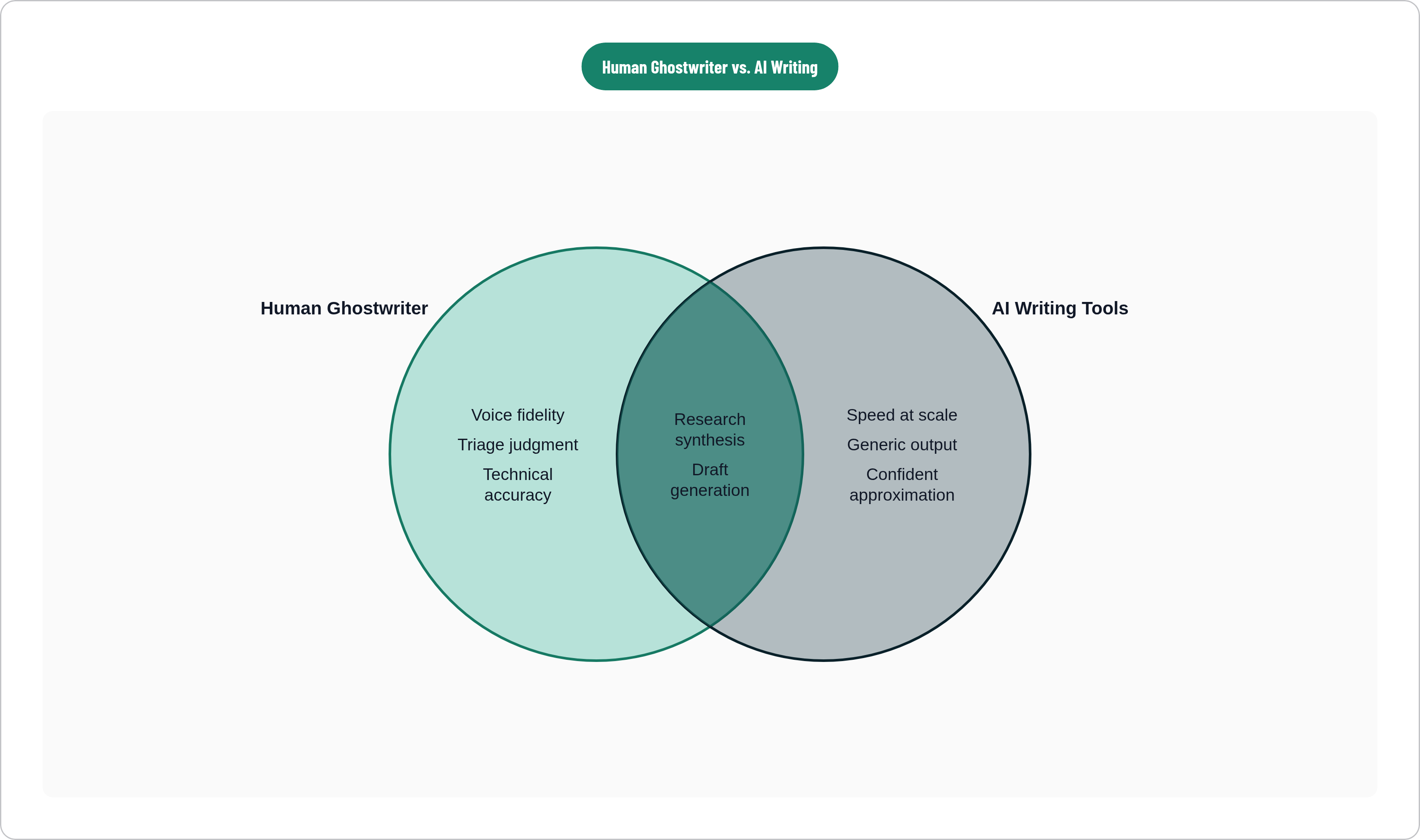
Everyone assumed AI would flatten ghostwriting into a commodity. The opposite happened. The Association of Ghostwriters' 2025 report found the industry actually ended the year on an upswing, largely because clients ran into AI's limits firsthand and came looking for the human version again.
The real bottleneck is voice fidelity, and knowing what's actually worth saying. Years of sitting across from executives and learning how they actually think remain irreplaceable.
Most ghostwriters lean on AI for support work, research synthesis, speeding up a rough draft, that sort of thing. A much smaller group use it to generate the finished client content outright. That distinction is the difference between using a calculator and having someone else take your exam.
Using AI to produce the actual deliverable without telling the client is, by most standards in the profession, a straightforward failure to deliver what was promised. The client paid for judgment and craft, not a chatbot wearing a trench coat.
Security content makes this failure mode worse. AI models produce confident, generic, technically approximate writing that sails through a casual skim and collapses the second a practitioner leans in, and practitioners always lean in. That's their whole job.
The piece AI still misses is triage: deciding what the executive should actually say, what's genuinely original versus recycled, what will land with this specific reader on this specific day. That's judgment, earned from doing the work rather than from training data.
What a credible security ghostwriting engagement looks like in practice
Good onboarding doesn't stop at "what does the executive believe." It digs for evidence: the actual incidents they've investigated, the patterns they've noticed across a dozen client environments, the frameworks they built themselves rather than lifted from a Gartner slide deck.
Early on, you want to nail down two or three themes the executive can credibly own, built from real expertise, the company's actual positioning, and gaps nobody else in the market is talking about yet. Then you hold those themes steady across everything you publish for them.
Quality control means someone reads the final draft the way a practitioner would: checking the technical accuracy, flagging any claim that's a little too neat, making sure the position survives a follow-up question before it ever goes live under the executive's name.
The best editorial relationships surface ideas as well as execute briefs. A ghostwriter who's actually embedded in the threat landscape will tell you when a topic is suddenly hot, when a competitor just published on the exact same ground last Tuesday, or when a claim simply won't hold up.
That can look like practitioner-triaged research paired with specialist authors, everything checked for technical credibility before publication, the same intelligence process behind work that has landed more than 300 tier-one media features, including original research that stayed core brand IP straight through a major acquisition. The standard doesn't move: accurate, specific, defensible, and unmistakably written by someone who actually knows this world.
The ethics of ghostwriting and why transparency with the audience is not the issue
Ghostwriting is standard practice across B2B communications, political speeches, and publishing generally. It's standard across B2B communications, political speeches, and publishing generally. Nearly every CEO byline you've read in a major outlet had writing support behind it somewhere.
The ethical line is clear: the published opinions have to genuinely belong to the named executive, and that executive reviews and signs off on every claim before it goes out. They stay accountable for the ideas, full stop.
Disclosing the ghostwriting arrangement to the general reader sits outside the norm and outside the requirements for ethical practice. The content must accurately reflect what the executive actually believes and would say themselves, under their own name, to your face.
The real danger lies in ghostwriting that puts words in someone's mouth they can't defend later. That's a process failure, a broken review step specific to how the engagement was run.
For security vendors specifically, the approval step doubles as risk management. A claim the executive can't back up when a journalist, a peer, or a buying committee pushes back doesn't just embarrass them, it torches the exact authority the content was built to create.
The discipline holds up when the writer knows the domain well enough to get it right, and the executive stays close enough to the content to genuinely own it. That alignment alone separates real executive thought leadership from words wearing someone else's name.