Cybersecurity Marketing Agencies Specializing in Enterprise Sales
Specialist agencies navigate multi-stakeholder buying committees and year-long sales cycles.

If you sell enterprise cybersecurity software, you already know the sales cycle is brutal. Seven to fourteen months, a buying committee that keeps growing, and a procurement process that treats your company like a suspect before it treats you like a vendor. Most marketing agencies are built for shorter cycles, simpler audiences, and markets where a well-timed campaign can move the needle inside a quarter. Enterprise cybersecurity is a different sport entirely, and the agency you pick either knows that or costs you time you do not have. Choosing the wrong agency is like bringing a knife to a gunfight — technically a weapon, but not the one the situation calls for.
How the Buying Committee Shapes What Marketing Actually Needs to Do
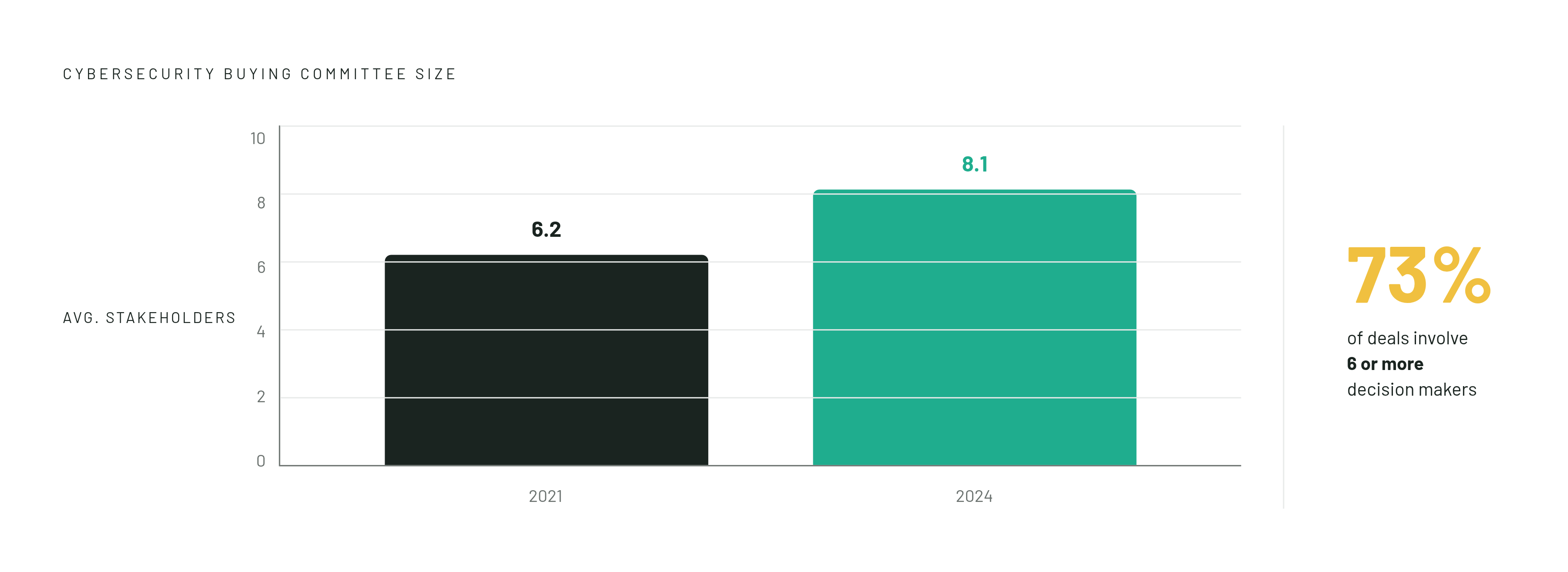
Here is the number that should reset your expectations: 73% of cybersecurity deals involve six or more decision makers. And the average buying committee has grown from 6.2 stakeholders in 2021 to 8.1 in 2024. In enterprise specifically, you are dealing with the CTO, the CFO, legal, compliance, procurement, a board risk committee, and sometimes an external auditor who has opinions about your SOC 2, alongside the security leader and an IT director.
Every one of those people has a different job. So every one of them needs a different message.
- The security leader wants technical proof. Show them architecture diagrams, threat coverage, and detection methodology.
- The CFO wants total cost of ownership. They want to know what this costs over three years compared to the alternative.
- Legal wants to know what regulations you cover and what exposure they are accepting if they choose you.
- The board wants to hear "risk reduction" in language they can repeat to a regulator.
Marketing's job is to arm every node in that committee, with the right material, at the right moment, across a cycle that spans most of a year. Think of it as setting a dinner table for eight guests, each with a different diet — one menu satisfies no one.
With more than 3,500 vendors competing for the same buyers, campaigns built around specific personas drive meaningfully higher engagement than generic messaging. That is exactly what happens when you stop treating an eight-person committee like a single buyer.
The Narrow Window When Enterprise Buyers Are Actually Reachable
This is where a lot of marketing spend quietly disappears. Per Gartner, only 5% to 15% of B2B prospects are in an active buying cycle at any given moment. In cybersecurity, that window opens on triggers.
The big ones:
- A breach makes the news in their industry
- An audit fails or surfaces a gap they cannot ignore
- A new regulatory mandate lands and suddenly they are out of compliance
- A new security leader joins and starts evaluating the existing stack (new leaders typically do this within the first 90 days, and it leads to vendor changes within the first year)
Cold email response rates in this market sit below 1%. Conversion to actual deals is around 0.2%. Security leaders report receiving roughly 60 cold outreach attempts per week. Volume-based outreach is noise that trains buyers to ignore you.
The smarter approach is sustained presence. You want to be the name that comes to mind when the trigger fires, rather than relying on a cold email landing on the right Tuesday. That takes months of consistent, credible content, not a campaign sprint.
What the Modern Enterprise Security Buyer Actually Responds To
The senior security leader has deep technical backgrounds, board-level accountability, and years of being pitched by vendors making claims they can immediately see through. They are professionally skeptical. It is practically a job requirement.
What moves them:
- Technical proof: architecture documentation, test results, independent validation.
- Peer recommendations. A reference from someone they trust inside the industry carries more weight than any campaign you run.
- Analyst recognition. Gartner Magic Quadrant placement, Forrester Wave positioning. These are third-party credibility signals that enterprise buyers are explicitly trained to look for.
- Business-risk framing. Fear, uncertainty, and doubt (FUD) messaging stopped working on this audience a while ago. They want content that connects your solution to their specific risk posture.
The thing that trips up most generalist agencies: content that sounds plausible in a marketing review still has to survive a technical read from a security practitioner. In enterprise deals, both reviews happen. The gap between those two standards is exactly where credibility gets lost.
What a Specialist Cybersecurity Marketing Agency Can Do That a Generalist Cannot
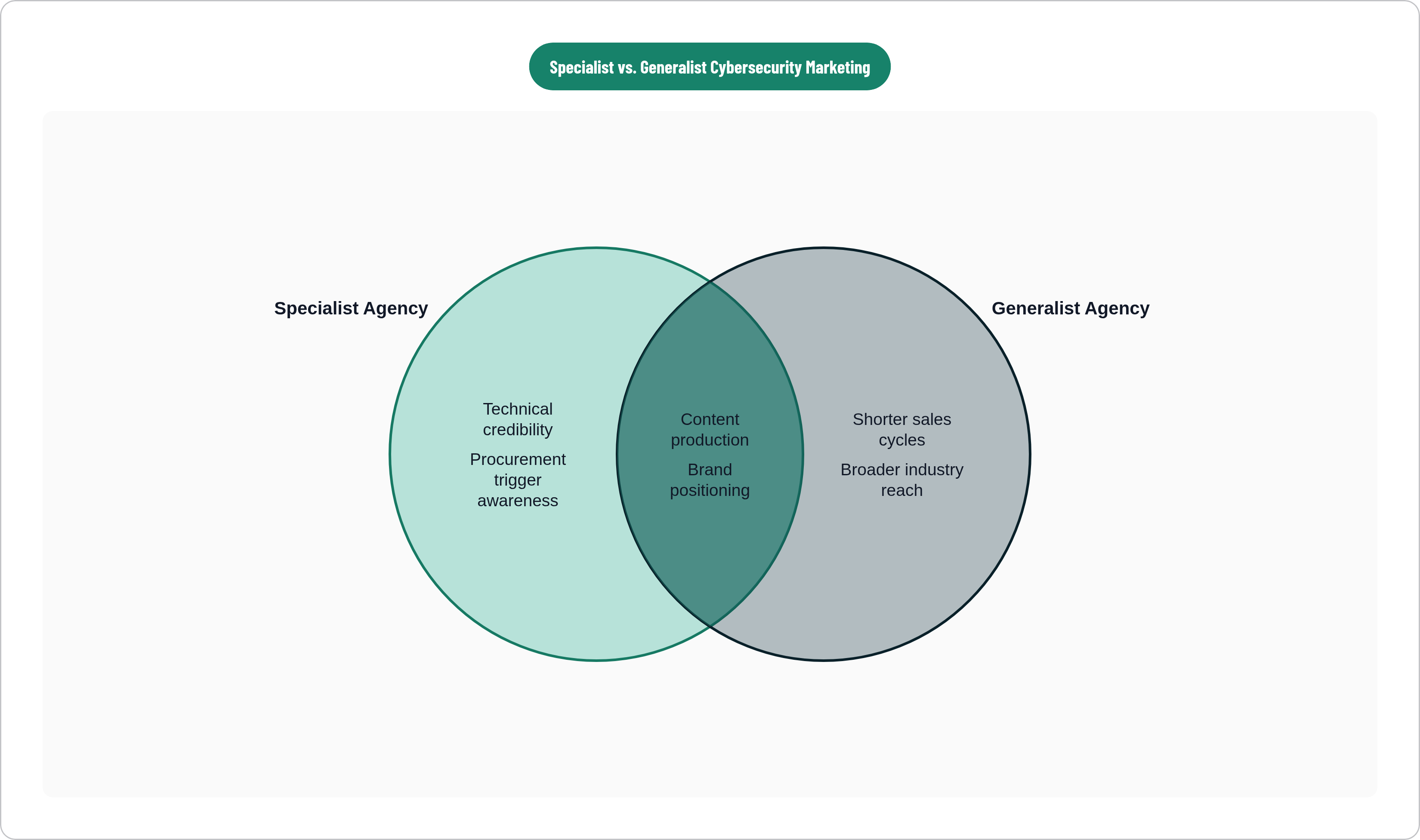
A generalist agency is competent at their own job, which is simply a different one.
When you bring a cybersecurity brief to a generalist, somebody has to translate it. The client explains zero trust, the agency tries to approximate it, the client edits it back toward accuracy, and you lose two weeks getting to something that is still probably not technical enough for the buyers you are trying to reach. Multiply that across a content program running for a year and you have a meaningful drag on output quality.
A specialist agency already knows what zero trust means. They know the difference between EDR and SIEM. They know why SASE matters to a distributed enterprise. They know which publications your buyers actually read, which conferences are worth being at, and how analyst relations actually affect procurement decisions.
More practically:
- They build multi-stakeholder content programs across the full buying committee
- They structure content calendars around procurement triggers rather than internal quarterly goals
- They understand that a white paper written for a CISO is a different document than a business case written for a CFO, even if both are about the same product
87% of cybersecurity companies planned to increase marketing budgets in 2025, according to a Gartner CMO survey. The competitive pressure is real and growing. With more than 3,500 vendors in the market, differentiation is a survival requirement.
The Agencies Operating in This Space and What Differentiates Them
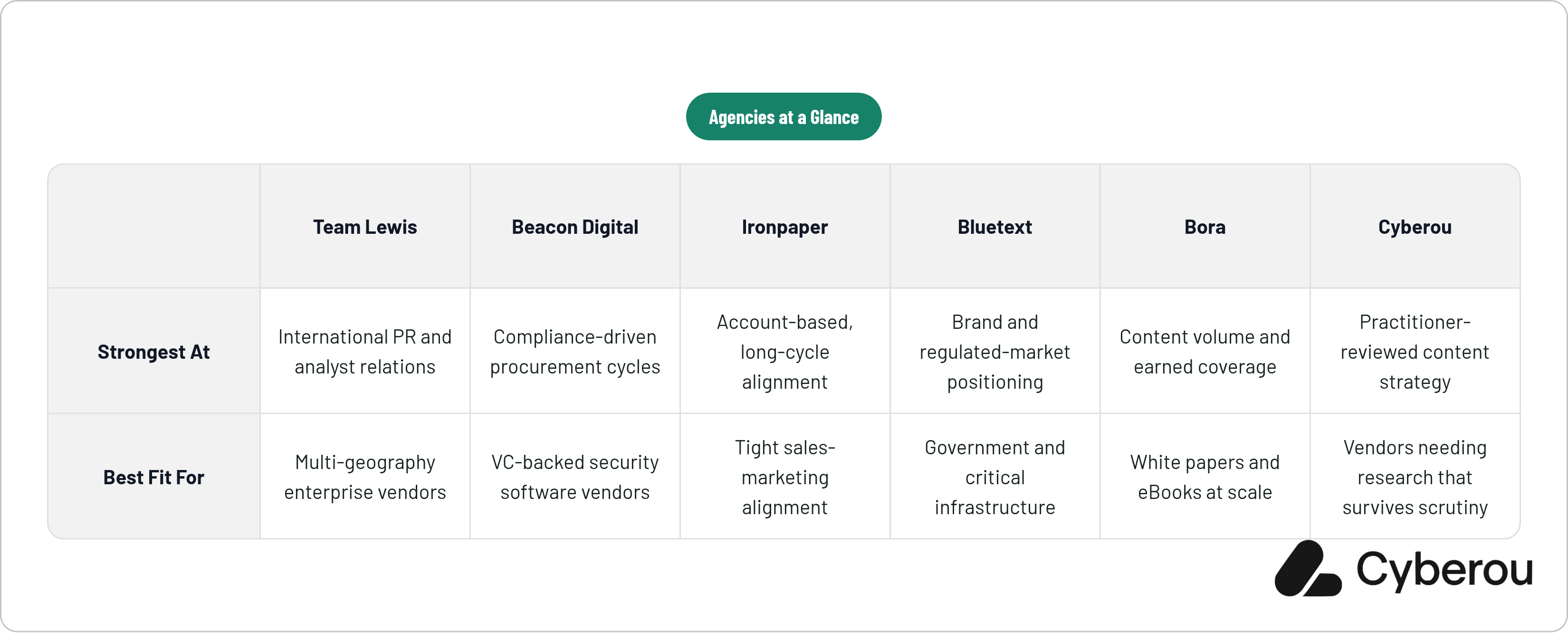
There is a real range here. Some shops are built for global enterprise PR. Others are pure content plays. Some are oriented toward early-stage companies trying to get their first foothold.
Team Lewis is the one to know if you need international reach and analyst relations at scale. Their client roster includes CrowdStrike and BlackBerry, and they won the Cybersecurity Excellence Award for Best Cybersecurity Marketing Agency in both 2025 and 2026. If you are a vendor that needs coordinated coverage across multiple geographies with established enterprise credibility, they are operating at that level.
Beacon Digital (now Yes& Beacon, following a February 2025 acquisition) works almost exclusively with security software vendors and VC-backed cybersecurity companies. Their playbooks are built specifically around compliance-driven procurement, multi-stakeholder evaluation cycles, and a buyer base that distrusts vendor content by default. They have served over 200 B2B companies across cybersecurity, fintech, and B2B SaaS. The acquisition adds broader resources while keeping the specialist focus.
Ironpaper plays in complex, long-cycle sales. Their model is built around account-based marketing, with ICP definition, buying committee mapping, and coordinated campaigns across marketing, SDR, and sales working in concert. If your sales motion requires tight alignment between GTM functions across a year-long cycle, this is the kind of structure they are built for.
Bluetext is Washington D.C.-based and strong in positioning, visual identity, and high-stakes digital presence. Their work leans toward regulated industries including government and critical infrastructure, with clients including Intel and Cisco. If brand and positioning in regulated markets is the gap you are trying to close, they are well suited to it.
Bora focuses on enterprise content marketing for the information security industry specifically. Their client roster includes Cisco, Thales, and (ISC)². They specialize in white papers, eBooks, and earned media. If content volume and earned coverage are the primary need, they have a track record in the space.
Envy (GoEnvy) operates inside the Israeli cybersecurity ecosystem and focuses on go-to-market and demand generation for early-stage security companies breaking into a crowded market. If you are at that stage and need someone who understands how to build presence from scratch against established competitors, their orientation is toward exactly that problem.
Cyberou is a research and content studio built specifically for B2B cybersecurity vendors. Their process treats content selection as editorial work first: practitioner judgment is applied to determine what is worth producing before specialist authors write it. The result is content that holds up when a security practitioner reads it, which is the actual standard that matters in enterprise evaluations. Work connected to Cyberou's research has produced more than 300 tier-one media features. They are the right fit for vendors who need content strategy and security research that can survive scrutiny from the buyers they are trying to reach.
How to Evaluate a Cybersecurity Marketing Agency Against Enterprise Sales Requirements
Treat this like a hiring decision for a role that sets the ceiling on your entire content program. Here is how to actually assess what you are looking at.
Test technical credibility directly. Ask to see technical assets they produced without heavy client editing. Have a security practitioner on your team read them. If the content makes a CISO wince, you have your answer.
Ask how they cover the buying committee. Confirm they build campaigns for multiple stakeholders across a 7 to 14 month cycle rather than defaulting to a single ICP and a 90-day content calendar. The structure of the program should reflect the structure of the buying decision.
Ask about trigger awareness. Do they have a process for identifying and acting on procurement triggers like leadership changes, regulatory shifts, or publicized incidents? Or do they publish on a fixed schedule regardless of what is happening in the market? Acting on triggers keeps you relevant; publishing on a fixed schedule burns budget in silence.
Probe their analyst and media ecosystem knowledge. Can they place content where enterprise security buyers actually read? Do they understand how Gartner and Forrester positioning affects the purchase decision? If they cannot answer those questions specifically, they are working from generic B2B assumptions rather than cybersecurity market reality.
Require domain-specific proof of work. A case study with a named cybersecurity vendor carries more weight than a general B2B success story. The same skepticism your buyers apply to your claims, you should apply to agency claims. Ask for documented outcomes. Ask who the client was. Ask what the metric was before and after.
The agency you choose does not just execute your marketing program. They set the upper limit of what that program can achieve. In a buying cycle this complex, with this many stakeholders, over this many months, that is a strategic decision. Treat it like one.