Cybersecurity Content Strategy for Channel and Partner Marketing
Partners control 90% of cybersecurity sales—your content strategy should too.

Most cybersecurity vendors build their content strategy for the buyer. That is the wrong person to build it for. Per Canalys, over 90% of global cybersecurity spend flows through the channel. Gartner pegs end-user security spending at $213 billion in 2025. Do the maths: nine dollars in every ten reaches a buyer through a partner. A content strategy aimed only at end buyers is structurally misaligned with how this market actually works.
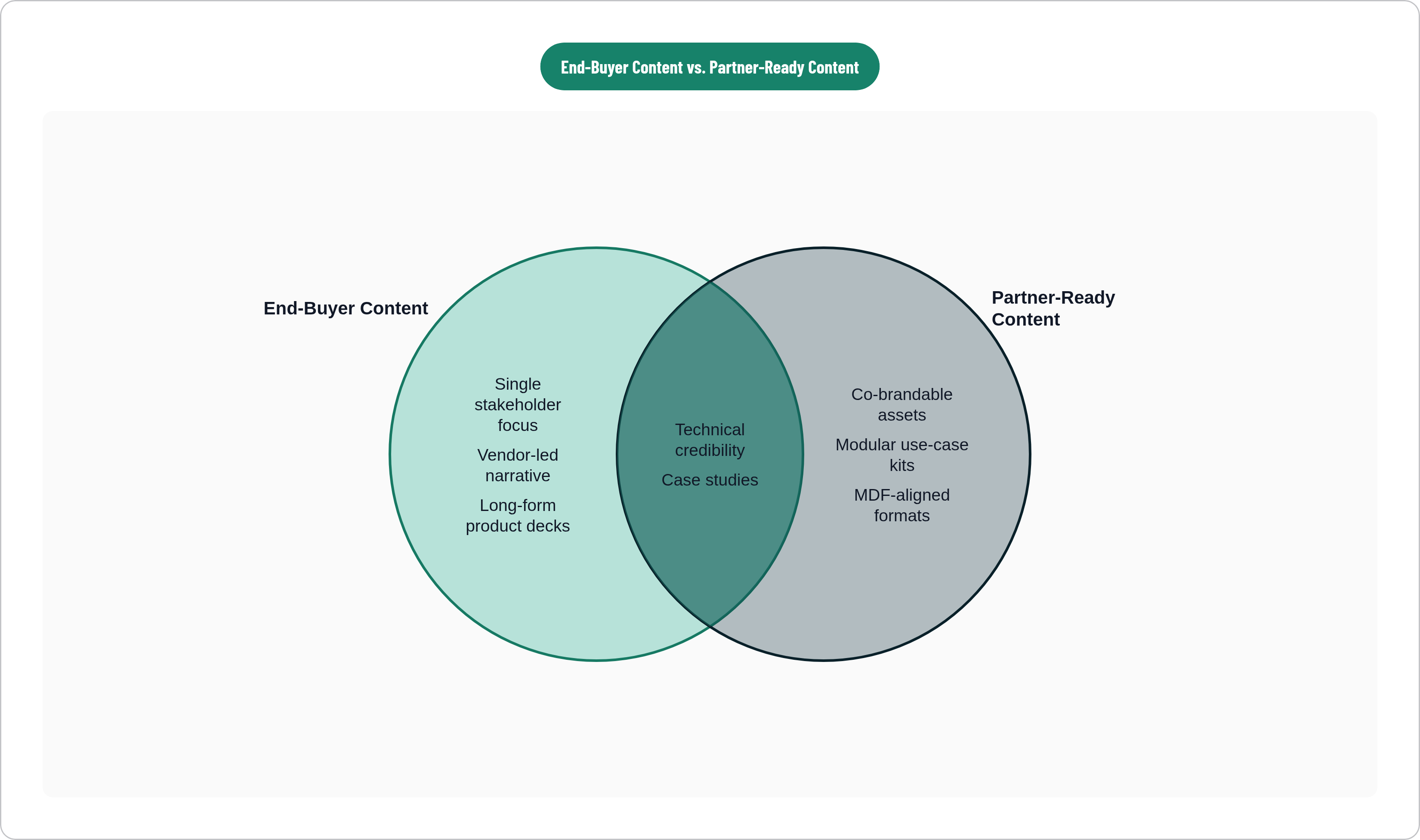
The fix is uncomfortable for teams that have spent years writing for buyers. You have to write for the person standing between you and the buyer. That means technically credible, modular content that a partner can pick up and use without needing to call you. It means content built for a relay, because a channel strategy without partner-ready content is like a relay race where the anchor runner never gets the baton. And it means accepting that your positioning lives or dies in someone else's conversation.
When a Partner Recommends You, the Sales Cycle Is Already Half Over
When an MSP recommends a vendor, the sales cycle compresses dramatically. Close rates run two to three times higher than direct outbound. The partner's existing trust with the buyer eliminates stages that vendor content would otherwise have to build from scratch.
That is the good news. Here is the catch.
The partner's recommendation is the content. What they say, how they frame the problem, and which proof points they reach for are all determined by what you gave them. Give them an 80-slide product deck and they will ignore it. Give them a use-case playbook built around the three problems their buyers actually show up with and they will use it.
Partners are translating your value into a conversation with someone they have known for years. Content that does not survive that translation does not get used. Full stop.
VARs moving to managed services models are already stretched thin. Their teams are evaluating dozens of vendors across a full security stack. Long, dense vendor materials compete for attention with every other vendor in the partner's portfolio. The practical demand is clear: partner content has to be immediately deployable, technically credible enough to hold up under a security-literate buyer's questions, and short enough to actually get read.
This is a different brief from end-buyer content. You are arming someone else to have a conversation on your behalf. That requires different assets, different formats, and a different definition of what "good" looks like.
Your Partner Program Is Not One Audience. It Is Six.
A typical enterprise security vendor is managing distributors, regional MSSPs, VARs, technology alliance partners, federal integrators, and cloud marketplace co-sell motions at the same time. Often with overlapping coverage. Often with minimal coordination between them.
Gold-tier partners typically require $500K to $2M in revenue thresholds, multiple certified technical staff, and dedicated channel account manager access. Platinum and Diamond partners co-sell directly with the vendor's enterprise team. The infrastructure looks tidy in a program guide. The reality is messier.
A federal integrator navigating FedRAMP authorization deals and a regional MSSP serving 50-person professional services firms are technically in the same partner program. They are having entirely different buyer conversations. Different regulatory contexts, different procurement processes, different technical depth on both sides of the table.
SOC 2 matters to one buyer's vendor assessment process. HIPAA shapes another buyer's entire security posture. GDPR governs a third. Content that ignores the regulatory frame a partner's buyer operates in is content the partner cannot adapt to fit their deals.
The implication is that a single partner kit does not work across this range. Modular content built around use cases, verticals, and buyer personas lets partners assemble what fits their specific motion. The alternative is that 80-slide product deck. The one partners consistently report receiving. The one they consistently do not use. Trying to serve six distinct partner audiences with one content kit is like fitting every client with the same suit — technically it covers everyone, and it flatters no one.
Technically Credible Does Not Mean Technically Dense
Here is what partners actually need to walk into a room and do their job.
Use-case playbooks. Not feature catalogues. Partners need to walk into a conversation about a specific problem. Identity sprawl. Ransomware recovery. Compliance evidence collection. They need to know how to position your solution against that problem without having to reverse-engineer it from a capabilities slide.
Objection-handling guides. Built around the objections that actually surface in partner conversations. Pricing comparisons against the incumbent. Integration complexity with what the buyer already owns. Loyalty to a vendor they have been running for years. Not the objections you wish buyers had.
Short technical briefs. Enough depth for a partner's pre-sales engineer or vCISO to answer a security-literate buyer without escalating to you. Credibility in the room is the partner's currency. You are protecting it or spending it with every piece of content you produce.
Co-brandable assets. The lower the adaptation cost, the higher the usage rate. If a partner has to rewrite or re-research the underlying content to put their logo on it, most of them will not bother. The asset needs to carry their voice as-issued, with cosmetic customisation available rather than substantive rework required.
Customer case studies. TechnologyAdvice's 2024 research found 63% of buyers cite case studies as a top purchase influence. A partner presenting a proof point from a comparable client in the same vertical is doing more selling than any product sheet you will ever write. Build the case studies. Tag them by industry and use case. Make them easy to find in the portal.
Vertical kits. Healthcare, financial services, manufacturing, whatever segments your partners actually sell into. Give them a ready-made content frame that speaks their buyer's language. Most partners are going to build it themselves. The ones that do are the exception, not the rule.
The structure of all of it matters as much as the content. Partners pull from these assets selectively, not linearly. Clear use cases, named proof points, and direct answers at the section level make content usable in the field. Wall-to-wall prose does not.
The Partner Is Navigating a Buying Committee, Not a Single Stakeholder
The typical cybersecurity buying committee now involves an average of 11.2 stakeholders. Security engineering, IT operations, procurement, legal, finance, and audit are all in the room at some point. Usually not at the same time, and usually with different questions.
A partner's account executive may have the trust relationship. But the deal stalls when procurement wants TCO analysis the partner cannot produce, or legal needs compliance documentation that was never created. That is a content problem.
Content built for only the security leader leaves every other stakeholder without a reason to support the decision. In a buying committee that size, one unconvinced stakeholder can kill the deal. That happens regularly.
The practical structure for a multi-persona content library breaks down cleanly.
- Security engineers want technical architecture depth.
- Procurement wants cost and integration analysis.
- Finance wants ROI framing.
- Legal and audit want compliance mapping.
That is four different documents. Four documents, each built for one audience.
There is another layer here. Gartner's 2024 data shows 70% of security leaders rely on peer recommendations and analyst insights over vendor-led content. And roughly two-thirds of the buyer journey is happening through digital channels before a partner conversation even begins. By the time a buyer sits down with a partner, they have already formed opinions. The content they saw beforehand shaped the questions they are now asking. The partner is walking into a conversation that your content (or someone else's) already started.
MDF Is Money That Most Partners Are Not Spending Effectively
Per The Channel Company's State of Partner Marketing 2025 research, 52% of smaller partners rely on part-time or shared marketing resources. Fewer than one-third have dedicated marketing staff. The content you produce has to be close to ready-to-run, because most partners lack the capacity to execute a campaign from scratch.
Larger partners are better resourced: roughly 85% have dedicated marketing staff. But dedicated resources do not mean those staff have deep product knowledge about every vendor in a portfolio that might include dozens of solutions.
The most common MDF failure is structural. Open-ended "submit a plan" requests disadvantage smaller partners who lack the capacity to write a campaign proposal. The fund ends up weighted toward partners who are already best-resourced, leaving the partners who most need activation support unable to access the budget.
Pre-approved MDF activity menus fix this. Joint webinars with associated budgets. Co-branded case study production. Sponsored roundtables. Define the activity, set the budget, and lower the barrier to access. The proportion of the fund that actually gets deployed goes up. That is the point.
Every MDF-funded activity needs a mechanism for attributing leads back to the investment. Without that, MDF is a budget line with no connection to pipeline. It becomes a cost of the relationship rather than a driver of revenue.
One more thing worth naming. Smaller partner marketing teams are increasingly using generative AI to produce blog posts, email sequences, and social content. That is not going away. Vendors who develop pre-built prompts or custom AI tools seeded with accurate product positioning give partners a path to differentiated output. The alternative is generic AI copy that sounds like every other security vendor in the partner's portfolio — which brings us to the next problem.
Positioning Dilution Is a Real Commercial Risk
There are over 3,500 cybersecurity vendors in market. If a partner introduces you as "another XDR platform," you have lost your differentiation before the conversation starts. The partner meant no harm; you gave them no better way to describe you.
FUD-based messaging compounds this risk. CyberBridge Marketing's survey found only 27% of cybersecurity professionals rated fear-based marketing as "very effective," with 28% saying "not at all effective." A partner deploying fear tactics on your behalf creates distrust, not pipeline. Per 2025 data, buyers prioritise trust over price in 82% of cases when selecting a security partner. The partner's credibility and your credibility are bound together in every deal. When they look bad, you look bad.
The control mechanism is content design, not policing.
Messaging frameworks that give partners the language for differentiated positioning with key proof points already built in reduce variance in how you are represented. Partners need guardrails, not a script to memorize.
Approved messaging guides should cover the following.
- What you do and what you demonstrably do not claim to do.
- How you differentiate from named categories of competitors.
- What proof exists to back those claims.
Co-brandable content that is complete as-issued means partners are less likely to improvise additions that undermine your positioning. Cosmetic adaptation, logo, intro, a vertical reference, is fine. Substantive rewriting is where things go sideways.
The Content That Never Gets Measured Never Gets Better
Certification completions, content downloads, and frequency of partner engagement are leading indicators. They tell you which partners are activating before deal registration shows up in the pipeline. They are worth tracking precisely because they are early signals.
Deal registration is the lag metric. It tells you which partners generated pipeline without explaining why. Pairing it with content and training engagement data surfaces which assets and programs are producing activated partners versus registered-but-dormant ones.
MDF ROI tracking tied to deal registration creates the feedback loop that content strategy decisions should actually be based on. Which co-marketed assets produced leads. Which webinars converted attendees into registered deals. Which vertical kits were present in won opportunities.
Per Demand Gen's 2025 report, 68% of cybersecurity buyers consume at least three pieces of content before engaging with a vendor. In a partner-mediated sale, at least some of that content journey passes through partner-owned channels. Understanding which content partners are actually deploying is part of understanding the buyer journey. Optimising what you cannot see is impossible.
The practical measurement stack is not complicated.
- Partner portal engagement data.
- MDF activity lead reports.
- Deal registration correlated with content usage.
- Win/loss data tagged by partner type.
All of it requires that the content and activity data get captured in the first place.
Vendors who close the loop between content investment and through-partner revenue have a compounding advantage. They concentrate future enablement resources on the assets and partner segments that are actually producing. Everyone else distributes effort evenly across a tier structure where most content sits unread in a portal.
That gap, between vendors who measure and vendors who do not, compounds over every quarter it persists.