Competitive Content Gap Analysis for Cybersecurity Vendors
AI search is reshaping where cybersecurity vendors actually get discovered by buyers.

Most cybersecurity vendor content is built for a moment that barely exists: the point where a buyer is finally ready to sign. The 2026 GrackerAI benchmark found that B2B buyers finish roughly three-quarters of their purchase journey before a vendor rep ever gets a call or email. By the time sales shows up, the real decision work is basically done.
CyberBridge Marketing's research is blunt about the mismatch. Most cybersecurity firms pour the bulk of their marketing budget into bottom-of-funnel "buy now" messaging, demos, free trials, pricing pages, even though buyers spend months doing quiet research before they're anywhere close to ready. That's a vendor showing up to a first date with a ring.
The content is aimed at the wrong stage, and it also sounds like everyone else's content: generic blog posts, fear-based statistics, and AI-template prose that practitioners dismiss immediately. Security practitioners, who spend their careers being skeptical of unverified claims, dismiss this stuff fast. They can smell a listicle written to hit a keyword, not to answer a question they actually have.
None of this is a keyword problem: it's a timing and credibility problem happening at the same time, and gap analysis, in this context, means finding where a vendor's content shows up too late, sounds too generic, or simply isn't there.
How AI search made the visibility gap existential
Cybersecurity buyers now do a lot of their early research somewhere other than Google, and that channel runs on rules most vendors haven't caught up to. Search engine optimization got vendors used to a certain kind of game: rank on page one, get the click. AI search doesn't play that game.
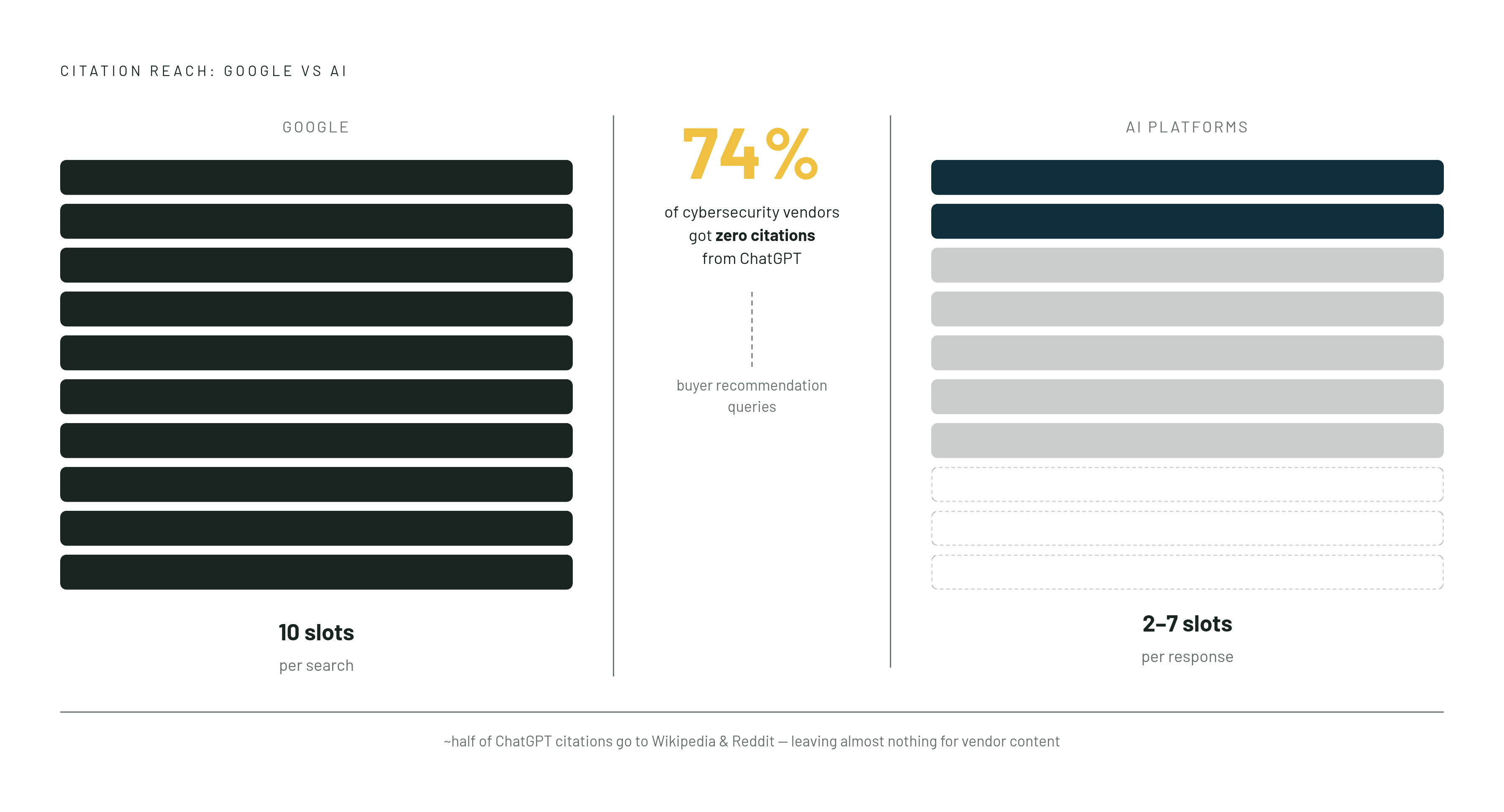
The 2026 GrackerAI benchmark tested six AI platforms against 250 buyer-intent prompts over a research window running from September 2025 through January 2026. Nearly three-quarters of cybersecurity vendors received zero citations from ChatGPT when buyers asked for vendor recommendations in their category, a finding that should worry a lot of marketing teams.
Part of why that number is so brutal comes down to simple math. Google hands back ten blue links per search. AI platforms cite somewhere between two and seven domains per response. Getting included isn't a little harder, it's a fundamentally smaller room with fewer seats.
That's also why strong SEO performance stops guaranteeing anything. One enterprise cybersecurity firm pulling more than 50,000 monthly visitors from Google organic search still got zero ChatGPT citations, while a much smaller competitor, with a fraction of that traffic, showed up consistently across multiple AI platforms. The difference wasn't traffic volume. It was structure: the smaller competitor's content was built in a way AI engines could actually retrieve and cite.
Where those citations come from matters just as much as how many exist. The same benchmark found that close to half of ChatGPT's citations point to Wikipedia, with Reddit picking up a large share of what's left. Most vendor-owned content isn't getting cited. A vendor can hold the top spot on Google for its category and still be invisible in the exact channel where a CISO is quietly building a shortlist, and no keyword tool will ever flag that absence.
Measuring a competitive content gap analysis for cybersecurity vendors
A proper competitive content gap analysis for cybersecurity vendors covers more ground than a standard Semrush keyword gap report. Three overlapping dimensions need measuring, and skipping any one of them leaves a distorted picture of where a vendor actually stands.
The first is topical coverage: the subjects and search queries where competitors show up and a vendor doesn't. Most existing gap-analysis tools already handle topical coverage reasonably well. The second is structural placement, meaning which funnel stages have content and which don't. Most vendors have plenty at the top (awareness posts) and bottom (demo pages, pricing) but almost nothing in the middle, where a buyer actually evaluates whether a product fits their environment.
The third dimension is AI citation presence, and it can't be inferred from Google rankings at all. It requires actually running prompts against ChatGPT, Perplexity, Google AI Overviews, and Gemini to see which competitors get cited, for which questions, and in what context. A vendor could dominate organic search and still not exist in this layer, which is exactly the trap described above.
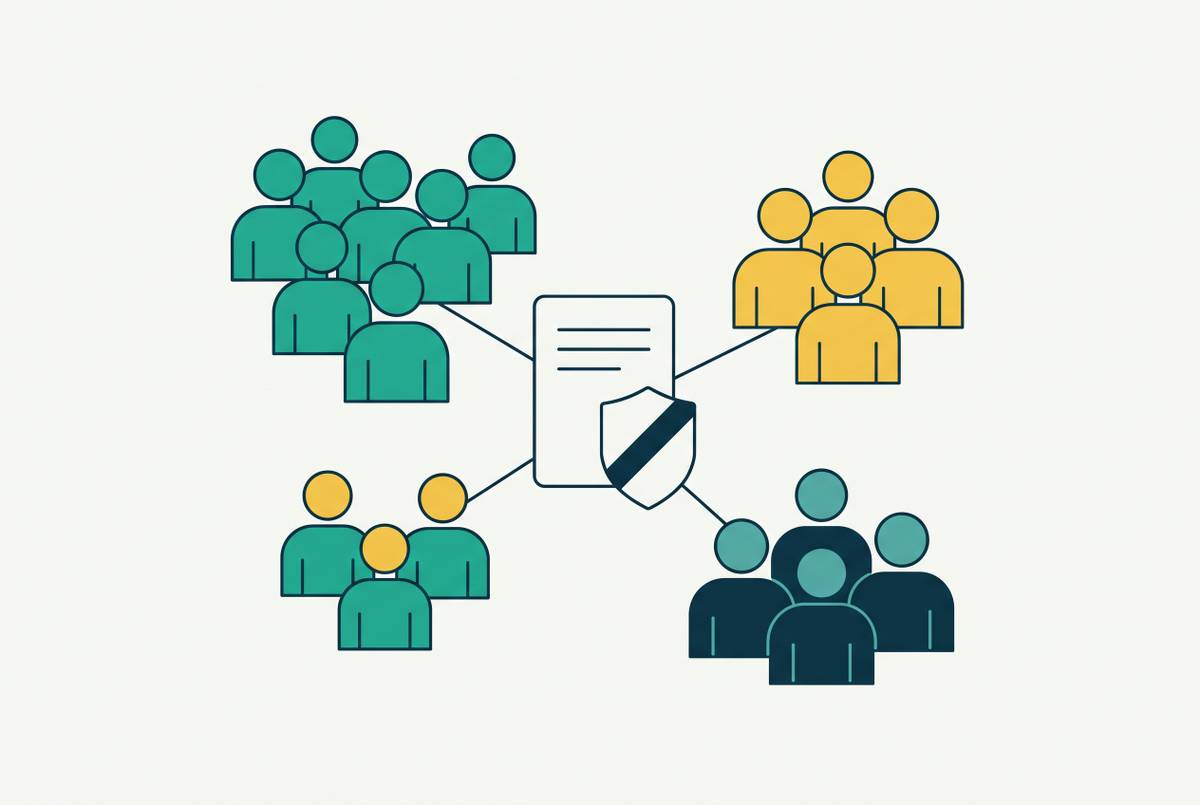
The buying committee itself forms a fourth layer that explains why a lot of "complete" content libraries still have holes. A single cybersecurity purchase usually involves a security engineer who wants architecture diagrams and integration docs, a CISO who wants executive proof points and peer validation, a procurement team that wants compliance certifications, and a finance team that wants an ROI case. Content written only for the CISO can lose the deal at the engineering review or the CFO's spreadsheet, long after the CISO was sold. A vendor whose entire content library speaks to one audience has gaps by definition, no matter how much of that one audience it covers.
Building the competitor content map before identifying the gaps
Gaps only exist relative to a baseline. Before anyone can say a competitor "owns" a topic or funnel stage, someone has to map out what competitors have actually published, where, and in what form.
Step one is picking competitors on purpose rather than by habit. That list should include direct product competitors, sure, but also category-adjacent vendors competing for the same practitioner attention even if their product doesn't overlap much, plus any vendor that keeps turning up in AI platform responses for the target category, regardless of whether it's a real feature-for-feature rival. That last group gets skipped constantly, and it's often the group actually winning the AI visibility fight.
Step two is the grunt work: crawling and sorting competitor content by topic cluster, funnel stage (awareness, evaluation, decision), format (blog post, technical guide, research report, case study, integration documentation), and target audience (CISO, engineer, procurement, compliance). Tedious, yes, but skipping it means every later judgment call is a guess dressed up as analysis.
Step three is the one most gap analyses never do at all: running direct AI platform audits. That means feeding buyer-intent prompts into ChatGPT, Perplexity, Google AI Overviews, and Gemini and recording exactly which competitors get cited, for which queries, and in what context. Organic search rankings tell you nothing reliable about this. It has to be tested directly, prompt by prompt, platform by platform.
Keyword gap tools like Semrush, Ahrefs, and MarketMuse still have a role here. They're good at surfacing topical and keyword coverage gaps, but they don't see AI citation gaps or structural funnel gaps on their own. Treat them as one input feeding the map.
One more thing belongs in this inventory: freshness. Cybersecurity content ages fast, since threat statistics, product integrations, regulatory requirements, and best practices all shift on a timeline measured in months, not years.
Gaps worth closing versus traps
Filling a gap only pays off when the topic, competitor weakness, and vendor's material line up. A content gap only turns into an opportunity when three things line up: practitioners are actually searching or asking about the topic during evaluation, competitor coverage on it is thin or out of date, and the vendor has something real to say, proprietary data, hands-on operational experience, or technical detail nobody else has published.
The mid-funnel keeps coming up as the biggest structural opening across cybersecurity categories generally. Technical evaluation guides, integration architecture documentation, threat model walkthroughs, and deployment guides built around specific use cases are what a practitioner needs while comparing options; most vendors skip this content type in favor of top-of-funnel blog posts and bottom-of-funnel demo requests.
AI citation gaps in a vendor's core category deserve priority treatment above almost everything else, because the citation math discussed earlier means being absent from AI answers functions the same as being cut from the shortlist before a single sales call happens.
Three traps deserve naming briefly, because judgment matters more here than a long checklist. Gaps that only exist because the target audience is too small to justify production cost aren't worth chasing. Gaps in categories adjacent to a vendor's core positioning can dilute the brand rather than strengthen it. And keyword gaps built around high-volume but generic queries, basic security definitions, consumer-facing content, tend to pull in the wrong readers entirely and weaken the domain authority signals that matter for practitioner-relevant content.
The consolidation wave sweeping cybersecurity right now reshapes this whole prioritization exercise. Gaps around integration complexity, platform consolidation rationale, and operational coherence now outrank gaps in feature-level differentiation content, because that's the question buyers are actually stuck on.
What closing a structural mid-funnel gap looks like
CrowdStrike offers the clearest example of what filling a structural gap produces when it's done well. Its annual threat intelligence output became a reference document across the entire industry because it delivered real intelligence value to security practitioners who weren't even customers. The Counter Adversary Operations team named 24 new adversaries in 2025 alone, pushing the total number of adversaries it tracks past 281, the 2026 Global Threat Report found.
That kind of output gets recognized externally, too. CrowdStrike was named a Leader in The Forrester Wave for External Threat Intelligence Service Providers, Q3 2026, scoring highest in both current offering and strategy. That recognition tracks directly back to the depth of the research.
Named individuals amplify the whole effect. John Hultquist at Mandiant, Adam Meyers at CrowdStrike, and senior named researchers at Cisco Talos and Palo Alto Unit 42 function as retrieval entities in AI engines in their own right. When an AI platform has learned to associate a name with specific campaign attribution and research output, the employer inherits some of that citation authority automatically. A named researcher becomes a kind of walking citation magnet, and the company benefits every time.
Format matters as much as substance. Column Five's Anatomy of a Breach campaign, produced for Microsoft, treated breach storytelling with the depth of investigative journalism rather than marketing copy, and that's the kind of content practitioners actually read, share, and reference later. Column Five's roster of cybersecurity and identity clients includes SentinelOne, HackerOne, Cylance, Auth0, and Okta, though there's no record of the Anatomy of a Breach format being applied to those specific engagements. The lesson transfers regardless of client: editorial depth outperforms marketing polish when the audience is technical.
None of this requires a content team the size of a newsroom. The content multiplication principle resolves the volume-versus-depth tension: one core research insight can be repackaged as a CISO executive summary, a security engineer technical deep-dive, and a CFO ROI brief, addressing the full buying committee from a single production effort rather than treating each audience as a separate content workstream.
Producing content that earns AI citations rather than hoping for them
AI citation is baked into how the content gets built in the first place, not a distribution problem to fix after the fact. Structure decides whether a piece gets picked up long before anyone hits publish.
The GrackerAI benchmark found that platforms like Perplexity cite five to eight or more sources per response, and they consistently favor content with clear entity structure, named claims, and specificity that can actually be retrieved and checked. That's a useful overlap: the same qualities that make content trustworthy to a skeptical security practitioner are the qualities that make it citation-friendly to an AI engine.
Content that names adversaries, attributes campaigns, cites specific CVEs, references named frameworks like NIST and CMMC 2.0, and structures arguments around clearly labeled claims is more likely to be retrieved and cited than prose that makes general assertions without specificity. Specificity is the whole game here. An AI engine has to be able to point at something concrete to cite it.
Bitsight's recent analyst recognition shows the same pattern from a different angle. Bitsight was named a Visionary in the first-ever Gartner Magic Quadrant for Cyber Threat Intelligence Technologies, and separately a Leader in the Q2 2026 Forrester Wave for Cybersecurity Risk Ratings Platforms, scoring highest on current offering and posting the top possible score across 11 criteria, more than any other vendor evaluated. Structured, third-party recognition like an analyst report or a named award gets cited by AI systems because it's verifiable and attributable in a way a vendor's own marketing copy simply isn't. It functions less like a badge on a homepage and more like a citation asset AI engines can lean on with confidence.
Translating this into a production checklist: structured technical guides with named entities, threat intelligence reports attributed to named researchers, integration documentation that references specific product versions, and case studies with measurable outcomes, an incident recovery time dropping from a named baseline to a named result, are the formats AI platforms cite most reliably.
Fear-based marketing copy and vague AI buzzword claims do the opposite. A phrase like "next-generation AI-powered zero trust," with no specificity behind it, isn't a retrievable claim at all. AI engines treat it as noise and discount it, the same way a security practitioner scrolls past it without a second thought.
Running the analysis as an ongoing process rather than a one-time audit
A competitive content gap analysis for cybersecurity vendors doesn't have a finish line. The threat landscape shifts, regulations get rewritten, the M&A wave keeps reshuffling category boundaries, and AI citation algorithms change their own retrieval logic, all fast enough that a static audit goes stale within months.
Stale content carries a specific cost with security practitioners who track the data closely. The Verizon 2026 Data Breach Investigations Report found that software vulnerability exploitation had become the leading initial-access vector, with ransomware appearing in nearly half of all breaches. Those numbers replace whatever last year's report said, and any vendor content still quoting the older figures gets flagged immediately by practitioners who track these reports closely, the same audience a vendor is trying to earn credibility with.
Consolidation keeps generating fresh gaps on its own. March 2026 alone saw 38 cybersecurity M&A deals, with Q1 2026 deal value landing around $2.6 billion. Category definitions, integration landscapes, and buyer priorities move faster than an annual content audit can possibly track. A vendor mapping competitor content on a quarterly cycle will keep finding gaps that a once-a-year audit walks right past, simply because the ground has already shifted twice by the time that annual audit gets scheduled.
Sources
- Best Content Gap Analysis Tools in 2026 | Single Grain
- The State of AI Search Visibility in Cybersecurity, 2026 Benchmark Report | GrackerAI
- 38 Cybersecurity M&A Deals in March 2026 Alone [Analysis]
- Gartner Magic Quadrant for Cyberthreat Intelligence Technologies
- Technical Content Marketing for Cybersecurity: Writing for Buyers Who Distrust Marketing - Security Boulevard