Threat Intelligence Reports That Earn Press Coverage
Original data and disclosed methodology are what earn journalists and practitioners' trust.

What journalists and practitioners need from a threat intelligence report
The threat intelligence field publishes on a schedule now. CrowdStrike drops a Global Threat Report every year and a separate Threat Hunting Report on top of it. Trellix, Fortinet, SonicWall, Verizon, CyberProof, Hoxhunt: all of them put out annual or semi-annual reports that land on roughly the same calendar. Most get almost no press pickup. A small number get quoted everywhere, cited by other vendors, and folded into AI answer engines as a source of record. That gap has nothing to do with PR budget or how many journalists got a pitch email. What actually determines outcomes is what's inside the document, and most vendors are optimizing the wrong element: they polish the design and the launch email instead of the data that produces those results.
Security reporters aren't chasing product announcements. They cover breaches, threats, and data nobody else has, so original research out of a detection team is close to the only hook that works over and over. A press release about a new dashboard feature does not clear that bar. A dataset showing breakout times dropped by double digits does.
Buyers behave the same way, just with different stakes attached. Research cited by Sliced Brand puts earned media trust above any paid content for B2B buyers, at 63%. The report has to work as the product itself.
Practitioners bring the harshest filter of the three groups, and for good reason. Security people get trained to distrust claims on sight, check assertions, assume the worst about intent, and hunt for what a sentence is dodging. Most CISOs struggle to tell real innovation apart from marketing dressed up as innovation, so skepticism is the starting position here, not an exception to it. The test a practitioner runs is simple: can this claim be checked? If yes, it earns some trust. If it's just persuasive language with nothing to grab onto, it gets ignored, no matter how well it's written.
Journalists and practitioners land on the same requirement from two different directions: original data, a disclosed methodology, and findings someone outside the vendor can verify without asking permission.
The structural qualities that make a finding newsworthy rather than merely informative
Take the Verizon 2026 DBIR. Its headline stat: for the first time in the report's history, vulnerability exploitation passed stolen credentials as the top way breaches start. That got picked up everywhere for an obvious reason. "First time in 19 years" is a record against a baseline tracked continuously since before most current CISOs had the job.
A number needs a time boundary, a disclosed method behind it, and something surprising about it, or it just sits there on the page. Record highs, year-over-year swings, "first-ever" language: these hand a journalist a lead sentence they don't have to write themselves.
CrowdStrike's 2026 Global Threat Report clocked average eCrime breakout time at 29 minutes, 65% faster than 2024, with a fastest-ever case of 27 seconds. Notice what actually got quoted around. Not the 29-minute average. The 27-second outlier. Extremes travel further than averages, every single time, and any vendor still leading with the average is burying its own best line.
NCC Group's July 2026 numbers, 894 ransomware attacks that month, up 22% from June and the highest single month of the year, work for a different reason: a monthly cadence gives reporters a reason to come back next month and check the number again. CrowdStrike's Threat Hunting Report named ALTERED SPIDER for compromising 300-plus software dependencies in a single day, and STARDUST CHOLLIMA for poisoning 131 AI framework packages. A named actor plus a hard number stacks two hooks instead of one.
None of this works because the statistic itself is dramatic. It works because of the contrast built into it: against last year, against the assumed norm, against what everyone in the room thought was true going in. A finding that just confirms what practitioners already believed doesn't move anywhere. A finding that overturns the consensus does, reliably, almost every time it runs. That's the whole game, and most reports never bother to play it.
Methodology as a credibility mechanism, not a disclosure formality
The DBIR's authority doesn't come from the Verizon brand name sitting on the cover. It comes from the data pipeline: contributions pooled from law enforcement agencies both domestic and international, forensic firms, law firms, cyber insurers, industry sharing groups, and Verizon's own VTRAC team. That pipeline is the actual reason the report gets treated as a benchmark instead of just another vendor's opinion.
Original datasets hosted on domains with real authority, tied to named findings and a clear collection method, are what gets pulled into AI-generated answers and cited by name. Methodology disclosure has quietly become a machine-citation requirement now, not just a courtesy for human skeptics reading closely. The stakes get higher every quarter, since a growing share of buyers see an AI-generated summary of a topic before they ever hit a search results page.
Look at how the named sources describe themselves. Trellix's report says its findings come from "a global network of experts, sensors, telemetry, and intelligence," covering October 2025 through March 2026. Hoxhunt's 2026 report is built on millions of user-reported phishing emails that got past filters. CyberProof draws from internal SOC environments, its own threat intel feeds, and broader industry reporting layered on top. Each of those is a claim a journalist can pressure-test, which is the entire point of stating it that specifically.
Even the arguments about methodology help a report's standing. Practitioners regularly fight over how the DBIR buckets phishing versus credential abuse versus pretexting, and that back-and-forth proves people care enough to argue about it. A responsible disclosure writeup that says the research team worked with the affected vendor and a CVE got issued before anything went public does something else entirely: it tells the story of an ethical actor, not just a technical one, and that story is what turns a bug writeup into news coverage.
Reports that skip sample size, skip the time window, skip how the data actually got gathered, hand a journalist nothing solid to lean on and a practitioner no way to check the work. Those reports sit on a shelf, unread and uncited, no matter how much money went into the launch.
The narrative spine: how reports that get covered are built around a single coherent argument
The reports that get cited over and over aren't structured as inventories of every threat category under the sun. They're built around one claim. The Verizon 2026 DBIR argues that vulnerability exploitation, not credential theft, has become the leading way breaches begin. CrowdStrike's Threat Hunting Report is built around a single unifying claim about how adversaries are operating across every domain they can reach.
SonicWall's Cyber Protect Report made a deliberate pivot away from tracking raw threat counts toward talking about protection outcomes, and it wrapped the whole thing in a named framework: the "Seven Deadly Sins of Cybersecurity." That's a headline concept an editor can run with as written, no rewriting required.
Trellix opens its report with a named VP of Threat Intelligence Strategy quoted directly in the preface, which gives the argument a human voice instead of a faceless data dump. CyberProof frames its 2026 report around one shift: attackers moving from breaking through the perimeter to compromising identity as the starting point for nearly everything downstream. "Identity is the new perimeter" is a sentence a reporter can lead a story with, word for word, no editing needed.
Anyone building one of these reports should find the one thing the data proves that contradicts what everyone currently assumes, before the outline gets touched. That contradiction is the spine of the report, because everything that follows depends on it. Every chart and every stat after it is evidence supporting it, not a new topic competing for attention. Skipping that step turns the finished product into a reference document: fine for a bookmark folder, useless as a news story.
Specificity of actor, sector, and geography as the key to a journalist's lead
An anonymous "threat group" is forgettable. A named one is a character. CrowdStrike's Threat Hunting Report names ALTERED SPIDER, STARDUST CHOLLIMA, VAULT PANDA, and GENESIS PANDA, each identified as a distinct named actor a security editor can write about. That gives a security editor an actual subject to write about instead of a vague category to summarize.
Sector data does the same work for trade press. NCC Group's July 2026 numbers show industrials as the most-hit sector at 28% of attacks, with The Gentlemen as the most active ransomware group at 138 attacks (15%), just ahead of Qilin at 127 (14%). An editor at an industrial trade outlet can lift that sentence and run it close to verbatim.
Geography works the same lever for regional desks. CyberProof's 2026 numbers log 31,020 incidents in the United States, 7,144 in Germany, 2,622 in the UK, and 2,581 in Canada, numbers that let a regional outlet cover a story global aggregate figures never reach on their own. NCC Group's data on North America taking 41% of all ransomware attacks turns a worldwide finding into a story a North American trade desk can call its own.
One vendor's report tracks something else entirely: gmail.com accounts for roughly a fifth of all malicious senders, malicious SVG attachments grew fiftyfold compared to 2024, and the mix of attack delivery methods has shifted measurably over the same period. That's a trend with a clear beginning and a clear current state, exactly the shape a journalist needs for a "here's what changed" story.
Granular detail is the mechanism doing the work here. It's what turns "attacks are increasing globally" into a sentence a reporter covering one specific beat can call their own. Vague global claims get skimmed. Specific regional numbers get quoted.
CVE credits, framework contributions, and advisory acknowledgments as press infrastructure
There is something quieter than press coverage worth noting: CVEs credited to a vendor's own research team and contributor status on MITRE ATT&CK. These work as retrieval anchors on their own, pulling in press pickup and AI citations regardless of how the report gets distributed afterward.
When a journalist or a fellow researcher goes looking for information on a specific threat actor, the query routes to a small set of names: Mandiant, CrowdStrike, Microsoft, Recorded Future's Insikt Group, and MITRE ATT&CK itself. None of that access got earned through a pitch email. It got earned by being the source everyone else already cites, over years, on a track record nobody can fake in a single quarter.
The research infrastructure that feeds outside frameworks is the real starting point for becoming a primary source. CrowdStrike's Global Threat Report noted ChatGPT gets mentioned in criminal forums 550% more than any other model, and that number reads as citable specifically because it's attributed to a named team running a documented method, not treated as one more line to double-check before anyone repeats it. A vendor not yet doing primary research needs to build the telemetry, the named analysts, and the CVE submission pipeline before anything else on this list can matter.
Common traits of reports that don't get covered
The most common failure mode is a report dressed up as original research that's actually a product pitch wearing a few statistics as a costume. Security professionals have been burned by the gated-asset bait-and-switch enough times that download rates on vendor research start out suspicious by default, before anyone's even opened the file.
Generic claims without a named source behind them give a journalist nothing to cite and a practitioner nothing to check. Vendor blog posts full of unattributed, unbounded claims rarely get picked up by AI engine retrieval either, so the failure now costs a vendor visibility on two fronts at once instead of one.
Numbers without a time window, a sample size, or a stated collection method can't really be argued with, which sounds like a strength until it means nobody can argue for them either. The 2026 DBIR's finding that the human element appears in 62% of breaches travels because it sits on top of years of comparable methodology, not because the number itself shocks anyone.
Reports built as category inventories, threats then malware then ransomware then phishing, in that predictable order, read like an encyclopedia entry. That structure alone signals "reference," and reference documents don't make news. Mimecast's writeup of the DBIR flags shadow AI as the third most common non-malicious insider action turning up in DLP data, a fourfold jump from the year before. That travels because it's counterintuitive and measured against a clear prior state. The same information phrased as "AI use is rising" goes nowhere, and plenty of vendors phrase it exactly that way.
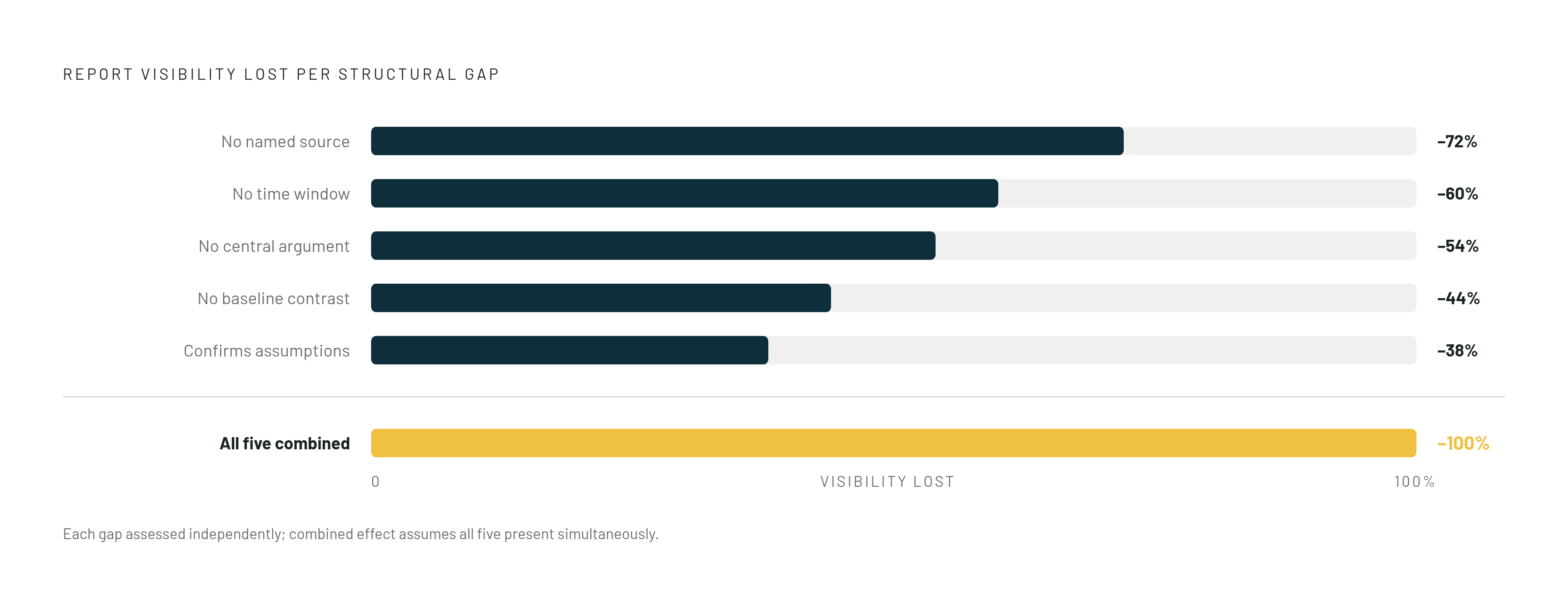
Add it up: no named source, no time window, no central argument, no contrast against a prior baseline, and a finding that just confirms the room's existing assumptions. Any single one of those weakens a report's odds. A report lacking a named source, a time window, a central argument, contrast against a prior baseline, and a finding that departs from the room's existing assumptions becomes invisible, regardless of how much research sits underneath it, because any single one of those five gaps weakens its odds and all five together erase it.
How security vendors build the research infrastructure behind press-worthy reports
CrowdStrike, Verizon's VTRAC team, Trellix's Advanced Research Center, Hoxhunt's threat intelligence group: different companies, same underlying bet. Named analysts, telemetry running continuously instead of sampled once a year, and a collection method written down somewhere that can actually be pointed to when someone asks.
Original research is the hardest content type to produce in the entire security marketing stack, and that difficulty is why it works. Research cited by Uplift GTM on selling to CISOs found that when a research team publishes something genuinely new about attack techniques or actor behavior, CISOs read it, pass it along, and remember who wrote it. Nobody forwards a product one-pager to a colleague. People forward findings, and only findings.
One well-built annual report can carry six to twelve months of pipeline, according to insights from cybersecurity marketing analyst Kayne McGladrey, generating press attention and analyst notice well past its publish date. That math favors putting real depth into one report over pushing out a dozen shallow ones on a content calendar just to stay visible. A vendor chasing quarterly output over annual depth is optimizing for busywork, not for coverage.
Presenting at practitioner conferences the vendor doesn't run itself, and contributing to open source security tooling, both work as separate credibility signals that back up whatever the report claims. Uplift GTM's research on CISOs found the practitioner community notices and responds to expertise that appears outside a vendor's own owned channels, where it cannot be dismissed as self-promotion, because that placement removes the incentive to wave it off.
Where a report gets published matters too. Content sitting on a high-authority security media domain gets pulled into AI answer engines far more readily than the same words posted to a vendor's own subpage, so pushing research out through publications the practitioner audience already trusts extends its reach well past the vendor's existing mailing list.
None of this is a shortcut, and there isn't one hiding somewhere in a distribution tactic waiting to be found. Research-backed content is a moat precisely because it can't be faked or rushed, in a market otherwise flooded with interchangeable noise. The sequence that actually works: build the telemetry and the analyst bench first, write down the methodology before a single finding gets drafted, find the one argument the data actually supports before laying out the report's structure, and only then put it somewhere the audience already trusts. Worrying about who's going to write about it comes last, not first.
Sources
- Threat Intelligence Report 2026: Tactics, Trends & Risks
- CyberProof 2026 Global Threat Intelligence Report
- The CyberThreat Report: April 2026 | Trellix
- Security News and Threat Intelligence | Cybersecurity Trends | SonicWall
- CrowdStrike 2026 Threat Hunting Report | CrowdStrike
- Cyber Threat Intelligence Reports
- CrowdStrike 2026 Global Threat Report | Key Cyber Threat Trends
- kaynemcgladrey.com