Newsjacking Cybersecurity Incidents Responsibly
Vendors must have proprietary data to comment responsibly on active breaches.
Newsjacking a breach works exactly once, and only if the vendor shows up with something the breaking story doesn't have yet. David Meerman Scott coined the term back in 2011 to describe piggybacking on a hot story, and the tactic hasn't changed much since. Cybersecurity is a rougher room than most industries that try this move: the audience can tell insight from opportunism inside two sentences, and most vendor commentary fails that test on contact.
The speed and shape of modern incidents make uninformed commentary actively harmful
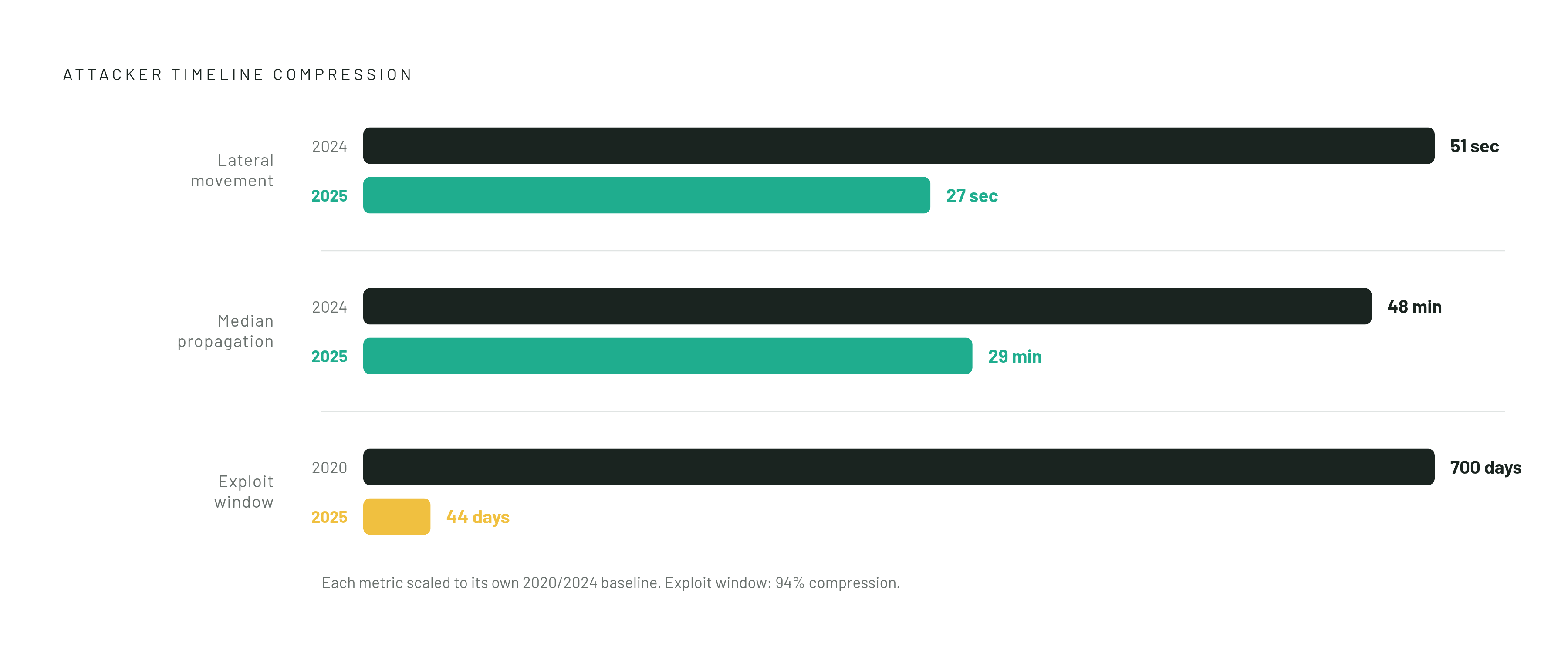
Start with the number that should stop anyone mid-sentence: 27 seconds. That's the fastest recorded time from initial access to lateral movement in 2025, down from 51 seconds the year before. Median propagation time across incidents fell to 29 minutes in 2025, from 48 minutes in 2024. The trend only moves one direction, and it's moving fast enough that yesterday's benchmark is already stale.
A defending team can still be knee-deep in remediation while a vendor is out publishing guesses about root cause. That's noise generated while the house is still on fire, and it doesn't help the people holding the hose.
The shape of these incidents changed right along with the speed. 82% of 2025 detections involved no malware at all: attackers used valid, stolen credentials and admin tools already sitting on the machine. So when a vendor's hot take says "they deployed ransomware," it's often wrong about the actual kill chain, because there wasn't a traditional one to describe. Most people commenting on breach news are still picturing malware drops from years past. That picture is out of date.
73% of ransomware victims had an info-stealer infection or a credential leak in the year before the ransomware landed, with half of those precursor events happening an average of 95 days earlier. The incident everyone's newsjacking is usually the last chapter of a book that started months back. The earlier chapters are invisible to anyone commenting inside the first 48 hours, which is exactly when most vendors decide to comment.
Black Kite's Third-Party Breach Report puts a number on the supply chain fallout too: every vendor breach now produces an average of 5.28 downstream companies publicly compromised, the highest figure Black Kite has recorded. Median detection takes 10 days, and victims stay unnamed for an average of 117 days. A vendor commenting fast is almost always commenting on a partial picture, and practitioners know it on sight. What mattered all along was whether the vendor has something the breaking story doesn't. It's whether the vendor has something the breaking story doesn't.
What responsible incident commentary requires: the intelligence bar
Commentary either adds technical substance the news can't provide yet, things like observed telemetry, proprietary detection data, tactics that match a prior investigation, or it's public reporting with a logo pasted on top. There's no third option, and vendors who pretend otherwise are the ones getting called out on a social platform by Tuesday.
A point that lands directly here: intelligence products fail when they're built for the analyst producing them instead of the person reading them. Audience has to shape the work from day one, not get bolted on during editing. Good intelligence practice forces a team to name who's reading and what decision the piece should help them make, before analysis even starts. A SOC analyst wants something different from what a CISO wants, and content built to serve both usually serves neither.
Vendor newsjacking runs into the same failure, just faster. Optimize for hitting the news cycle, and the output looks like threat intelligence while reading like filler.
The other end looks like sustained observation of attacker behavior, telemetry correlated across regions and sectors, vulnerability research layered onto active investigations. Proprietary data plus real method, sustained over time, earns trust. Nothing else does.
A vendor earns the right to comment when it has matching detection data from its own environment, documented tactical overlap with something it's investigated before, or technical context on the vulnerability or actor group that isn't public yet. Missing all three, the piece is speculation wearing a lab coat, no matter how good the graphics look.
The clock keeps tightening either way. Time to exploit dropped from over 700 days in 2020 to 44 days in 2025, and CrowdStrike's 2026 report logs an 89% year-over-year jump in AI-enabled adversary activity. The window for doing this responsibly is shrinking about as fast as the incidents themselves are speeding up.
Regulatory disclosure timelines and legitimate newsjacking windows
2024 was the first full year under the SEC's cyber disclosure rules, which require public companies to disclose material incidents within four business days. That single requirement reshaped how organizations run incident response, forcing faster materiality calls and tighter coordination between legal, investor relations, and security teams, frequently at 2 a.m.
CIRCIA's final rule adds another clock for critical infrastructure: 72 hours to report a substantial incident, 24 hours to report a ransom payment. These deadlines create real, time-stamped moments where a vendor with genuine expertise in materiality assessment or disclosure workflow can say something useful to a peer company staring down the same countdown.
That's the legitimate hook. Not "look at this breach," but "here's what this disclosed incident implies for your own four-day clock."
NYC Health + Hospitals shows why these windows aren't one-and-done. An unauthorized actor sat inside the network from late November 2025 through February 11, 2026, following a compromise at a third-party vendor, affecting at least 1.8 million people. The story resurfaced on July 27 when the extortion group LeakNet published a preview claiming an 11-terabyte archive. That's two separate, legitimate commentary windows on one incident, months apart, each with its own angle.
The test doesn't change between windows. Does the piece help a practitioner make a better call about disclosure or board communication, or is it just tying a vendor's name to whatever's trending this week?
Incidents that reward close technical reading
Some incidents are documented well enough, after the fact, that a vendor with real telemetry can add something. Others are still too raw to touch. Mixing those two categories up is where most bad commentary comes from, and it happens more often than it should.
Kettering Health got hit by Interlock ransomware in May 2025. The attack knocked out internal systems, phone lines, and EHRs across 14 medical centers, forcing ambulance diversions and canceled procedures. Generic "ransomware is scary" framing adds nothing here. What actually helps is commentary on EHR interdependency across a hospital network, plus the specific tactics Interlock has used elsewhere.
Marks and Spencer got hit over Easter weekend 2025, attributed to Scattered Spider. Payment systems and Click & Collect failed, online shopping got suspended starting April 25, and weeks of disruption followed. The useful angle here is the social engineering methodology, the identity-based initial access, and what that pattern means for any retailer carrying similar third-party identity exposure in its stack.
Bank Sepah got hit in March 2025 by a group calling itself Codebreakers, exposing a million customer records and demanding $42 million, one of the largest financial-sector compromises of the year. Extortion paired with data theft is fast becoming the default playbook for financial targets.
And back to NYC Health + Hospitals: the July 27 LeakNet wave is a second, distinct window, and it deserves commentary on what a third-party vendor compromise, followed by months of silence, means for vendor risk management specifically.
What connects these four is documentation. Each is settled enough that a vendor with matching telemetry can say something real, and none of them are live, contested, still-unfolding situations, which is exactly when speculation causes the most damage. Before publishing on any of these, ask what the vendor knows that the news article doesn't. If the honest answer is nothing, don't publish. Wait.
Practitioners disengage the moment the commentary feels thin
Research into B2B buying behavior consistently finds that decision-makers weight an organization's thought leadership heavily when sizing up capability, and that sustained, credible work builds the kind of trust that influences vendor selection.
That number turns uncomfortable fast when flipped over. One piece of thin, speculative incident commentary undoes months of credibility built through careful work. Practitioners remember the vendor that got it wrong in public, and they remember it longer than the vendor would like.
Peer conversation, not analyst reports, drives the actual buying decisions in this market. Peer conversation, not analyst reports, drives actual buying decisions in this market, and CISOs are known to weight peer input heavily when evaluating vendors. A CISO who reads a shallow newsjacking post doesn't quietly judge it and move on. That CISO mentions it to three peers over coffee, and the damage spreads through exactly the channel that matters most here.
Analysis of cybersecurity company marketing has found most firms pour the majority of their effort into bottom-of-funnel messaging, even though buyers typically spend six to ten months researching before they're ready to buy. Newsjacking that reads like a sales trigger lands squarely inside that research window, right where trust either gets built or gets burned for good.
Across the cybersecurity marketing landscape, fear-based messaging is increasingly seen as losing its grip, and traditional ABM and marketing automation tactics are widely regarded as underdelivering on their promise. Educational content backed by specific data, written by people who actually know the subject, is starting to beat scare tactics on both engagement and conversion.
None of this plays out in a quiet market, either. Global cybersecurity spending hit $301.9 billion by the end of 2025, up 15.1% that year. Any vendor publishing into that kind of demand is publishing into deafening noise, in front of a practitioner audience whose filters are tuned specifically to catch shallow newsjacking.
The operational checklist: what to verify before publishing incident commentary
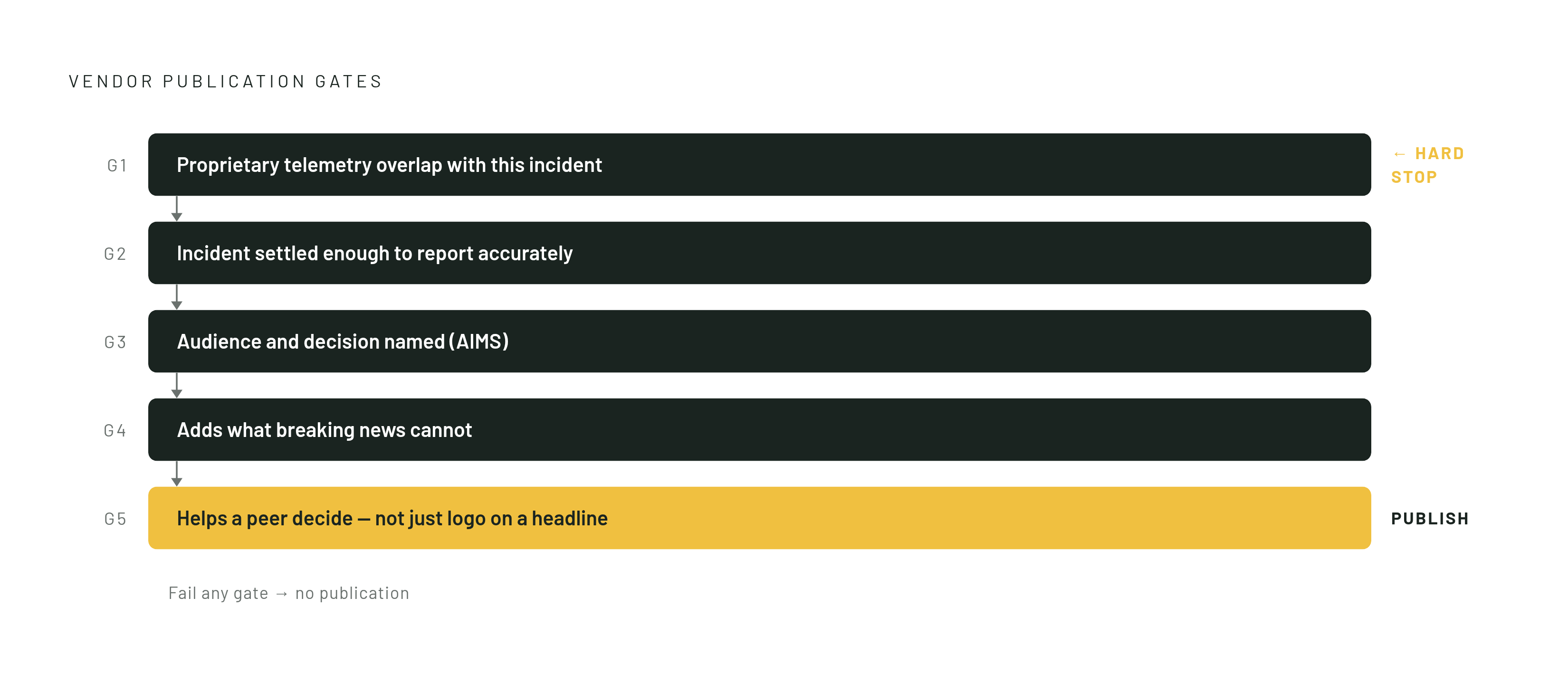
Five gates, run in order, before anything goes live.
Gate one checks for proprietary data. Does the vendor's own telemetry, detection logs, or past investigations show real overlap with the tactics, actor group, or vulnerability class in this incident? No overlap means no publish, at least not yet.
Gate two asks whether the incident is settled enough to comment on accurately. Live, unresolved incidents with contested attribution are dangerous ground to stand on, while the fully documented incidents covered above carry lower risk, provided gate one already passed.
Gate three names the audience and the decision the piece enables. Run the AIMS framework here. A SOC analyst and a board member need different content entirely, and the format should follow from who's reading, not from how fast the team can hit publish.
Gate four tests whether the piece answers something the breaking story can't. If a journalist working from the same public sources could've written it, the piece adds volume, not value.
Gate five asks whether the commentary helps a peer make a better decision, or just tapes the vendor's logo to a headline. Readers answer this question in the first two paragraphs regardless of what the writer intended, so answer it honestly before publishing, not after.
If the incident triggers SEC four-day disclosure or CIRCIA's 72-hour and 24-hour clocks, commentary that walks peer organizations through those obligations earns its speed. That's the one legitimate case for moving fast, and it's the exception, not the rule.
Recorded Future's survey of cybersecurity executives, managers, and practitioners found 91% plan to invest more in threat intelligence in 2026, and 81% plan to consolidate the number of vendors they work with. Vendors who show real intelligence depth in their incident commentary are positioning themselves right where that market is headed. Vendors who publish thin, fast, logo-first takes are spending down the exact credibility that consolidation wave would otherwise reward.
The last check is the only one that really matters: would the team that actually investigated this incident read the piece and feel it added something? If the honest answer is no, the piece isn't ready. Let it sit another day.