Translating Threat Intelligence Into Non-Technical Buyer Content
Bridge the gap between technical threat data and executive decision-making with strategic messaging.
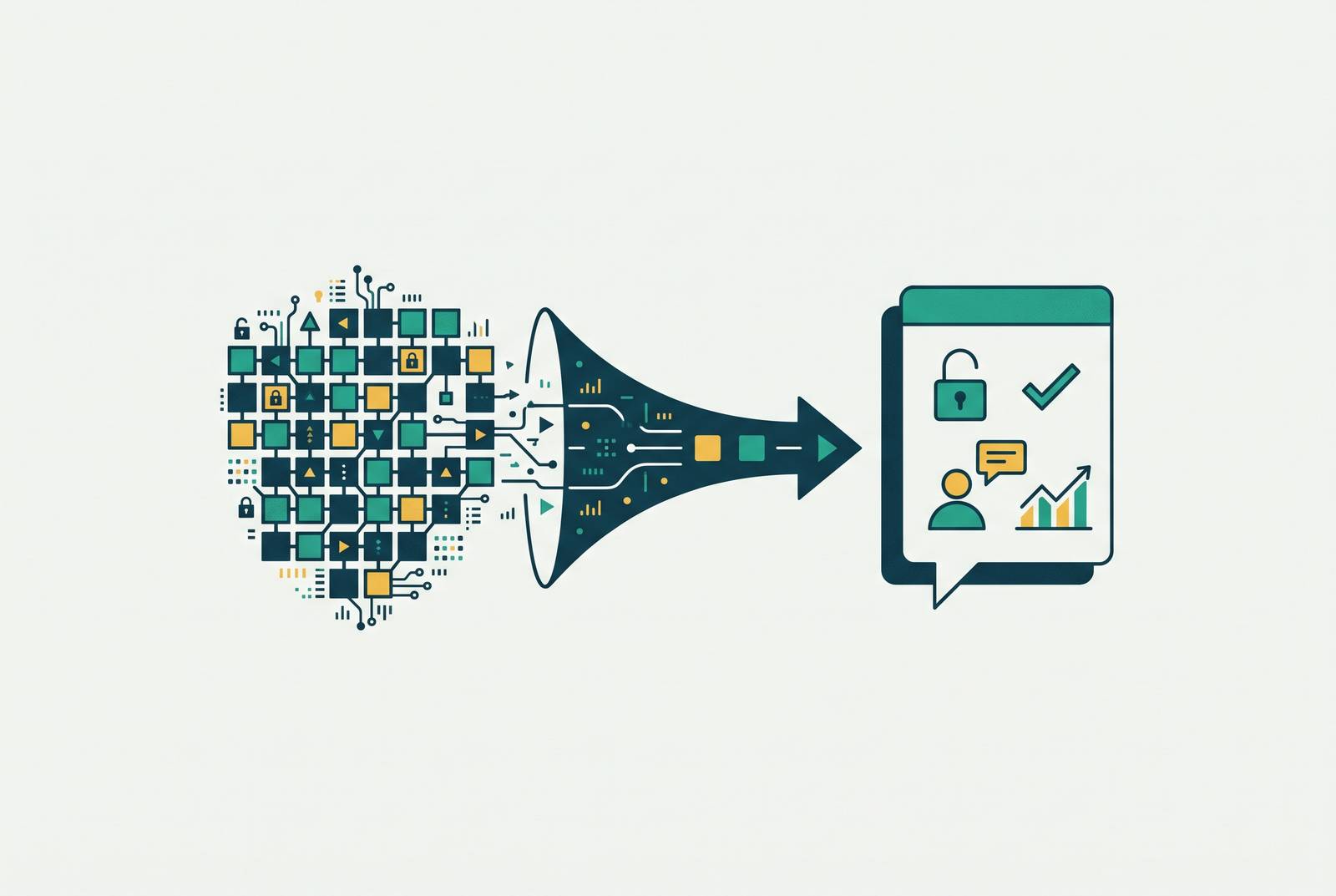
Threat intelligence isn't one thing. It's a stack, running from raw indicators that a firewall reads automatically all the way up to the kind of narrative a board member reads before deciding whether to approve next year's security budget. The job of translating that stack for non-technical buyers is really a matching exercise: figuring out which layer of intelligence actually touches the decision a given person is about to make, then stripping the jargon without stripping the proof.
Here's the four-layer version, because the rest of this piece leans on it. Tactical intelligence is the indicators: IP addresses, file hashes, malware signatures, the stuff that feeds directly into a SIEM rule or a firewall policy. Technical intelligence is one step up, covering malware behavior and attacker infrastructure. Operational intelligence covers campaign context and adversary methods, the "who's doing what and how" layer. Strategic intelligence is at the top, framed around business consequence for people who think in budgets and risk, not packet captures.
None of these layers work in isolation, and they don't stay put. Technical malware analysis turns up new C2 infrastructure, which reveals a pattern in adversary methods, which eventually rolls up into a strategic read on a whole campaign. Intelligence moves upward through the stack whether anyone plans for it or not.
The reason translation is hard isn't a writing problem, though. It's a worldview problem. The research literature on this is pretty blunt about it: business stakeholders find cyber threat intelligence reporting difficult to decipher because the business side sees the world through market share and capital allocation, while the technology side sees it through uptime and incident counts. Two departments, two dictionaries, one report expected to satisfy both.
What the threat landscape looks like in the data buyers are buying against
Money talks, and right now it's shouting. MarketsandMarkets puts the threat intelligence market at $11.55 billion in 2025, headed to $22.97 billion by 2030, a 14.7% annual growth rate. The Business Research Company runs the numbers differently and lands higher: $13.48 billion in 2025 climbing to $30.22 billion by 2030, at 17.6% a year. The two firms disagree on the exact size of the pie. Neither disagrees that it's growing fast, and that organizations are backing that growth with real budget.
What's driving the spend is not subtle. Ransomware attacks jumped 355% from 2020 to 2025, hitting close to 6,500 incidents in a single year. AI-enabled attacks grew 89% year over year. CrowdStrike's 2026 Global Threat Report clocks the average time from initial access to lateral movement at 29 minutes, a 65% jump in speed compared to 2024. Attackers aren't just getting in more often. They're getting in and moving faster once they're there.
Mandiant's M-Trends 2025 report, built on more than 450,000 hours of consulting investigations across 2024, backs that up with specifics. Exploits remain the top initial infection method at 33%. Stolen credentials climbed to second place at 16%, the first time credentials have ranked that high. Financial services took the biggest target share at 17.4%, followed by business and professional services at 11.1%, high tech at 10.6%, government at 9.5%, and healthcare at 9.3%. Global median dwell time: 11 days.
CrowdStrike's numbers get stranger the closer you look. The fastest recorded eCrime breakout time in 2025 was 27 seconds. Faster than reading this sentence out loud, probably. Malware-free activity accounted for 82% of detections, meaning attackers increasingly just use whatever legitimate tools are already sitting on the network. And ChatGPT got mentioned in criminal forums 550% more than any other AI model, which says something uncomfortable about which tools criminals trust to help them plan.
An industry report analyzing over 22,052 incidents and 12,195 confirmed breaches for 2026 rounds this picture out: 31% of breaches started with a software vulnerability exploit, ransomware occurred in 48% of breaches, and third-party involvement doubled to 30%. That's the raw material, presented the way an analyst sees it first. What a CFO or board member actually hears from those same numbers is a different conversation, and it comes later.
Who is in the room when a security purchase gets made
Nobody signs a security contract alone anymore. Cybersecurity buying decisions involve multiple stakeholders, which means content aimed only at the CISO leaves others in the room with nothing to work with. And these deals don't move fast: enterprise cybersecurity purchases typically run through extended cycles, with different stakeholders driving different stretches of that timeline. A single article, however good, is not winning that deal by itself.
Three types of people show up with three different scorecards. CISOs weigh technical architecture, detection efficacy, deployment complexity, and vendor reputation. CFOs want the number spelled out in dollars, something like "reduces the average cost of a security incident by X." Practitioners, the people who'll actually live with the tool, care about false positive rates, how much integration work it takes, and whether it makes their day harder or easier. A CISO might sign the contract, but security engineers vet the tool first, meaning content written for practitioners quietly shapes the recommendation that eventually lands on the CISO's desk.
Recorded Future's State of Threat Intelligence report found a strong majority of cybersecurity executives, managers, and practitioners plan to invest more in threat intelligence in 2026, and 81% plan to consolidate vendors. Consolidation decisions are cross-functional by nature: someone's checking the technical fit, someone else is checking the invoice. Which means the same underlying intelligence has to reach multiple audiences inside the same buying cycle. Translation can't be a one-off editorial call made once and forgotten. It needs a repeatable process.
The trust problem that makes translation harder than it looks
Security practitioners are trained, professionally, to not believe things. Verifying claims, assuming the worst intent, spotting what a sentence is quietly leaving out: those are core job skills. Point those same instincts at a vendor's blog post and you get a reader who's scanning for exaggeration before finishing the first paragraph. Trying to write your way past that instinct with better persuasion is backwards. The instinct isn't overcome. It's satisfied, with content specific enough that the reader could go check it themselves if they wanted to.
Research into enterprise cybersecurity decision-makers has found that a majority say cybersecurity marketing lacks technical depth and fails to justify ROI, and that research and survey reports carry the strongest direct influence on vendor selection. People trust data they can inspect more than they trust a pitch.
Recorded Future's State of Threat Intelligence report found that enterprise organizations are committing substantial budgets to external threat intelligence. Buyers spending at that level are not reading marketing copy for entertainment. They expect the content to match the seriousness of the check they're writing.
Executives have a different filter entirely. CFOs and board members aren't checking whether a technical claim is accurate, they're checking whether the framing connects to a decision they're actually authorized to make, things like budget cycles, M&A due diligence, or cyber risk quantification. Which creates a trap: content that gets simplified enough to feel accessible often loses the specificity that made it credible in the first place. Result is a piece that satisfies nobody. Too vague for the practitioner to trust, too abstract for the executive to act on.
There's a broader signal here too. The same dynamic holds in B2B security: polish isn't the currency that buys attention in this market. Specificity is.
How to identify which layer of intelligence a given buyer's decisions require
The question isn't "how do I make this simpler." It's "which layer of this intelligence stack connects to a decision this specific person is allowed to make." Those are very different questions, and only one of them produces content that actually gets used.
Map it by role and it gets concrete fast. Boards and C-suite executives decide on resource allocation, risk appetite, and regulatory posture, so they need strategic intelligence framed around financial impact and probability, not packet-level detail. CISOs decide on program investment and vendor selection, so operational intelligence showing adversary methods relevant to their environment does the work. Practitioners decide on detection rules and response playbooks day to day, so tactical IOCs and technical behavioral signatures are what they need on their desk.
Mandiant clearly understands this, because M-Trends 2025 comes in more than one edition, including a standard version, an Executive Edition, and a Public Sector Edition, three different framings, because one report can't serve three decision-makers equally well.
Before writing anything, name the decision your reader faces in the next 90 days. Then find the layer of intelligence that actually informs it. If you can't draw a straight line from the data to a decision, the translation hasn't started, no matter how many words are on the page. A common misfire: handing a CFO operational intelligence about an adversary's campaign methods when what they need is financial scenario modeling. The intelligence might be accurate. It's just aimed at the wrong reader.
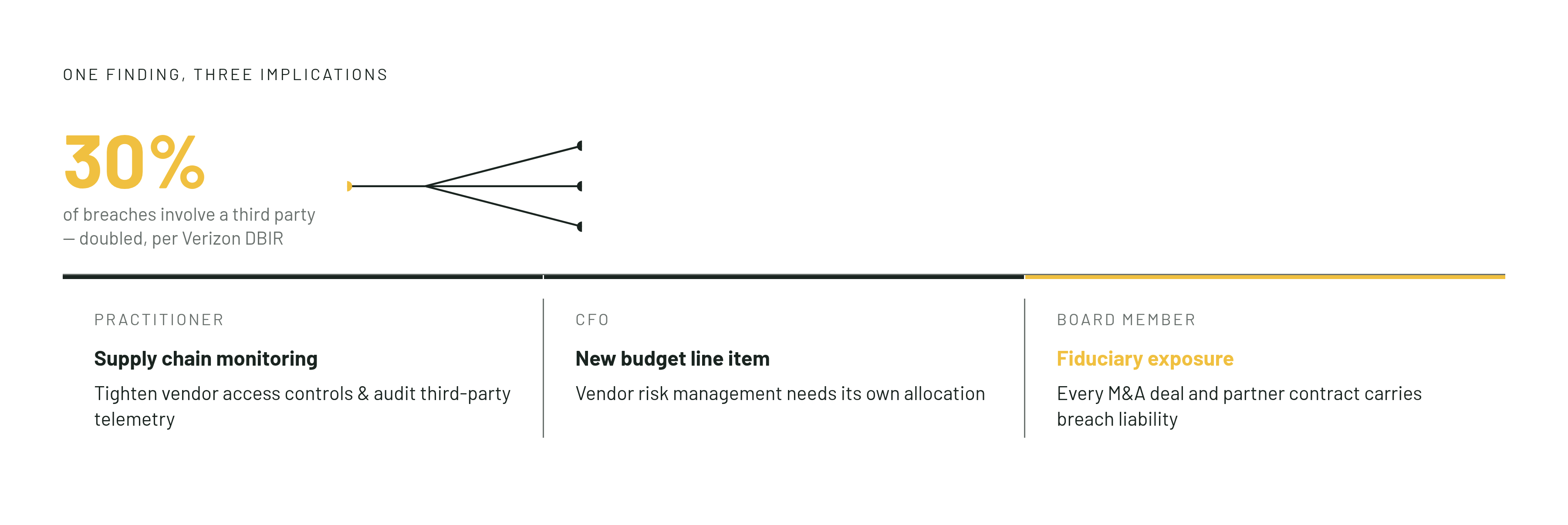
Take Verizon's finding that third-party involvement in breaches doubled to 30%. A practitioner reads that as a signal to tighten supply chain monitoring. A CFO reads it as a new line item in vendor risk budgeting. A board member reads it as fiduciary exposure sitting inside every M&A deal and partner contract on the table. Same number, three completely different implications, depending entirely on which chair the reader is sitting in.
Stripping jargon without losing the intelligence's claim to authority
Simplify carelessly and you cut the evidence right along with the jargon. A practitioner notices instantly when a statistic shows up with no methodology attached, and that missing context is exactly what makes the number worthless to them.
Sample size is a credibility signal, not a detail to trim for space. Honeywell's 2025 Cyber Threat Report analyzed 253.2 billion logs and 79.2 million scanned files across 4,600 triaged events. Hoxhunt's 2026 report draws from more than 400,000 user-reported email threats every month. Those numbers aren't decoration. They're the reason anyone should believe the finding at all, and they need to survive translation even when the surrounding technical detail doesn't.
Swapping jargon for plain language works, as long as the substitution keeps the meaning intact rather than just making the sentence shorter. An IOC becomes "a digital fingerprint of a known attack." Lateral movement becomes "the window between first break-in and full network access." Dwell time becomes "how long an attacker sat inside the network before anyone noticed." All three preserve what the term actually does, they just drop the acronym.
Then there's the deeper move: reframing around consequence instead of mechanism. CrowdStrike's finding that 82% of 2025 detections were malware-free means attackers are increasingly using tools already sitting inside the environment, things that look legitimate because, technically, they are. Say that to an executive as "fileless attacks increased" and it means nothing. Say instead that traditional antivirus spending no longer covers the threat, and suddenly it's a budget conversation.
What has to survive translation, no matter what: the source of the data, the scope of the study, and the specific number. Cut any of those and a finding turns into an assertion, one a practitioner can't verify and an executive can't use to justify a dollar of spend. What can go: acronym chains, product-specific detection logic, protocol-level details with no equivalent in a business decision.
Rebuilding the finding around business consequence rather than threat mechanics
Analysts read intelligence in one order: threat actor, then method, then indicator, then recommendation. Non-technical readers need the order flipped. Lead with the consequence, then explain why it matters to this reader specifically, then show the evidence, then state the decision it implies.
Take that 29-minute breakout time from CrowdStrike's report. An analyst would write it like this: "Breakout time dropped to 29 minutes, a 65% increase in speed from 2024, indicating adversaries are optimizing lateral movement post-compromise." True, and useless to a board member. Flip it: "Once an attacker gets inside your network, there's less than half an hour before they reach sensitive systems. Detection and response programs built around longer windows are now structurally too slow." Same data. Different door in. Different decision waiting on the other side.
Honeywell's 2025 Cyber Threat Report, covering October 2024 through March 2025, found a significant jump in ransomware extortion incidents, tied heavily to the CL0P group. For an industrial executive, the consequence-first version leads with "your sector saw nearly half again as many ransomware extortion events in six months," and only gets to CL0P's role afterward, if at all.
Scenario modeling works especially well for this audience, which is why strategic threat intelligence reports so often present projected financial loss from an attack as a scenario rather than a statistic. It maps directly onto a decision a CFO or board member can actually make: how much to set aside in reserve, how much insurance coverage to carry, whether to keep an incident response retainer on file.
And consequence has to be specific to the industry in the room. A financial executive reading M-Trends' 17.4% targeting share for their sector should not get the same paragraph as a government reader looking at 9.5%. Translation isn't finished until the consequence belongs to a specific reader in a specific seat.
What content formats carry translated intelligence most effectively to each buyer type
Format isn't about looking nice. It's about matching how someone actually reads under time pressure. A CISO walking into a board meeting needs a one-page brief with scenario and financial framing, not a white paper. A security engineer evaluating a platform needs a technical deep-dive with actual detection logic. A CFO building a budget line needs a cost-impact narrative backed by sourced numbers, nothing more, nothing less.
Industry research has found that research and survey reports carry the strongest direct influence on vendor selection, ahead of other content formats. Translated intelligence packaged as original research does more purchasing work than almost anything else a vendor can produce.
Strategic intelligence, per JumpCloud's IT Index, gets delivered best in short, jargon-free reports and briefings built around narrative, risk, and financial impact, with cost scenarios as one recurring feature for board-level readers. Practitioner content runs the opposite direction: technical blog posts that show their methodology, detection engineering notes, threat actor profiles with sourced TTPs. These work for one reason. They're specific enough to be checked, and being checkable is what earns trust with this crowd.
Nokia's 2025 Threat Intelligence Report is worth pointing at here, since it combines operational data, real-world managed security service insights, and research across the telecom sector into one product. The credibility doesn't come from piling on more numbers. It comes from layering different kinds of evidence together.
None of this happens in one shot, either. A long enterprise sales cycle needs content spaced across awareness, evaluation, and decision stages, not one big asset dropped at the start and forgotten.
Where most security vendors lose the translation in practice
The most common mistake is treating translation as summarizing: cut the technical detail, add nothing back, ship it. What's left is neither credible to a practitioner nor useful to an executive, a piece of content that satisfies nobody and wastes everybody's time reading it.
Citing "ransomware up 355%" without saying whose data that is, over what period, or what it's measured against, produces a number practitioners instantly distrust and executives can't act on. The provenance is what makes a statistic do any work at all; strip it out and you're left with a slogan.
Then there's jargon laundering, which is its own special failure: swapping one opaque term for another that just sounds friendlier. "Advanced persistent threat protection" is not translated content for a CFO. It's the same wall, repainted.
Content that ignores industry also falls flat fast. M-Trends 2025 shows financial services facing 17.4% of targeting and healthcare facing 9.3%. Generic threat content that doesn't localize to a specific vertical fails the relevance test before a reader gets past the headline, on either side of the technical divide.
And budget alone doesn't fix any of this. CISO budgets have continued to grow through the 2024 to 2025 cycle, yet close to half of those same buyers say vendor marketing still lacks technical depth. Money solves a lot of problems. It doesn't solve a credibility gap, and the vendors who close that gap first are the ones winning the evaluation, not the ones with the biggest ad spend.
That multi-stakeholder mess (eight people, three languages, one report) is exactly why content strategy built on live threat data gives a CISO, a CFO, and a security engineer something they can each act on, unlike another glossy PDF. Cyberou works from that same premise: a content studio that pairs current threat intelligence with practitioner-level writing so a CISO, a CFO, and a security engineer can each read something built for their actual decision, instead of all three fighting over one document written for someone else entirely.
Sources
- Threat Intelligence Market Report 2025 - 2030, By Application, Geo, Tech
- Threat Intelligence Market Size, Share, Drivers Report 2026-2030
- M-Trends 2025: Data, Insights, and Recommendations From the Frontlines | Google Cloud Blog
- What Is Cyber Threat Intelligence (CTI)? Definition & Types
- CrowdStrike 2026 Global Threat Report | Key Cyber Threat Trends
- Introducing the 2025 State of Threat Intelligence Report: Threat Intelligence Shifts from Defense to Strategy