Cybersecurity Research Agencies With In-House Red Team Capabilities
Embedded operators separate credible research from polished marketing.
Global cybersecurity spending hit $213 billion in 2025, growing 15% a year, according to Gartner. That growth pulls in a crowd of vendors and agencies all reaching for the same three words: research-backed, threat-informed, battle-tested. Most of those claims can't be checked, and in-house red team capability stands among the rare few that can be verified directly. It's turning into the line that separates agencies doing real adversarial work from agencies describing that work in a nicer font.
The distinction matters more than it used to, because buyers have gotten sharper. Sixty-seven percent of enterprises now run annual red team assessments, up from 43% in 2023, based on survey data from over 500 security leaders across 28 countries. They've seen the real thing, so they can smell a knockoff from across the room. Picking a research partner whose output is disconnected from live engagements used to be a subtle miss. Now it's the first thing a practitioner checks, and once caught, the credibility gap doesn't close.
What red teaming actually involves and why "in-house" is the operative word
A vulnerability scan checks boxes in an afternoon. A red team engagement emulates an actual attacker, moving through people, processes, and technology the way a real intrusion would, over days or weeks.
The discipline splits into distinct skill sets, and good operators rarely master all of them at once. There's technical exploitation and lateral movement, the part most people picture when they hear "hacker." There's social engineering, talking a help desk employee into resetting a password they had no business resetting. There's physical security testing: walking into a building with a clipboard and a face that says you belong there. And there's extended operations, engagements built to test whether the security team notices something's wrong at all, let alone stops it. MITRE ATT&CK gives the field a shared vocabulary for mapping how attackers behave across all four, and purple teaming, red and blue teams working side by side in coordination rather than in opposition, is where the field is headed next.
"In-house" carries the weight in that sentence, though. An agency can subcontract red team work to a boutique firm, get a PDF back, and call it a capability on a slide. That finding stays siloed from the agency's analysts, leaving their thinking and writing unchanged. Operators sitting in the same Slack channel as the research team, day after day, change the substance of the output. A vendor relationship wearing a skill set as a costume produces a fundamentally different product.
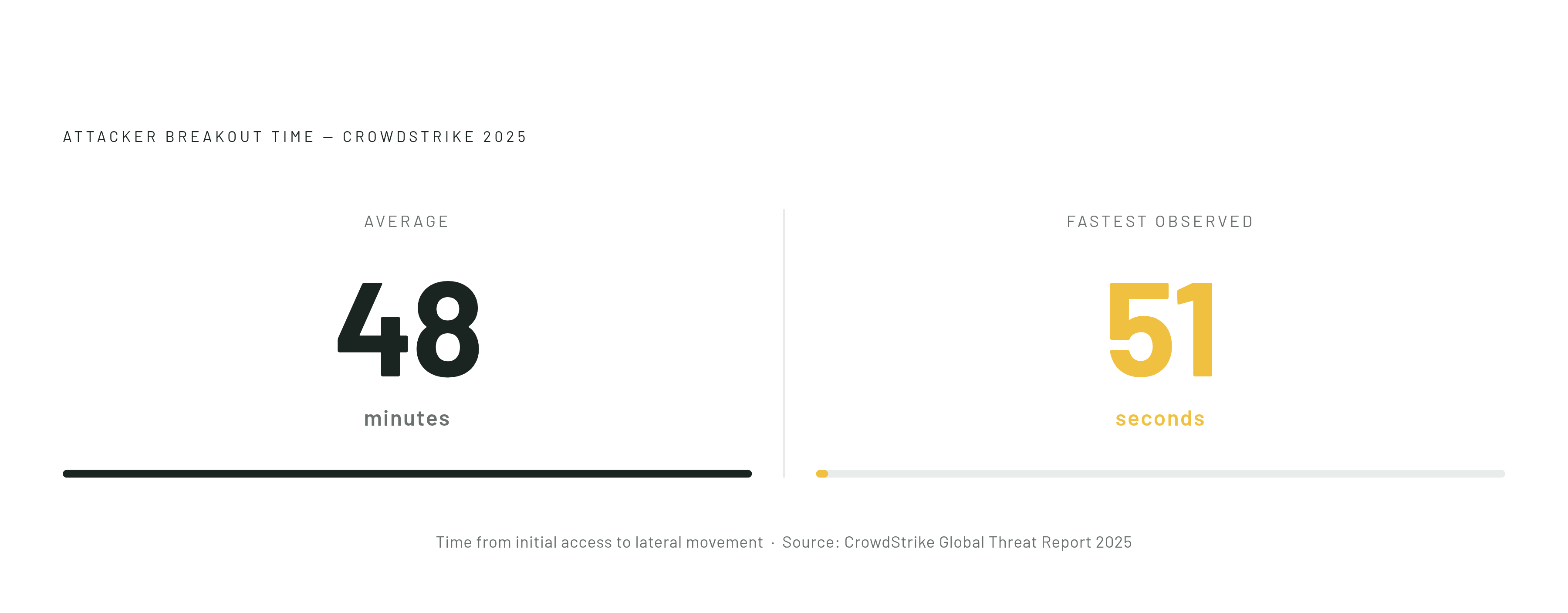
Speed is why this can't wait. CrowdStrike's 2025 Global Threat Report clocked average breakout time (how fast an attacker moves from initial access to lateral movement) at 48 minutes, with the fastest observed case at 51 seconds. A framework written last year and left on a shelf falls behind an attacker who's inside and moving before the coffee's done brewing. Add AI red teaming to the pile, testing large language models for prompt injection, jailbreaks, and agentic misuse, and there's a discipline regulators and standards bodies are actively working to define and formalize. This is the baseline now, a discipline that has moved firmly into the mainstream.
How in-house red team capability shapes the research an agency actually produces
Put a red team operator inside a research function, and their habits leak into the work whether anyone plans it or not. Threat models stop chasing vendor marketing narratives and start reflecting attack paths that actually exist, because someone in the room has walked one.
CISA's published advisories offer a useful illustration here, reflecting findings from sustained, adversary-realistic engagements that feed directly into public guidance. Findings from assessments of federal civilian agencies have surfaced persistent gaps that only become visible when someone is inside the network watching what gets caught and what slips past, because you have to be there, breaking things, to see what the defenses actually miss.
That's the gap between analyst-driven research and research with a red team pulse behind it. Reports written with operator input surface attack paths and detection gaps a literature review misses, because the writer walked the path being described rather than reading about it secondhand. Recorded Future's 2025 State of Threat Intelligence report found 43% of security leaders now use threat intelligence for strategic planning beyond reactive defense, and agencies with embedded red team input are built for that shift by default. Their material already assumes the reader is planning ahead rather than patching a hole.
The gap rarely shows up in a report's formatting or production value. It shows up when a practitioner reads a threat scenario and either nods, because it matches something lived through firsthand, or winces, because it clearly came out of a slide deck.
What to look for when assessing whether a red team capability is real and integrated
The real question goes deeper than whether an agency can provision red team services. Plenty can, the same way plenty of restaurants can heat up frozen lasagna and call it homemade. The harder question is whether the operators sit inside the research function itself, shoulder to shoulder with the people writing the reports, as opposed to down the hall or on retainer somewhere else.
A few tells separate the real thing from the branding exercise:
- Operators show up as named authors or contributors on published research, credited visibly rather than tucked into an "our team" page nobody clicks.
- Threat scenarios map to specific MITRE ATT&CK technique clusters, grounded in precision rather than vague gestures at "sophisticated attackers."
- Content tracks current adversary behavior, updating past the same three case studies from three years back.
- Coverage spans all four vectors, technical, physical, social engineering, extended operations, since narrow capability produces a narrow view of the threat surface.
A working AI red teaming practice matters too, because agencies that lack one tend to produce AI security content that reads shallow to anyone who's actually poked at a model.
Long engagements simulating real dwell time and lateral movement surface far more than a two-day assessment ever could, and CISA's advisory output offers a useful yardstick for what that depth looks like in practice. So when evaluating an agency, ask about engagement depth over how many assessments got logged this year.
Ask directly, too. Who on the red team contributed to this report? Is there a finding from a recent engagement that changed how a threat got framed? What specific TTPs are driving the current threat model? A vague answer is, itself, an answer.
Agencies that visibly combine red team operations with research and advisory output
IBM Security, CrowdStrike, and Mandiant are among the most recognized names in the competitive field, each known for combining offensive security work with published threat intelligence and advisory output. That's the operating model behind their results.
Mandiant is widely cited as an illustration of this loop closing internally, where incident response experience informs offensive security work and that work shapes published research. Some mid-tier firms work a similar approach, pairing offensive security testing with intelligence-led assessment built around one question: how well does an organization actually detect and respond, beyond whether it owns a firewall. Rapid7 and Secureworks operate in the same lane, and a wave of cloud-native specialists is starting to fold red teaming directly into CSPM and XDR platforms, blurring the line between "agency" and "software vendor" a little more each year.
CISA earns its own mention here. CISA's published advisories stand on their own as a benchmark for what practitioner-grade output actually looks like, reflecting the depth of its internal security work. The same logic applies to any security company evaluating a research and content partner as much as a pentesting vendor. A studio where analysts sit next to active red team operators produces work that earns trust with technical readers in a way a generalist shop cannot replicate, regardless of how good its writers are.
Why the red teaming market's growth is making this capability easier to verify
The global red teaming market hit $1.8 billion in 2025, up 28.6% from $1.4 billion in 2024, according to survey data spanning 500-plus security leaders across 28 countries. Regulatory pressure, high-profile breaches, and a consensus that traditional pentesting is insufficient are driving that growth. North America holds 38.5% of the market, which lines up with both enterprise demand and a regulatory stack (SEC disclosure rules, HIPAA, PCI-DSS, critical infrastructure standards) turning red teaming into a documented, auditable requirement.
Here's the part that actually helps buyers: as red team assessments become routine, that 67% annual adoption figure again, more security leaders have run one firsthand. That familiarity exposes agencies that lack operational depth, because buyers finally have a reference point. Emerging standards frameworks do similar work for vocabulary, giving buyers reference points to check agency claims against rather than relying on the sales deck alone.
A growing market attracts opportunists too, of course, and plenty of agencies without the operational infrastructure to back it up are branding themselves as red team shops anyway. That's exactly why the checklist two sections back exists. The signal is getting diluted at the same rate the market is growing, and buyers need sharper tools to tell the two apart.
What in-house red team capability signals about an agency's broader relationship with the threat landscape
The red team itself is only part of the picture. What matters is what it takes to keep one running: constant contact with live adversary behavior, the discipline to update tactics as fast as attackers update theirs, and a culture where practitioners decide what counts as accurate.
That connects to a bigger problem across threat intelligence generally. Recorded Future's 2025 State of Threat Intelligence report found that integrating threat intelligence into broader security practice remains a persistent challenge for many organizations. Agencies with red team operators embedded in their research function have already solved that integration problem internally.
That matters for security vendors beyond their own walls, too. The research and content a vendor publishes is a credibility signal on its own, and practitioners can tell almost immediately whether it reflects real adversarial understanding or was assembled from other people's blog posts. An agency whose research runs on live red team thinking is simply better positioned to help those vendors close that gap, because the same rigor that makes a red team finding trustworthy is what makes security content trustworthy.
It comes down to one test, in the end. Does the agency's research contain claims that only someone with actual adversarial experience would know to make, or does it read like something anyone with a browser and a threat report subscription could have assembled over a long weekend?