Turning Vulnerability Disclosures into Thought Leadership
Security vendors build authority by covering fewer disclosures with deeper analysis.

More than 130 new vulnerability disclosures hit the wire every day. Most security vendors respond by either ignoring the flood or writing about all of it, and both approaches fail for the same reason: neither one applies judgment. The vendors who actually build authority in this space are the ones who pick a small number of disclosures that mean something and go deep, while letting the rest pass by without comment.
That sounds simple, but it isn't. The rest of this piece is about how to do it on purpose instead of by accident.
By mid-2025, the CVE catalog had passed 21,500 entries for the year, up 16 to 18% over the same point in 2024, according to deepstrike.io's vulnerability statistics report. Stay on that pace and the full-year count creeps toward 50,000. The cumulative database now holds over 300,000 entries, and this is a structural fact of the profession now, the way weather is a structural fact of farming.
For practitioners, the volume was already too much to handle by hand years ago. For vendors, publishing a take on every single disclosure doesn't make you thorough, it makes you noise. Nobody builds a reputation by being the loudest voice in a room where everyone is shouting. The opportunity lies in signal: figuring out which disclosures actually tell practitioners something they can't get from a three-paragraph advisory, and skipping the rest entirely.
What makes a vulnerability disclosure worth writing about
Three questions do almost all the filtering. Does the vulnerability hit something widely deployed? Is there active exploitation, or a public proof-of-concept, backing it up? And does it expose something structurally interesting about how attackers actually work, rather than just being one more bug in one more product?
The timing question is the sharpest of the three. Tenable looked at 63,862 CVEs disclosed between January 2024 and September 2025 and found that only 2.6% ever got a public proof-of-concept. That's already a small slice, but of that small slice, 56% had a PoC published within seven days of disclosure. That figure is the whole editorial filter in one sentence: when a PoC shows up within a week, the gap between "this exists" and "this is being used against you" collapses fast. A vendor publishing sharp analysis inside that window is doing the job practitioners actually need done.
Severity scores don't carry the same weight, and this trips people up constantly. Most high-CVSS vulnerabilities never get exploited at scale, full stop. A 9.8 score sitting untouched in the wild teaches nobody anything, while exploitation evidence, attribution to a known threat group, and PoC timing all matter more than the number on the label.
There's a third filter worth naming separately: does the disclosure describe one bug, or a whole class of bugs? Instance-level findings (this one product, this one flaw) are good for a fast reactive post. Class-level findings (this entire category of authentication bypass, this whole pattern of misconfigured cloud storage) support a sustained content series that pays off for months.
Here's the part vendors underrate: choosing not to write about something is itself a signal. When a security team consistently skips the noise, practitioners notice, and they start trusting the stuff that does get published. Silence, applied deliberately, is a credibility tool.
The exploitation timeline that turns a disclosure into a narrative
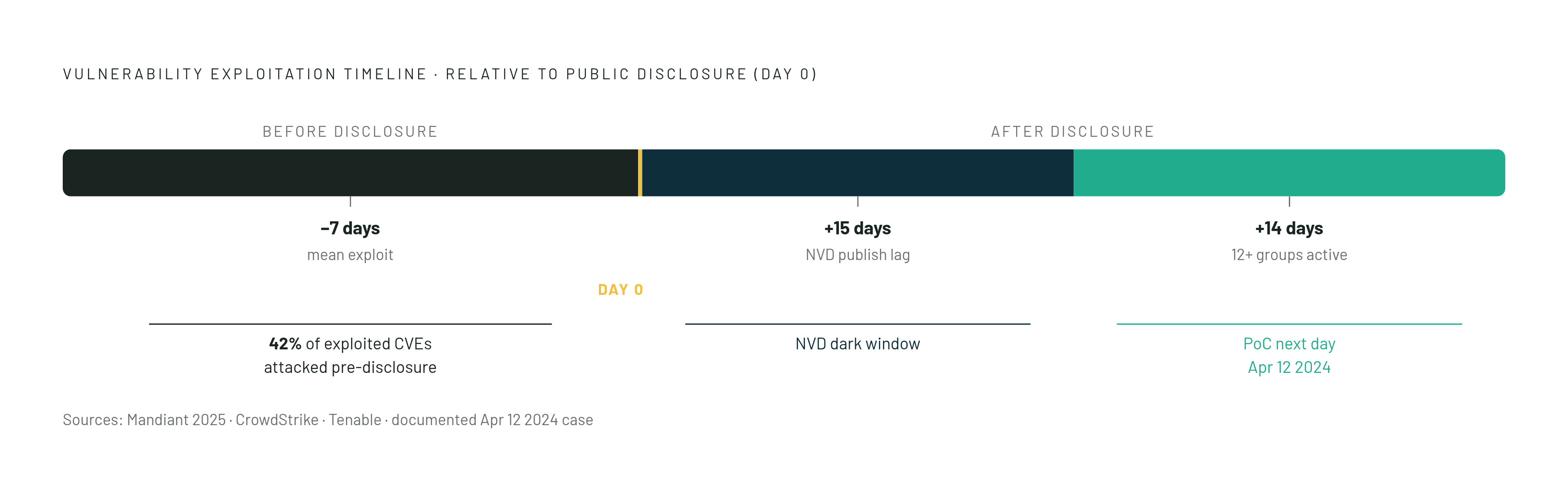
Something strange happened to the exploitation clock, and it's worth sitting with. Mandiant recorded a mean time-to-exploit of negative seven days in 2025, meaning that on average, attackers are already exploiting a vulnerability before it's even publicly disclosed. CrowdStrike backs this up from a different angle, finding that 42% of exploited vulnerabilities were attacked before public disclosure ever happened.
That flips the old model on its head. "Patch when the advisory drops" was always a little behind reality; now it is obsolete. A vendor whose research team is tracking exploitation before the advisory even exists is offering intelligence nobody else in the room has.
Add to that the lag baked into the official system: Tenable found an average 15-day gap between disclosure and publication to the National Vulnerability Database. Any scanning tool leaning on NVD as its core feed is structurally, permanently behind, because the pipeline itself has a two-week hole in it.
Mandiant's M-Trends 2025 report lays out the clearest template for what this looks like in practice. A vulnerability disclosed on April 12, 2024, got a public PoC the very next day. Within two weeks, more than a dozen separately tracked threat groups were exploiting it. Disclosure, then PoC, then coordinated exploitation by named threat actors, all inside fourteen days. That sequence, disclosure to PoC to mass exploitation to named attacker, is a reusable narrative skeleton. Any vendor with real research behind them can hang their own findings on that same frame.
Zoom out and the enterprise picture gets starker. Google's GTIG 2025 review tracked 90 zero-days exploited in the wild, and 43 of them, 48%, targeted enterprise technologies specifically. That's the highest enterprise share on record. The target has moved from consumer software to the stuff running your business, and the timeline from bug to breach keeps getting shorter.
For a content team, mapping that timeline is not a side analysis to append after the fact. It's the entire hook, built from urgency and differentiation, on the back of the same set of dates.
How to layer a single disclosure into content that reaches both practitioners and leadership
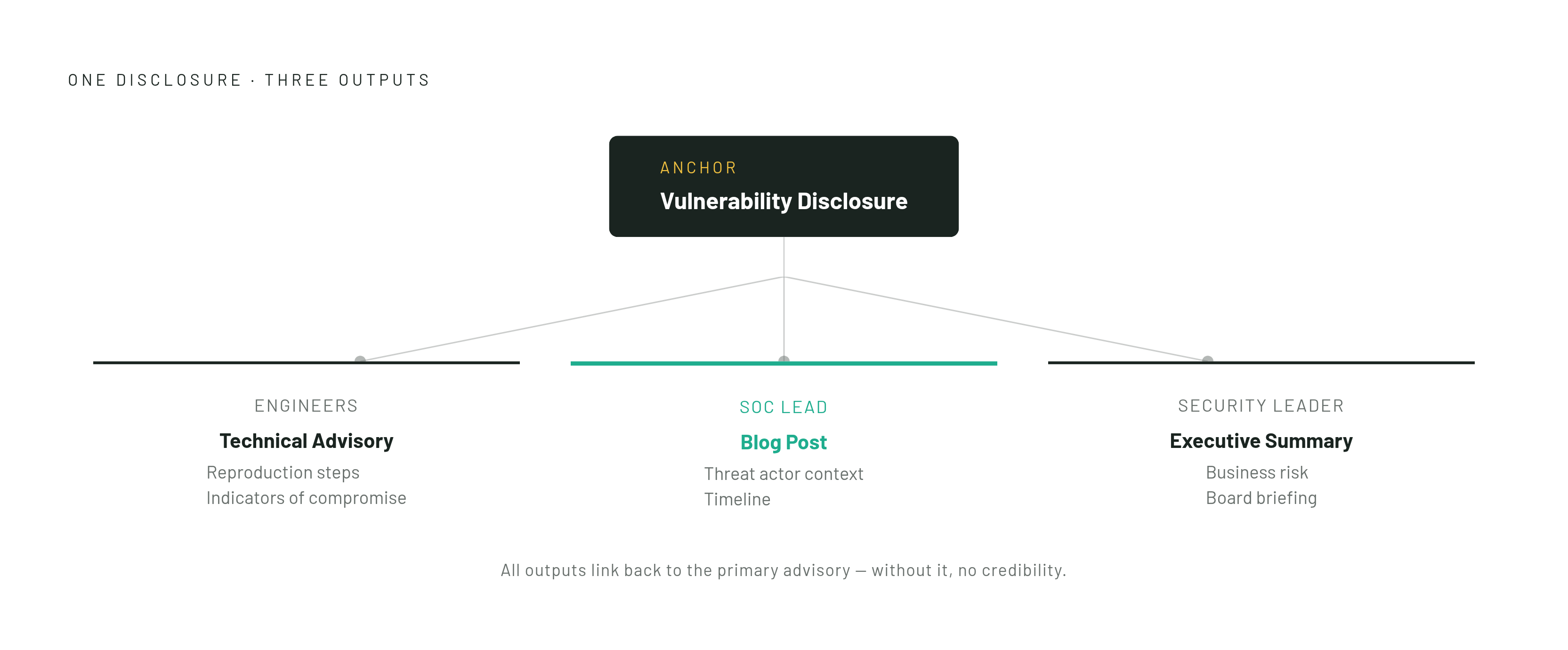
One disclosure, done right, can feed three completely different pieces of writing at once. A technical advisory with reproduction steps and indicators of compromise, aimed at the engineers doing the patching. A blog post with threat actor context and a timeline, aimed at the SOC lead trying to prioritize their week. And an executive summary translating all of it into business risk, aimed at the security leader who must explain it to a board unfamiliar with vulnerability disclosures.
This is what Tenable, VulnCheck, and Mandiant do at scale already. What separates them from most mid-market vendors is a mindset: they treat a disclosure as a content event with three outputs, not a single advisory that gets published once and forgotten.
Here's the production trap: collapsing all three registers into one document. Try to write for the engineer and the board member in the same paragraph and you'll satisfy neither. The engineer wants indicators and reproduction steps. The board member wants a dollar figure and a risk rating. Mixing those voices tells both readers the vendor didn't think hard enough about who they're talking to.
The stakes for getting this right have gone up. SEC cyber disclosure rules have put vulnerability exposure directly in front of boards, which means security leaders now need metrics that a non-technical board member can actually act on. For any vendor selling upmarket, the executive layer is the layer that closes the deal.
Mandiant's M-Trends report, now in its 15th edition, is the clearest public proof that a single research program can work as both a technical reference and a strategic narrative simultaneously. Median dwell time dropped from 205 days in 2014 to 11 days in 2024. That's a trend line built one year at a time, and it's exactly the kind of long-run number that makes each new edition carry more weight than the last.
The production sequence that makes this repeatable: the researcher documents the findings internally, the content team co-authors the three layered outputs alongside them, and every single output links back to the primary advisory as the anchor. No advisory means no credibility, and everything else builds off that base.
Why practitioner credibility is the only standard that matters for this kind of content
Security practitioners recognise reheated advisory text immediately. If the "analysis" is just a restatement of what the vendor's own advisory already said, with no new interpretation layered on top, it reads as filler, and it gets ignored. The only thing that earns attention here is a layer of insight that could only come from someone who actually did the digging.
What does real practitioner-grade work look like? The vendor's team was tracking the disclosure before it ever hit NVD. They mapped exploitation attempts to specific named threat groups. They produced detection logic or remediation guidance that goes further than what the original advisory offered. That's the bar.
The inverse matters just as much, maybe more. A vendor claiming "our product would have caught this" without showing the work does more damage than saying nothing at all. Practitioners are reading vendor blogs for information they can use in the next hour of their shift.
Some context on how little patience that audience has for stale news: Verizon's 2026 DBIR found vulnerability exploitation became the number one initial-access vector in breaches for the first time, at 31%. Practitioners already know that number by the time it's published. A piece of content that opens with a statistic the reader has already seen, and doesn't add anything past it, tells that reader the vendor is following the news cycle instead of getting ahead of it.
Experienced practitioners already feel this in their gut: technically sound findings lose their punch when the writing buries the recommendation three paragraphs deep, or when the structure ignores how much a tired reader can actually absorb. Rigor and readability are supposed to work together.
Here's the test, and it's a simple one: would a competent security engineer learn something they didn't already know, or find better words for something they already suspected but hadn't quite articulated? A "no" on both counts means the editorial call that picked this disclosure in the first place was the wrong call. Fix the filter, not the writing.
Building a repeatable editorial process rather than reacting to each disclosure
Most security vendors already have researchers capable of producing sharp, credible analysis. That's rarely the missing piece. The missing piece is cadence. Without a defined process, disclosure-based content only happens when someone happens to have a free afternoon, and a free afternoon has nothing to do with when the exploitation window is actually open.
A workable process runs on three gates. Triage first: does this disclosure clear the filters from the second section? Production next: which of the three output layers, technical, practitioner, executive, does it actually support? And timing last: can the analysis get published before the PoC window slams shut?
A coordinated vulnerability disclosure program is a good illustration of how this becomes self-sustaining. Each project can function as a legitimate security service, a source of original research, and a piece of publishable content, all three at once. The content is a predictable byproduct of research that was going to happen anyway.
First-party intelligence is the highest-value fuel for this engine, and it's worth being specific about why. Data pulled from a vendor's own sensors, honeypots, or deception systems can't be copy-pasted from a commodity threat feed, because nobody else has it. Content built on top of it can't be replicated by a competitor with a faster blog and a bigger content budget, because the competitor doesn't have the underlying data.
Original research also compounds in a way one-off blog posts never do. A single well-built research report can carry months of downstream content, pick up press citations, and get referenced by analysts long after the initial publish date. Money spent on the research process is, in effect, money spent on the content pipeline too. Treating them as separate budget lines misses the point entirely.
And the calendar for all of this should be event-driven, not date-driven. Build a process designed to fire the moment a disclosure clears the filter, whenever that happens to land, rather than one designed to fill next Tuesday's publishing slot.
What sustained disclosure-based content builds over time
When a high-profile disclosure hits a widely deployed platform, press coverage follows fast. Scale gets you attention. Credible analysis is what gets you cited.
Run that pattern across enough disclosure cycles, applying the same selection logic and the same production standard each time, and something shifts. The vendor becomes the name practitioners cite when they're briefing their own leadership up the chain. That citation habit, repeated enough times, is what thought leadership actually means in this market: a pattern of being useful, often enough, that people start pointing to you by default.
The money backs this up, too. The threat intelligence market hit an estimated $11.55 billion in 2025, according to MarketsandMarkets, with a projected 14.7% compound annual growth rate through 2030. Buyers in that market are buying because a vendor demonstrated they can actually analyze a threat, and disclosure-based content is the most direct proof of that capability available.
The compounding works like this: one credible piece of analysis gets cited by another credible source, which tells practitioners the research team behind it is worth following, which generates inbound attention no paid placement can buy. Vendors who go quiet on every disclosure lose that compounding entirely, ceding the space to whoever does show up, while vendors who comment on everything lose it just as fast, training their own audience to tune them out.
None of this requires a research team the size of a small university. It requires a selection framework, applied the same way, every single time a disclosure crosses the desk. That discipline is the minimum viable process. Everything else, the citations, the inbound attention, the reputation that outlasts any single advisory, follows from doing that one thing consistently.