Commissioning Third-Party Security Research for Credibility
Independent research partners earn practitioner trust where vendor claims alone cannot.
Cybersecurity spending hits $213 billion this year, up from $193 billion in 2024, and every dollar of that growth pulls more vendors into the same crowded room. This piece is about the one credibility move that still works in that room: commissioning third-party research, done in a way that survives contact with a skeptical buyer and earns genuine practitioner trust.
Here's the paradox nobody in marketing wants to say out loud. Demand for security products has never been higher, and buying committees have never been more allergic to being sold to. Average committee size went from 6.2 stakeholders in 2021 to 8.1 in 2024, so now your slick one-pager has to survive a CISO, a SOC lead, a procurement analyst, and a handful of people who will ask the one question you didn't prep for. Say "scalable, AI-driven, end-to-end platform" one more time and see what happens. Nothing happens. That's the problem. Nobody even looks up anymore. Marketing buzzwords are like fog machines at a magic show that once created wonder and now just make everyone cough.
What practitioners actually trust when evaluating security vendors
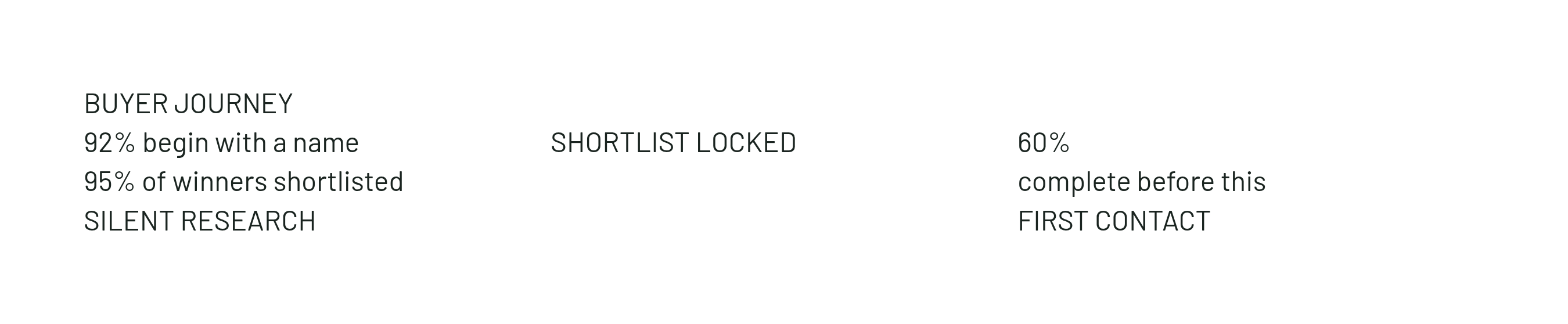
Buyers show up with their minds mostly made up. 92% start their vendor journey with a name already in mind, and 95% of eventual winners were already on that shortlist on day one. The deal gets won months earlier, in whatever the buyer read before they ever filled out a contact form, long before any demo happens.
That tracks with how much of the journey happens without you in the room. Buyers complete roughly 60% of their research on their own, which means by the time your SDR gets a reply, most of the persuading is already done or already failed.
And what actually persuades them? 35% of B2B tech buyers say they trust independent research analysts, a real and meaningful signal that the same fact lands differently depending on who's saying it, a homepage claim included. Peer proof and third-party research are cousins at the same family reunion. Both work because the source isn't the one with something to sell.
Security leaders in particular run on data and evidence. Which leads to a blunt structural fact: a claim from the vendor gets discounted on arrival, while the identical claim attributed to an outside researcher gets a premium. That discount-versus-premium gap is the entire reason commissioned research exists as a category, and it amounts to a trust transfer, full stop.
Why commissioned research in particular closes the credibility gap
Buyers who read 13 or more pieces of content before ever booking a call arrive at that call already decided. So research that circulates before your sales team ever picks up the phone is doing the actual selling. Everything after that is paperwork.
The difference between a vendor blog post and commissioned research is format, not framing. A blog post states a claim. Research demonstrates something under conditions set and controlled by an independent partner. That's the whole trick, and it's really just accountability wearing a different name. Cyberou, a cybersecurity content studio that grounds its work in live threat intelligence, is built on that same distinction.
Look at what happened when SecurityScorecard partnered with the Cyentia Institute. The finding, that 98% of organizations have a relationship with a third party that suffered a breach in the past two years, read like a headline, because it was one. Bitsight did something similar working with Google, analyzing close to 100,000 organizations across nine industries. Practitioners trusted the number before they even got to the conclusion, because the methodology and the partner's name did the convincing first.
That's the pattern across every example worth studying: pair with a partner practitioners already respect, whether that's Cyentia, Forrester, Google, or 451 Research, and the resulting work gets picked up by press, gets passed around Slack channels and Discord servers full of security engineers, and eventually becomes part of how people talk about the problem. Self-published vendor surveys tend to get closed tabs instead. And when a neutral outlet amplifies commissioned research, it behaves like word of mouth at scale, the same mechanism practitioners consistently cite as among the most influential factors in vendor consideration.
How the structural independence of the research partner determines whether practitioners accept or dismiss the findings
Independence is structural and verifiable. Practitioners check it the hard way: who ran the study, what methodology got published alongside it, and whether the vendor had a red pen anywhere near the conclusions.
Group-IB commissioned Forrester Consulting to evaluate its Threat Intelligence and Attribution offering, and Forrester ran the customer interviews and financial modeling on its own. The vendor's job was to pay for it and hand out copies. That division of labor is the whole point.
Another example: a major infosec vendor's work with 451 Research (part of S&P Global Market Intelligence) produced an award-winning report on data threats and cloud security. The finding mattered, sure, but 451's name is what got it into rooms the vendor couldn't have entered solo.
Practitioners have a nose for the fakes, too. Red flags include a vendor sitting on the raw dataset, a vendor cherry-picking which findings see daylight, no methodology section anywhere, and no named research partner at all. If you can't answer "who ran this and how" in one sentence, you've already lost the room. The bar for independence is structural: a named partner, a disclosed method, full editorial authority retained by the named research partner. Picking that partner is a credibility decision that shapes how every single number in the report gets read.
What makes the methodology credible to a practitioner audience
Practitioners actually read the methodology section, and that's a warning as much as a compliment. "We surveyed security professionals" with no sample size, no selection criteria, and no stated controls is an instant tell that nobody's checking this thing twice.
Quick one: why did the survey refuse to cite its sample size? Because it had something to hide, and so does everyone who tries that trick.
Data grounded in something real, live telemetry, actual breach records, documented incident patterns, earns citations. Opinion surveys alone don't carry the same weight, and practitioners know the difference on sight. The Verizon Data Breach Investigations Report earns its yearly authority precisely because it applies the same rigorous method to real incident data, year after year. Anyone commissioning research should treat that report as a syllabus.
This audience isn't guessing at quality either. Nearly half of security professionals, 49%, describe their own threat intelligence maturity as advanced, running automated workflows with dedicated teams, according to the 2025 State of Threat Intelligence report. These are people who can pull apart a methodology section for sport. So disclose your sample size. Name your data sources. State your scope limits plainly, and include findings that put the commissioning vendor in an awkward spot. Research that only proves what the vendor already believed is marketing. Research that surfaces something inconvenient, something the vendor has to work around rather than work with, earns the label of research. That's the entire test.
How to structure the research so it serves practitioners, not the sales deck
Structure does the credibility work, not persuasion.
Good research answers a question practitioners are already losing sleep over, chosen entirely on its merits rather than reverse-engineered toward a purchase conclusion. And different readers want different things from the same study: security leaders and VPs gravitate toward strategic framing, while engineers and SOC analysts want the technical guts, the operational detail, the part that actually helps them do their job Monday morning. Serving both takes deliberate work at the framing stage.
A few structural habits protect the whole thing. Lead with findings, not vendor throat-clearing. Put the data before the interpretation. Keep any vendor positioning to a short section at the very end.
Research built around a real threat-landscape question, third-party breach exposure, gaps in detection coverage, how AI-driven threat actors actually operate, spreads on its own because practitioners share what's useful and skip what's promotional. Sales gets a copy of the research too, sure, but it should be written for the practitioner who reads it entirely on their own terms. When the two versions read differently, ship the practitioner version.
Where the commissioning process most commonly breaks down
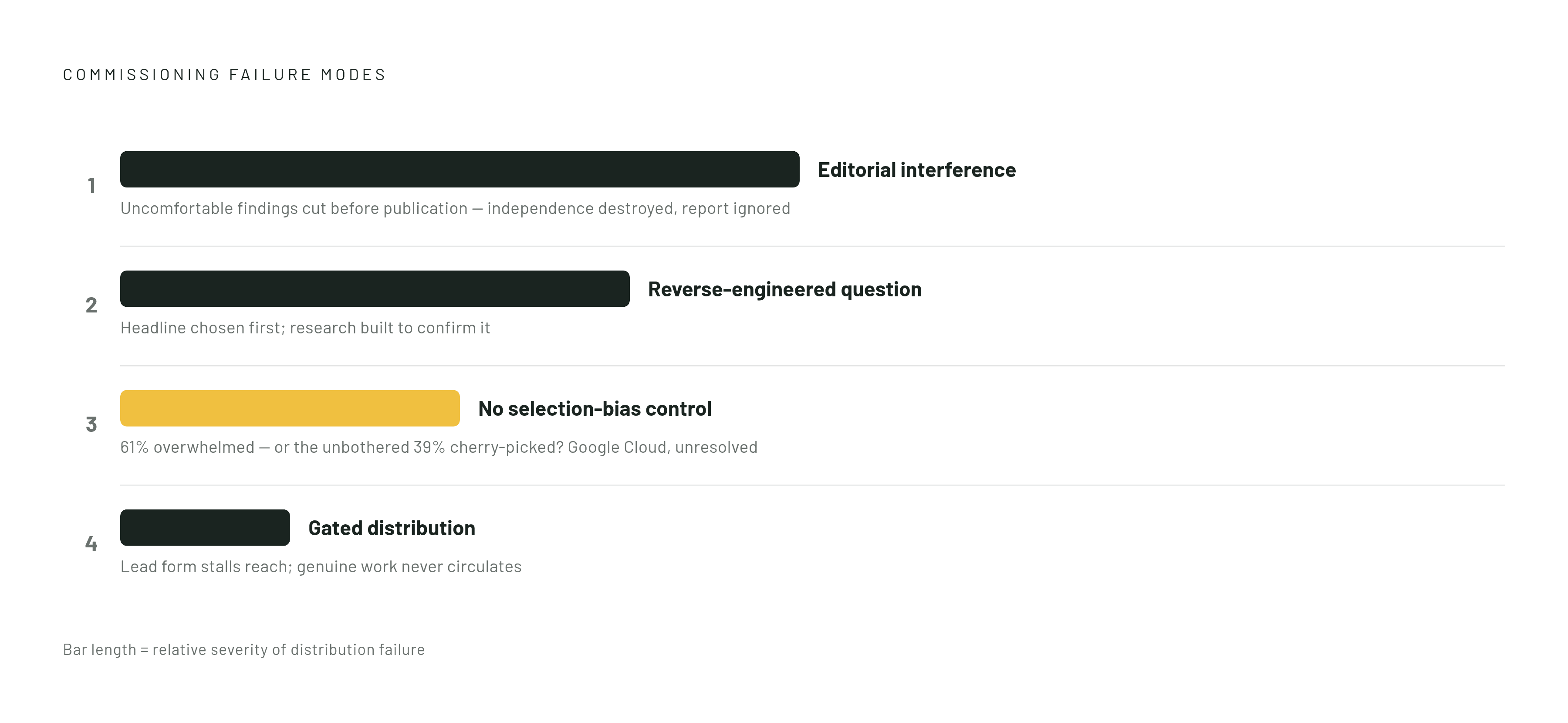
Failure number one, and by far the most common: marketing reviews the findings before publication and quietly files down anything uncomfortable. Independence you built on day one gets undone in a single editing pass on day ninety. It's a strange kind of self-sabotage, spend six figures on a credible partner, then hand the eraser to the same team the research was supposed to convince people to ignore.
A friend of mine who runs research partnerships for a mid-size vendor told me about the time her team commissioned a genuinely rigorous study, only to watch a VP ask, in the final review, whether they could "soften" a finding that made their own product look average. She pushed back, lost the argument, and watched the published version get quietly ignored by the exact analysts they'd hoped would cite it. Eighteen months later, a competitor ran the same study honestly, uncomfortable findings included, and that version is the one still getting cited in conference talks today. She keeps the two PDFs side by side on her desktop as a reminder of what flinching costs.
Failure number two: designing the research question backwards from the headline you already wanted. Practitioners can smell a survey built to permit exactly one conclusion, and once they smell it, the whole report is compost.
Failure number three is quieter and more technical: commissioning a survey without controlling for selection bias. A Google Cloud-commissioned survey of more than 1,500 professionals found 61% report feeling overwhelmed by threat intelligence feeds. Imagine that same vendor deciding to publish only the answers from the 39% who weren't overwhelmed. The study would collapse the second anyone checked the math, and somebody always checks the math.
Failure number four: gating genuine research behind a lead form. If reading it requires an email address and a phone number you didn't want to give up, the exact practitioners who would have shared it with their team never see it in the first place, and the whole distribution engine stalls before it starts.
Here's the part that should scare vendors more than doing nothing: a commissioned study that practitioners catch being methodologically hollow does more damage than never commissioning anything at all. Faking it earns a memory, and that memory travels in exactly the community you were trying to win over.
How research-backed content compounds over the buying cycle
Security deals at the mid-market and enterprise level run 12 to 18 months, sometimes longer, which is a long time to stay relevant with one press release. A single strong research study can spin off technical writeups, detection guides, and practitioner briefings that keep the vendor's name in front of buyers across that entire stretch, well beyond launch week.
The real payoff shows up when a statistic escapes the report entirely and starts living in CISO briefings, incident write-ups, conference talks, places the vendor reached without an introduction. That's the vendor's name doing work in rooms it physically never entered. Good research is a bit like a seed on the wind: you control only whether it was healthy enough to grow once it landed.
Among the content categories that move sophisticated buyers, original research, live threat intelligence, named case studies, and analyst validation, commissioned research sits at the top and feeds everything below it. Each derivative piece, a detection guide, a technical breakdown, inherits a slice of the original study's credibility. A writeup grounded in real commissioned data earns practitioner trust; one built on vibes and a stock photo of a hooded figure at a keyboard does not.
Vendors who treat this as a yearly habit, returning to the same research question with fresh data each cycle, build something that outlasts any single sales cycle. That's the actual target: becoming the vendor whose numbers get quoted before a prospect has ever spoken to your sales team. Building that reputation takes sustained, repeated effort. It comes from doing the same disciplined thing, again and again, until the research is the reputation.