Original Security Research as a Marketing Asset
Original security research establishes vendor credibility where marketing claims automatically fail.

Cybercrime is on track to cost the world $9.5 trillion in 2024, and Cybersecurity Ventures has it climbing 15% a year toward $10.5 trillion by 2025. That number quickly becomes a threat environment. In that environment, a vendor claiming "our product stops threats" carries about as much weight as a fortune cookie.
How security buyers decide, and why vendor claims don't survive contact
Here's the uncomfortable part for anyone in security marketing: the sale is mostly over before the sales call even starts. Research puts the number at 81% of buyers who already have a preferred vendor by first contact, with 85% locking in purchase requirements before they ever reach out. Whatever glossy one-pager or "trusted by industry leaders" banner you had queued up, it's showing up to a decision that already happened.
Buyers discount self-description on sight, too. They go looking for peer accounts, analyst write-ups, practitioner commentary, anything that didn't come from the company selling the thing, because source matters as much as substance here. Nomadic Advertising found 76% of security leaders got budget increases heading into 2024 to 2025, and more money hasn't made anyone more credulous. If anything, the skepticism sharpens as the checks get bigger.
Worth sitting with the backdrop for a second. The FBI's IC3 logged hundreds of thousands of complaints in 2025, tied to billions of dollars in reported losses, and read against that, "industry-leading protection" just sounds like noise.
Security questionnaires are where this skepticism gets formalized, honestly. Buyers want documentation, not adjectives. A vendor that already talks in evidence-first language has cleared a filter most marketing campaigns never even find.
What original research actually does to a vendor's position in the market
Original research changes what a vendor is in the market's eyes. The right word for it is an authority position. Buying attention and earning citations run on two completely different economic models, and only earning citations compounds.
A well-built piece of research travels beyond its own webpage. It gets picked up by a journalist, referenced in an analyst note, quoted in a competitor's blog post (awkward, but it happens), and increasingly it turns up inside AI answer engines that seem to prefer original data over recycled opinion. Each pickup reinforces the next one. A trade-press citation becomes the data point an analyst cites, which becomes the answer an AI system serves up when someone asks a question in that category six months later. A customer testimonial video, however nicely it's lit, stays put.
Placement matters too, and it's a detail a lot of marketing teams skip past. Publish the exact same research on a trusted third-party site and it reads as more credible, because where the data lives is part of the evidence.
Underneath all of it: storytelling asserts, research demonstrates. A practitioner can poke at a demonstration, check the sample, replicate the logic. An assertion asks only for belief.
The buying committee that research must actually move
Nobody buys security software alone anymore. Gartner's 2024 data puts the average enterprise buying group at 11 stakeholders, up to 20 on complex deals, a 57% jump since 2017. Each added stakeholder shaves off roughly 10 points of purchase probability, which explains a lot about why deals stall even when the room seems to like you.
Cybersecurity has followed the same curve. Committees grew from 6.2 stakeholders in 2021 to 8.1 in 2024, heading above 9 by 2026. Security staff now share this with executives; 31% of buyers say the CEO gets highly involved in cybersecurity purchases, and 37% say the same about the CFO. Financial scrutiny now sits in the same room as technical scrutiny, at the same time, in the same meeting.
That's a real content problem, not a theoretical one. Security leaders want board language, risk exposure, financial impact, while security engineers want something they can run through their own mental test lab, detail specific enough to survive contact with what they already know. Most vendor content picks a lane and abandons the other audience. Research that carries strategic framing and technical rigor at the same time is one of the few formats that can move a whole committee.
SANS found 83% of organizations say threat intelligence improved their security posture in 2024, and yet most security leaders still can't translate that into something a board will fund. Research that closes that specific gap gets forwarded to a CFO ahead of a budget meeting, which is a much better outcome than a PDF download nobody opens twice.
What separates research that earns authority from research that gets ignored
Practitioners have sharp eyes for shallow work. One vague claim, one number nobody can verify, and the whole piece loses the reader right there. You get one shot at accuracy, on the first try.
Verizon's Data Breach Investigations Report is the benchmark, whether people admit it or not. The 2025 edition analyzed 22,052 real incidents and 12,195 confirmed breaches, and the authority comes straight from the mix of contributors behind it: law enforcement, forensic firms, insurers, Verizon's own VTRAC investigators. Nobody argues with the DBIR's numbers because the sourcing is laid out plainly enough to check yourself.
CrowdStrike's Global Threat Report runs on the same logic, built by analysts tracking more than 280 named adversaries. The 2026 edition found average eCrime breakout time dropped to 29 minutes (a 65% jump in speed from 2024), with the fastest breakout on record clocking in at 27 seconds. Those are numbers journalists quote verbatim and practitioners test against their own incident logs that same week. Proofpoint's Voice of the CISO report runs on 1,600 surveyed security leaders worldwide, and it's the methodology transparency, not the survey size, that makes the figures usable elsewhere, since practitioners quote only numbers they can trace.
Line these three up and the pattern's obvious enough. Primary data beats secondary synthesis, named methodology beats vague sourcing, and specific findings beat "the industry agrees," which is lazy shorthand for nothing in particular. Annual security reports are common enough now that a repository exists just to catalog them, so the rigor behind it is now the differentiator.
How research formats match different strategic objectives
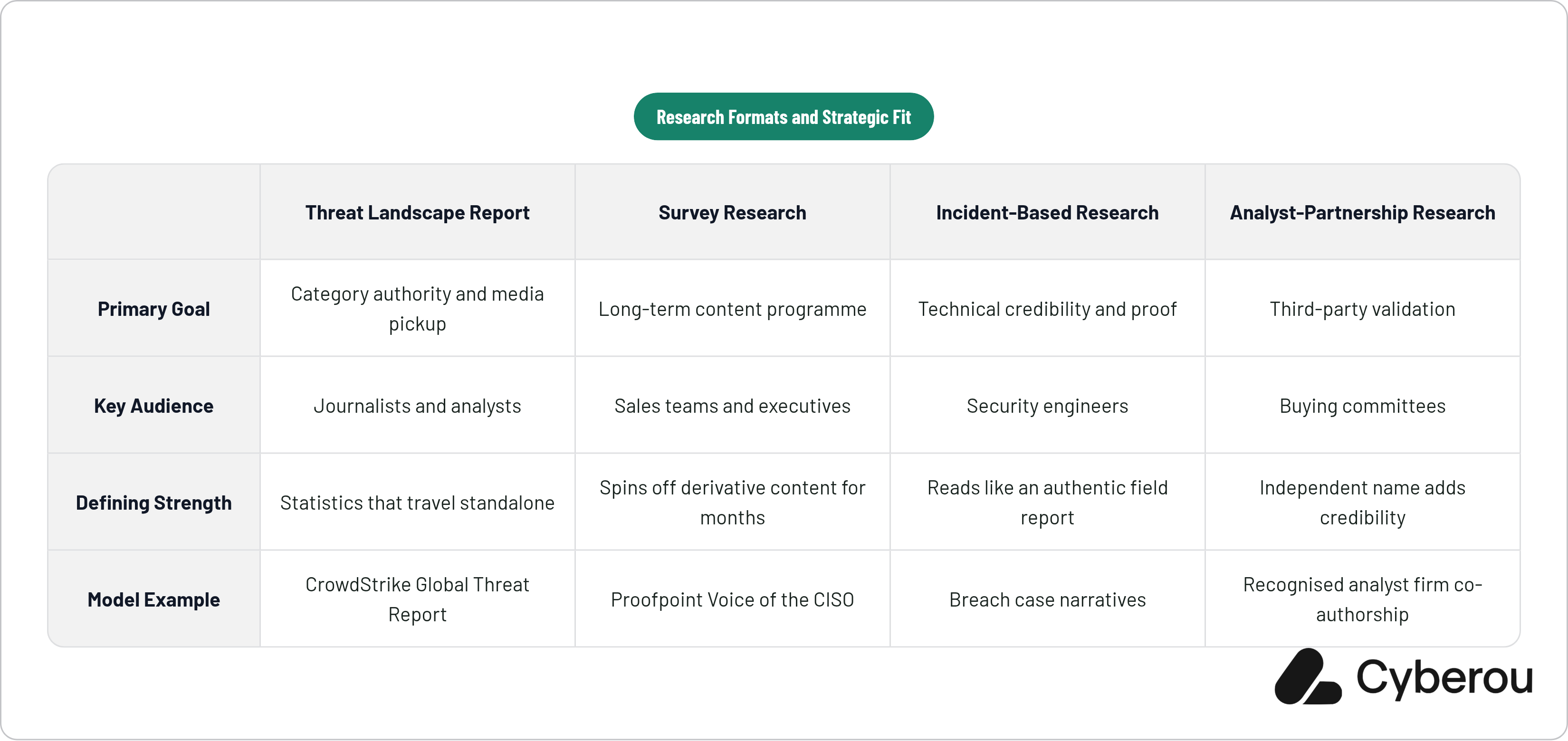
Different formats solve different problems, and picking the wrong one for your goal means wasting a research budget on the wrong audience.
Threat landscape reports, the CrowdStrike and Verizon model, exist for category authority and media pickup. Their job is producing statistics specific enough to travel alone, quoted in articles on their own terms. That's the format working exactly as intended.
Survey research, the Proofpoint model, plays a longer game. One well-run survey spins off a flagship report, a dozen derivative blog posts, conference material, and sales-enablement content a rep is still pulling out ten months later. Longevity matters more than launch impact here.
Incident-based research, built around real case narratives, shows the product or the team working against an actual threat under actual conditions. Security engineers respond to this format most, because it reads like a field report.
Analyst-partnership research buys a kind of validation you can't manufacture alone; collaboration with a recognized third-party analyst firm carries weight because an independent name sits next to yours. Niche research earns its keep by staying narrow. Niche reports like a dedicated Insider Threat Report tend to perform precisely because they stick to one threat domain.
All of these formats suit different strategic objectives. The question is which authority gap you're closing, and who actually needs to move.
The production requirements that determine whether research survives a technical read
Technical accuracy is the floor, maintained throughout the entire process. One verifiable error and the whole structure comes down, taking the marketing value with it on the way.
Practitioner involvement matters more than most marketing teams treat it. Engineers and analysts who use these tools daily know instantly when a finding doesn't match reality, and research produced without them shows its weakness by page one, in ways a technical reader spots almost immediately.
Grounding research in live threat data, indicators of compromise, adversary tactics, MITRE ATT&CK mappings, gives it a specificity a generic survey can't touch. It's also more likely to actually get used inside a security team's day-to-day, rather than filed away. SANS found 75% of organizations use threat intelligence for proactive detection in 2024; research built around how practitioners actually apply intelligence earns deeper attention than research built on how a vendor imagines they should.
Methodology transparency has to be a production standard, built in from the start: named sources, stated scope limits, disclosed sample sizes. Practitioners apply peer-review standards regardless, so write accordingly.
Here's the constraint most vendors underestimate, and it's the one that quietly kills programs: producing research this credible, at a frequency that builds momentum, requires practitioner capacity in-house or outside authorship with real domain fluency. Most vendor research programs fall apart right around report two, once everyone realizes how much practitioner time it actually takes.
How research compounds into a durable content programme rather than a single asset
One good piece of research multiplies across formats when the program is built right. A single data set turns into an executive briefing, a technical deep-dive, a handful of media angles, a conference abstract, and reference material sales pulls out for the next two years. One data set, five surfaces, zero additional research required.
Citations compound; paid promotion decays. Research picked up by media or cited by an analyst becomes a fixed reference point in its category, one that keeps working long after the campaign budget runs out. A buyer a year from now might find your findings through a source they already trust, with no outreach required. Most marketing decays the second you stop paying for it; research compounds.
A research program that runs long enough shows this loop in action: coverage reinforces recognition, recognition gets cited back into the next report's framing as proof of authority. It feeds itself, unlike a content calendar that needs new fuel every single week just to stay lit. One finding, the 136% surge in cloud intrusions CrowdStrike documented in its 2025 Threat Hunting Report, is specific enough to travel across formats and audiences on its own.
Consistency is the mechanism underneath all of it. An annual report only becomes a data series if you publish it annually, obviously, but people skip this step constantly. Year-over-year comparison turns one finding into a trend, and a trend into the narrative a category eventually gets defined by. Skip a year, or fold the budget back into brand campaigns once the first report lands, and the program resets, back to zero, and you start over from a seller's position.
The vendor that builds practitioner authorship, live data access, and real publication relationships into how it operates ends up with something that gets more valuable the longer it runs. The vendor that publishes one report and drifts back to brand storytelling spends the next year wondering, a little too late, why the first one worked and the programme since has stalled.