Cybersecurity Research Reports as a Demand Generation Tool
Research reports build vendor credibility where skeptical security buyers actually find it.

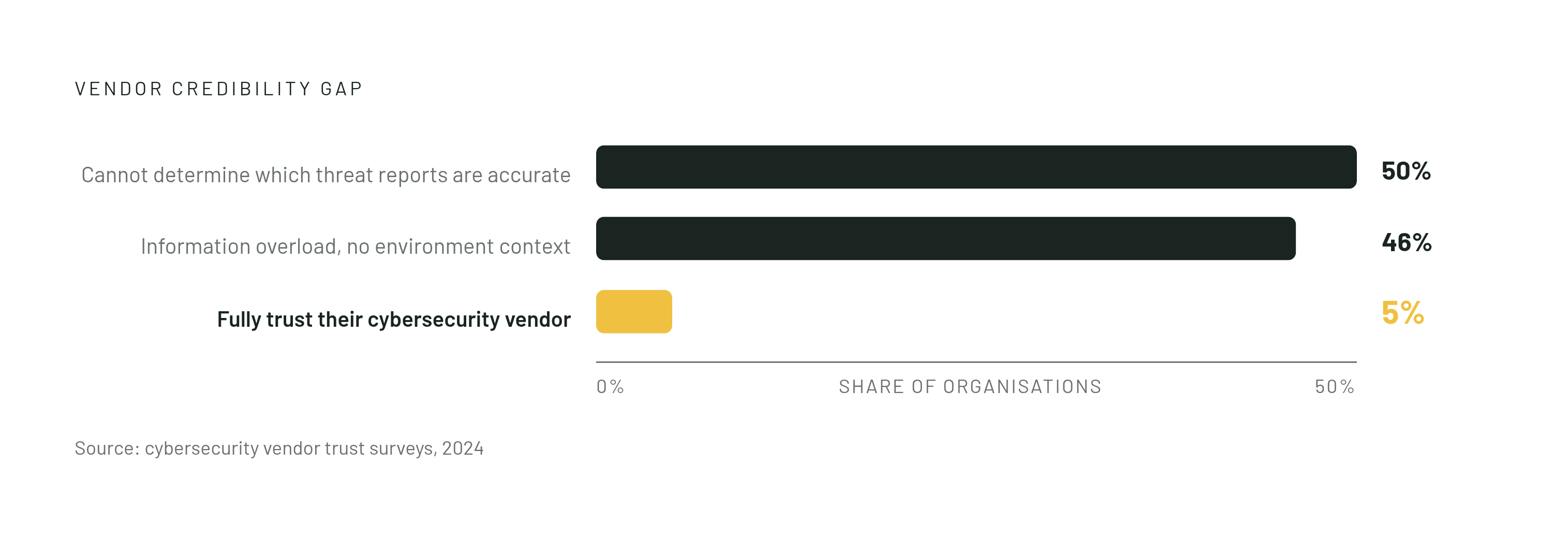
Only 5% of organizations fully trust their cybersecurity vendors. That's the baseline, not a rough patch in an otherwise fine relationship. Every pitch, every deck, every "trusted by industry leaders" slide gets read against that number, and this piece is about the one format that seems to move it: the research report.
Why most demand generation tactics fail to close the trust gap with technical buyers
Almost every cybersecurity marketer runs on third-party intent data now, but almost none of them think it's actually working. That's the odd little contradiction sitting at the center of the category: everyone's using the tool, hardly anyone believes in it. When something gets used by nearly the whole market and trusted by almost none of it, the audience is the real obstacle, ahead of the tactic itself.
Security engineers and CISOs are trained, professionally, to distrust claims. That's their job. Someone hands them a "leading platform" or "best-in-class detection," and the trained response is suspicion rather than curiosity. So generic thought leadership actively works against the vendor with this crowd, because it reads as an ad wearing a lab coat.
What buyers actually reach for before they'll take a sales call is third-party validation: peer reviews, analyst write-ups, independent commentary. Something with no stake in the sale. And that points to the real gap. Practitioners want proof of what the company knows, specifically about the threats they're dealing with at 2 a.m. on a Tuesday, rather than a description of what the company does.
The fix is a format problem, and format is structural.
What a research report actually does at each stage of the buying journey
A research report earns three different jobs depending on where the buyer sits in the funnel, and it does all three independently of any individual deal the vendor is working.
At the top, it creates awareness through earned coverage. Journalists and analysts treat original data as news, so a report gets picked up, linked, and quoted in places beyond the reach of a paid campaign.
In the middle, it builds credibility. The report functions as proof rather than promotion. It shows the vendor has real visibility into the threat landscape, a defensible methodology, and enough analytical discipline to say something specific and pointed.
At the bottom, it converts. A buyer who's already read the vendor's research shows up to the first call pre-sold on competence, ahead of any conversation about pricing or roadmap. Buyers who've worked through a dozen or more pieces of content before that first call tend to arrive already convinced, and a flagship report is usually the anchor piece that the rest of that content orbits around. One well-built annual report, according to kaynemcgladrey.com, can carry six to twelve months of pipeline on the back of press pickup and analyst attention alone.
The mechanism worth remembering here is demonstration: the report proves the expertise by using it in public.
The flagship reports that define the standard practitioners use to evaluate vendor research
Practitioners don't evaluate new research in a vacuum. They hold it up against a small set of reports that already set the bar.
Verizon's Data Breach Investigations Report, built from over 22,000 incidents and more than 12,000 confirmed breaches across 139 countries, is the obvious reference point. Mandiant's M-Trends draws on more than 500,000 hours of incident response work. CrowdStrike's Global Threat Report tracks over 281 adversary groups. They earned their standing because the methodology is visible: sample scale, scope, and sourcing are all stated plainly, with no shelter behind 'trust us.'
Verizon's own Senior Director of Cybersecurity Sales has called the DBIR "not just data; it's a sales tool," and that's not a throwaway line. Channel partners use it to open discovery conversations, because it tells them what's actually keeping customers up at night before the customer says a word.
There's a seasonal rhythm to all this, too. Major reports cluster around spring, which creates a real scrum for attention, but also an opening: a vendor with a genuinely different finding gets to stand out precisely because everyone's looking that direction already.
Every publisher of a threat report has an incentive to shade findings toward whatever supports their own product category. Practitioners know this. It's baked into how they read everything. The reports that survive that skepticism are the ones that show their work.
What practitioners actually find credible in a research report's methodology
Half of companies surveyed cannot determine which threat intelligence reports are accurate and credible, according to cybersecuritydive.com. That's the credibility gap, and it lives at the methodology level, not the headline level.
A further 46% cite information overload paired with a lack of context for their specific environment. A technically accurate report that never touches the reader's actual situation is still, functionally, noise.
The best-regarded reports in this space model transparency well. They state the data set's origin, its time window, and its selection logic up front. Nothing is left to trust on faith.
That transparency makes the findings falsifiable. A report that resists interrogation reads as marketing dressed up in charts. A tightly scoped finding, defined time window, defined data set, defined sector, earns more trust than a sweeping claim about "the threat landscape" in general. On top of that, a third of practitioners surveyed said faster delivery of intelligence was their top ask. Timeliness matters as much as accuracy: a finding that arrives six months late has already lost its value.
How research reports reach practitioner audiences through media and analyst coverage
Original data is raw material to journalists and analysts, and that changes how it travels. A report with a genuinely new finding on a live threat gets cited and quoted well past the vendor's own website, across independent publications and editorial platforms.
Because the big flagship reports run on an annual cadence, security media has come to expect fresh data every cycle. Vendors who show up on that same rhythm become part of the editorial calendar. That's a different kind of relationship entirely.
The earned reach that original findings generate far exceeds what an unsolicited press release produces.
The pattern holds across the category: a single well-timed finding, done right, outlives the news cycle it was born into and continues pulling coverage long after the initial publication date.
Media pickup works as validation by proxy. When a journalist cites a vendor's research, that's a stranger with no financial stake telling the audience: this is worth your attention. Which loops back to the real requirement underneath all of it. Distribution starts with the finding being genuinely new, well before any PR plan comes into play. Recycled data closes a journalist's inbox.
How research converts late-stage buyers who are already doing independent due diligence
Most cybersecurity decision-makers are already well into their buying decision before they'll even take a vendor call, and research reports tend to be the piece everything else gets built around during that self-directed stretch.
That's the pattern worth noticing across the category: proof beats explanation, every time, whether it arrives as a customer outcome or a proprietary data set.
A buyer who's already read a vendor's research, maybe even shared it around internally, shows up to the first conversation with credibility already established.
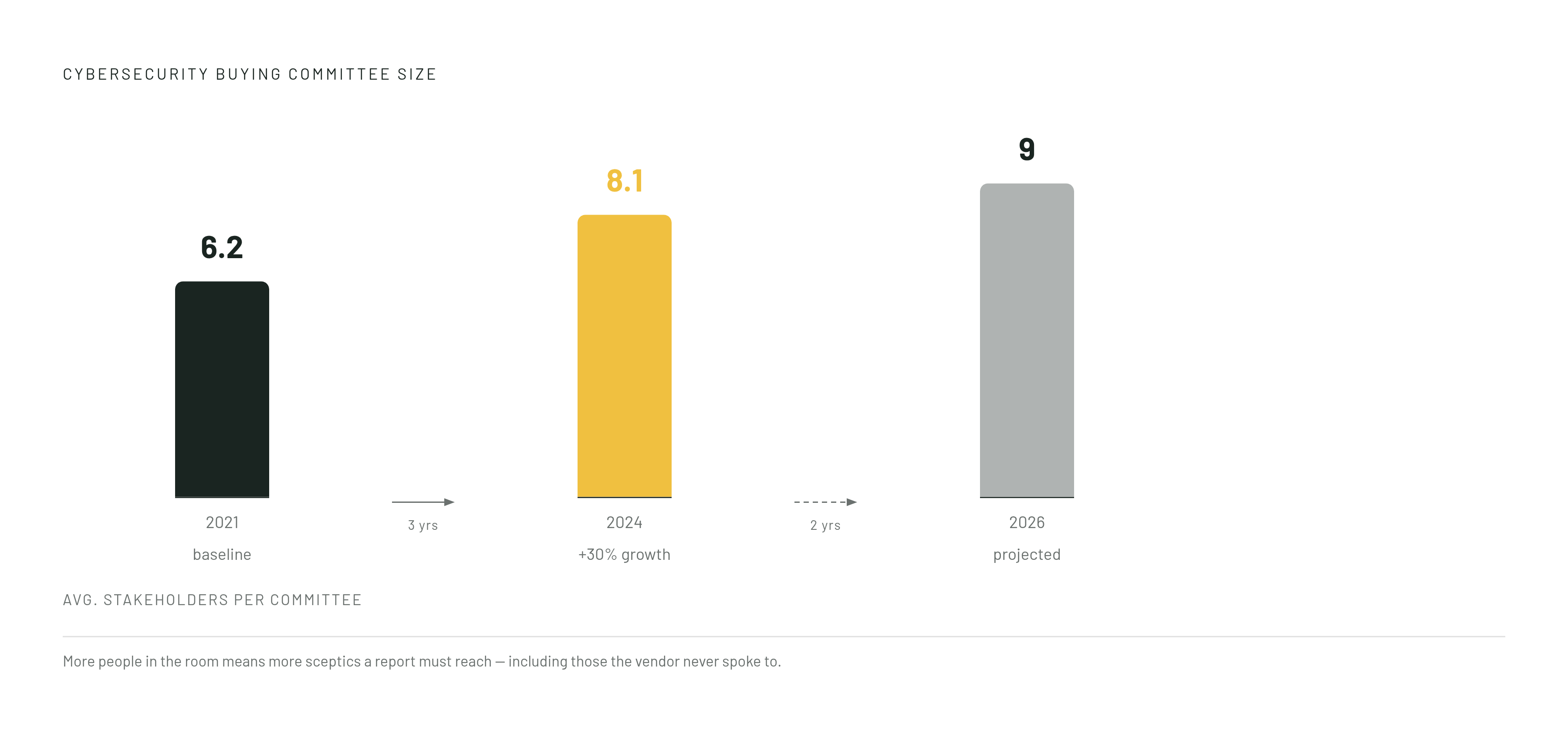
There's a two-track effect worth naming here too. Original research tends to win over the security leaders and boards who need to justify the spend upward. Technical writeups and detection guides win over the practitioners who need to trust the depth. A strong flagship report can quietly do both jobs at once, which matters more now than it used to: buying committees have grown from an average of 6.2 stakeholders in 2021 to 8.1 in 2024, and they're expected to hit 9 by 2026. More people in the room means more skeptics to win over, and a report that gets forwarded around the building reaches people the vendor never got in front of directly.
What separates a research report that generates demand from one that disappears on publication
Novelty is the whole game. If Verizon, CrowdStrike, and Mandiant have already said it, publishing a smaller version of the same finding adds another PDF to the pile and leaves practitioners no better informed.
That's why proprietary data matters so much. Research built on something only the vendor could produce, product telemetry, incident response engagements, unique sensor coverage, stands on its own because that dataset is exclusive to that vendor.
Operational relevance is a different quality than technical depth. The report has to answer a question a practitioner is actively stuck on, going beyond confirming that threats exist.
What decides whether a finding is worth publishing is a researcher choosing, deliberately, that this particular thing is worth chasing down, ahead of any automated data pull or keyword calendar. That decision is itself a signal of credibility, arguably a bigger one than the finding itself.
And a report shouldn't be treated as a one-off. Findings can get broken apart into technical blog posts, cross-referenced against the other flagship reports, refreshed on a yearly cycle. The vendors who end up mattering publish on the same domain long enough to become part of the reference layer, the reports practitioners just reach for automatically, the way they reach for Verizon's or CrowdStrike's. Get there, and the report becomes infrastructure: a permanent reference point rather than a marketing asset.