Using Threat Intelligence Data to Inform Content Calendars
Real-time threat data beats editorial guesses for security content.

A content calendar built from live threat intelligence beats one built from keyword research and guesswork, and it's not close. Simple reason: it tracks what security practitioners deal with this week, reflecting the actual state of threats in real time rather than what an editorial calendar guessed back in March. The threat landscape doesn't wait for anyone's quarterly review, and content that ignores it reads like it was written by someone checking the wrong calendar.
The money backs this up. MarketsandMarkets pegged the threat intelligence market at $11.55 billion in 2025, climbing to $22.97 billion by 2030. That's not a niche budget line, and organizations aren't spending that kind of money on real-time threat awareness for fun. It's become load-bearing for security operations. Content strategy needs to sit on that same foundation, or it'll look like it's stuck a few years behind.
The structure of threat intelligence and why it maps directly onto audience tiers
Cyber threat intelligence splits into three tiers: strategic, operational, tactical. This isn't a marketing invention, it's how the field actually organizes itself. Each tier answers to a different reader with a different time horizon, and that happens to be an unreasonably useful map for anyone planning content.
Strategic intelligence covers the big, slow stuff: attacker motivations, long-arc trends, shifts in the overall threat landscape. Board members and senior leadership read this to decide where next year's budget goes.
Operational intelligence gets more specific. It's the how: how an adversary gets initial access, how they move sideways once inside, how they escalate privileges and pull data out the door. Security architects and program leads live here.
Tactical intelligence is the fast lane: real-time indicators of compromise, mapped against MITRE ATT&CK, feeding straight to SOC analysts and detection engineers tuning rules right now, not next quarter.
A CEO does not lose sleep over the same things a SOC analyst does, even though they work at the same company and sit through the same earnings call. Different jobs, different worries, different intelligence needs. So an executive briefing pulls from strategic intel, a detection writeup pulls from tactical intel, and the tier itself tells a content team who the piece is for before anyone types a word. No need to invent an audience segmentation framework from scratch. The intelligence community already built one, and ignoring it just means rebuilding it badly.
What the current threat landscape actually looks like as the right raw material for content
Numbers first, argument second. Google Cloud's M-Trends 2025 report, drawn from more than 450,000 hours of Mandiant Consulting investigations across 2024, found 55% of active threat groups that year were financially motivated, a steady climb. That's a steady climb. Espionage-driven groups sat at 8%.
Exploits stayed the top initial infection vector at 33%. Stolen credentials jumped to second place at 16%, the first time credentials have ranked that high. That jump is a story on its own: infostealer operations are now feeding initial access at real scale, and every piece written about credential hygiene or MFA gaps just got a fresh, dated reason to exist.
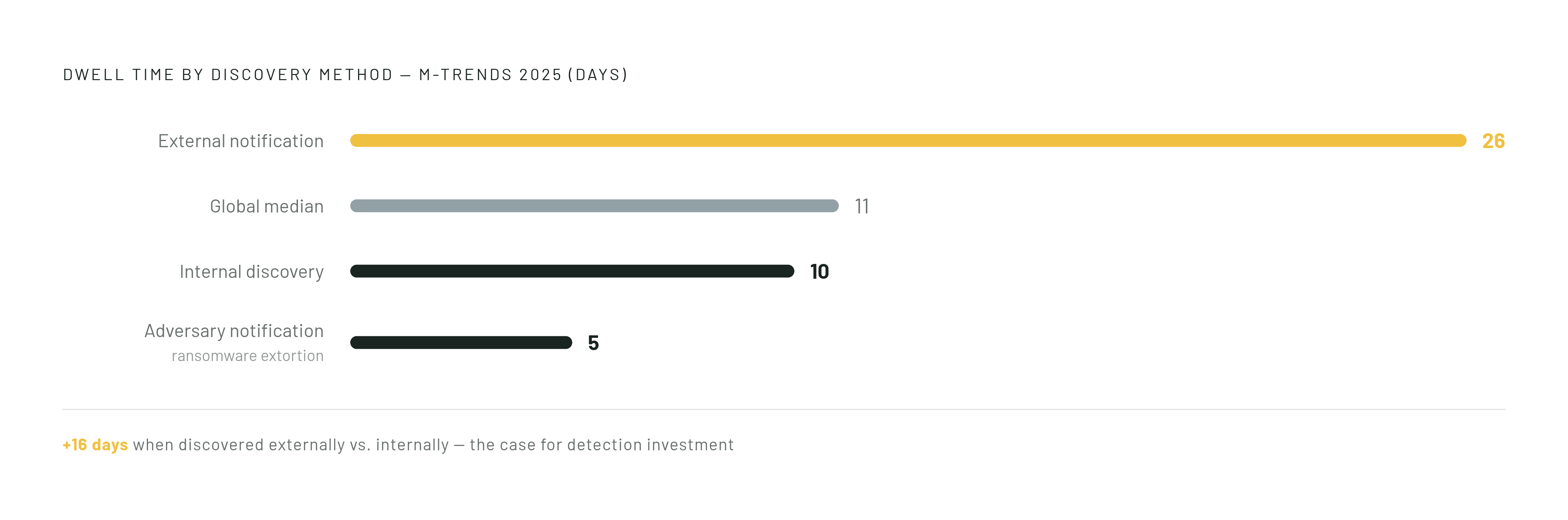
Dwell time tells its own story, and this is where the real content angle sits. The global median rose to 11 days. When an outside party did the notifying, that stretched to 26 days. When the adversary notified the victim (common in ransomware cases, for obvious extortion reasons), it dropped to 5 days. Internal discovery landed at 10 days. That gap between 26 and 10 is a content prompt with a bow on it: a direct, data-backed argument for detection investment. No persuasion required, because the number does the persuading on its own.
M-Trends 2025 also breaks down which industries are catching the most heat: financial services at 17.4%, business and professional services at 11.1%, high tech at 10.6%, government at 9.5%, healthcare at 9.3%. That breakdown alone should decide which vertical a content team writes for this quarter, and there's no debate to have about it. The credential vector shift points toward infostealer markets and authentication gaps. The industry numbers point toward a sector. Content anchored to figures like these lands differently than content anchored to a hunch, because the reader isn't imagining the scenario. They're living in it, probably at 6pm on a Friday, staring at an alert nobody wants to own.
Security vendors' operationalization of threat intelligence as a content production system
Mandiant's M-Trends report, in its 16th edition as of April 2025, is built entirely from frontline incident response work and gets cited widely across security and business media. One report acts simultaneously as a primary source for the entire security media world and a content engine that feeds Mandiant all year long. Efficient, if you can pull it off, and most can't.
CrowdStrike takes a different angle with its Global Threat Report, naming specific adversaries (COZY BEAR, FANCY BEAR, and the rest of the menagerie). That naming convention carries real weight beyond flavor text. It's a content strategy wearing a disguise. Practitioners end up tracking these names across years the way people track recurring characters on a show they've watched too long, and that gives the reporting a stickiness a generic "sophisticated threat actor" writeup never earns.
eSentire runs its Monthly Threat Intelligence Briefing off its Threat Response Unit, which pulls in intelligence daily from 54 commercial threat feeds, more than 10 proprietary sources, the dark web, social media, security reports, and SOC-driven investigations. That rolls up into a briefing published the second week of every month, like clockwork. It's a standing calendar commitment set entirely by what the intelligence produces, following the data wherever it leads regardless of what a content calendar template says is due.
Hoxhunt's research pipeline puts a number on the turnaround, and it's a useful one: its H1 2025 research on platform-specific malicious email data reflects that kind of disciplined, scheduled output. A standing cadence, enforced by the intelligence cycle itself.
Fortinet, as covered by Security Boulevard, leans on methodological transparency as the trust play instead. Clear explanations of how data gets collected, specified timeframes, acknowledged limitations, version histories showing updates as new information arrives, and a clean line between confirmed threats and potential ones. Design discipline appears in the documentation.
The pattern across all four is the same: the intelligence program isn't feeding a content team from across the hall. It is the content strategy. The publishing calendar just reflects whatever the data hands over, and that's a much better system than the reverse.
Translating a threat signal into a content piece, across formats and audience tiers
One threat trend, multiple pieces, different depths, different readers, same tier logic doing the organizing.
Take one dataset and spin it into three formats. A short blog post serves the non-technical reader. A technical whitepaper, downloadable as a PDF, offers the deeper dive. A live workshop or code walkthrough suits practitioners who want to get their hands on the thing directly. Same intelligence, three different doors in.
Quarterly mapping keeps this from turning into chaos. Assign a team's focus to a specific threat trend each quarter: API security one quarter, identity-based attacks the next, cloud misconfiguration after that. The intelligence signals decide the priority, and the quarter provides the production window. Simple math, less simple execution, since legal and technical review both need a seat at the table, balancing openness against protecting the underlying proprietary data. Any team building on its own threat research needs to plan for that review chain before the draft even exists, not after.
Reactive content needs its own lane, separate from the quarterly plan. A sudden spike in attack activity or a newly disclosed vulnerability doesn't wait for the next planning meeting. eSentire's monthly briefing handles this by cadence alone, but vendors without a standing monthly slot need a fixed "rapid response" space on the calendar to do the same job. Hoxhunt's 2 to 4 week SLA works as a useful outer limit here: a short blog should move faster, and a whitepaper needing peer review earns more room, but nothing sits past that window and still gets to call itself reactive.
Per TierPoint's data, 66% of organizations expect AI and machine learning to have the biggest security impact over the next year. If that's where the audience's head already is, the intelligence program should push AI-enabled attack patterns to the top of the queue instead of burying them three items down.
Practitioner disengagement from vendor content not grounded in real threat data
Security people are trained, professionally and by habit, to distrust claims. Verify the assertion, assume someone's hiding something, look for what's missing from the sentence. Point that instinct at vendor content and the reader starts scanning for exaggeration before finishing the first paragraph.
Fear-based framing has lost its punch, and this is the part most vendors still get backwards. "Your data will be stolen" doesn't differentiate anybody anymore, not when every vendor on the block opens with the same line. Security buyers are worn out on FUD, and they respond better to content built around solutions, resilience, and proactive defense. The vendors still leading with the scare tactic are the ones getting scrolled past fastest, and they usually don't know it.
The depth complaint isn't a hunch, either. According to cyberdb.co, more than half of surveyed buyers said cybersecurity marketing often lacks enough technical depth. A documented gap, not an assumption dressed up as data.
Research into threat intelligence consumption consistently finds that security practitioners are already using intelligence to guide strategic decisions on their own time, before a vendor ever reaches them. Content that speaks that language confirms what they already know rather than teaching them something new. It's meeting them where they already stand, not where a marketing brief assumes they stand.
CyberRisk Alliance's end-of-year report backs this up from another angle: practitioners gravitate toward real-world insights and concrete use cases, with GRC, identity, and cloud security ranking among the year's most popular topics. Topic interest tracks the actual threat landscape, following real-world developments instead of whatever a content calendar guessed six months out.
A simple credibility mechanic runs all of it. When a vendor publishes something that cites its own telemetry, names the exact tactics it observed, and admits what the data can't confirm, the practitioner reader reads that as honesty. That kind of honesty is rare enough in vendor content that it works as a differentiator on its own. CyberArk's shift away from product-description marketing toward practitioner-led implementation guides, real engineers walking through actual privileged access management deployments with configuration screenshots and command-line examples, is exactly this instinct in motion. Show the real work instead of just claiming the outcome.
Building the intelligence-to-calendar workflow as a repeatable system
Three inputs run this workflow, and none of them are optional. The standing quarterly intelligence review assigns a threat trend to a production window. The monthly or biweekly signal scan catches emerging patterns before they peak. The reactive slot holds standing capacity open, ready to publish inside that Hoxhunt-benchmarked 2 to 4 week window whenever something significant lands.
Before topic, before format, before word count, the first editorial decision on any piece should be the intelligence tier. Who's actually going to read this, and which tier of intelligence speaks to what they're worried about? Get that answer first, and everything downstream, tone, length, distribution channel, falls into place a lot faster.
Methodology transparency belongs in the content itself, as much as in the intelligence report backing it. Fortinet's approach, specifying data collection timeframes and drawing a clear line between confirmed threats and potential ones, works as a trust signal on its own. It's what separates a vendor's own research from something a generalist agency put together over a slow weekend.
Gating decisions should follow value, and here's where most teams get it backwards: they gate everything. Wrong move. The flagship annual research, the M-Trends or Global Threat Report equivalent, has earned a gate. Everything else, the tactical blogs, the fast writeups, the practitioner explainers, should stay open. Those are the pieces reaching engineers and analysts who shape a purchase decision long before anyone on their team fills out a form.
Refreshing old content counts as an intelligence function, one to prioritize on an ongoing basis. Search engines favor recently updated pages for security queries, and a quarterly audit tied to the intelligence review cycle keeps statistics current and threat descriptions accurate. The same process updating the intelligence program ends up updating the content too, basically for free.
Distribution should follow the audience tier all the way through. Strategic-intelligence content aimed at executives does well on LinkedIn long-form, especially video posts and long-form written content alike. Tactical-intelligence content belongs in practitioner communities, technical blogs, and wherever detection engineers actually spend their working hours, which is rarely a LinkedIn feed.
Add it up over a few quarters and the effect compounds. Each piece of intelligence-grounded content is proof of domain knowledge, and enough of them strung together turn the library itself into the credibility signal, no slogan required. Vendors who keep this up earn practitioner trust the only way that trust has ever actually been earned: by showing, quarter after quarter, that they understand the landscape their readers are stuck navigating every single day.
Sources
- Threat Intelligence Market Report 2025 - 2030, By Application, Geo, Tech
- M-Trends 2025: Data, Insights, and Recommendations From the Frontlines | Google Cloud Blog
- Navigating the Cyber Threat Landscape in 2025
- Shaping Your Cybersecurity Marketing Strategy for 2025 with Actionable Insights from Our Latest Report
- Tendencies in Marketing and Cybersecurity for 2025
- Three Types of Threat Intelligence: Defined and Explained
- esentire.com
- hoxhunt.com