Repurposing Cybersecurity Research Across Content Formats
One research project funds multiple formats if you treat each one as a full translation job.
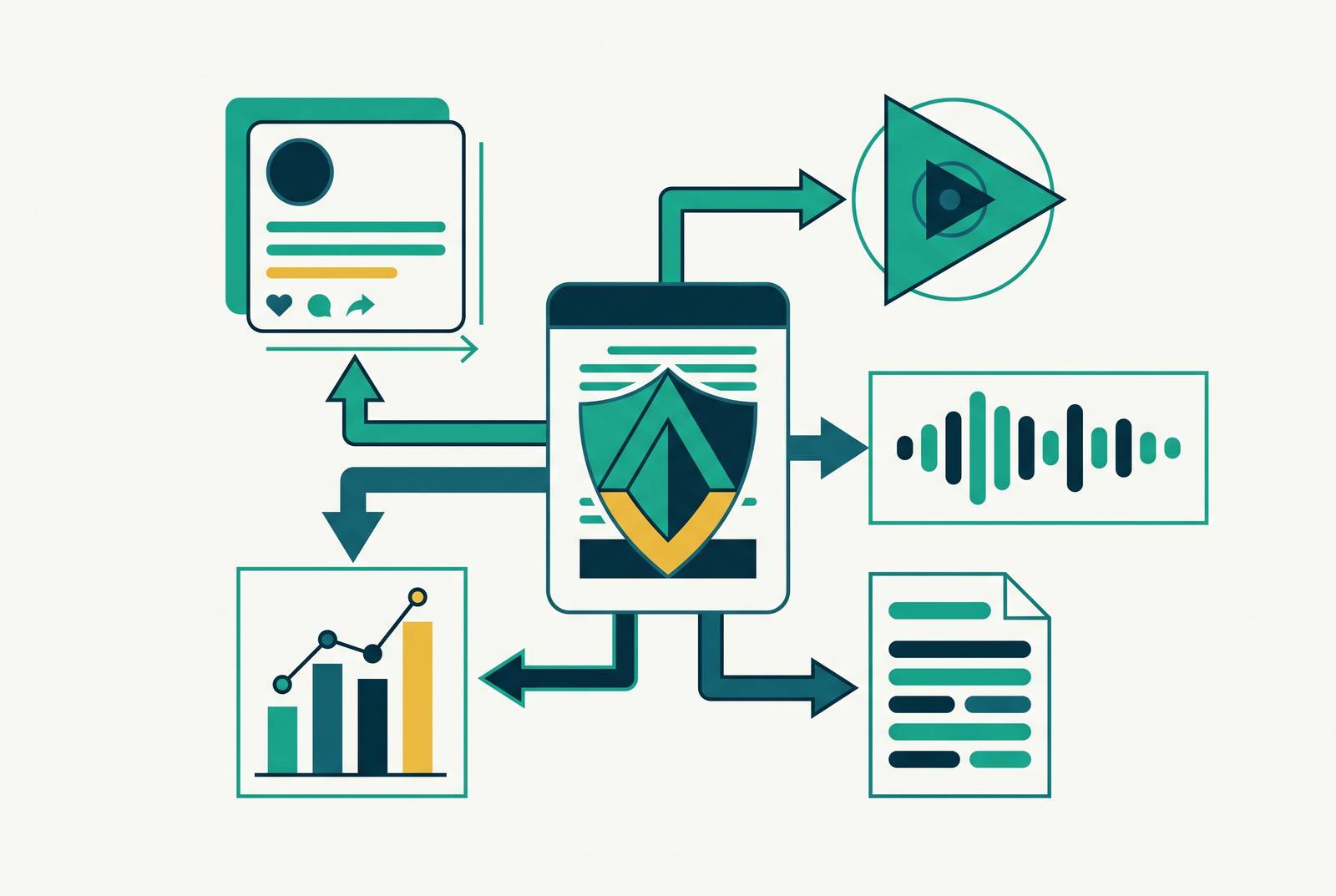
One piece of cybersecurity research can fund a blog post, a chart, a board memo, a LinkedIn feed, and a webinar, all at once, all accurately. That's the whole premise here. Security vendors compete in a market headed toward $424.14 billion by 2030, growing at 12.63% a year, with something like 3,500 vendors fighting for the same eyeballs. Original research is one of the only things that actually sets a vendor apart in that crowd, but only if it survives the trip from PDF to Instagram-sized attention spans while keeping what made it true in the first place.
Most repurposing programs get the hierarchy backwards, and this is the part worth arguing with directly: they treat the flagship report as the real work and every other format as a diluted afterthought, something an intern knocks out after the "real" report ships. The blog post, the chart, the LinkedIn carousel each deserve the same rigor as the report itself, because each one is a full translation job, a deliverable in its own right. Treat them like leftovers and a stat gets trimmed to fit a caption, then trimmed again for a tweet, until the finding says something the researchers never found. Practitioners notice this. They read threat reports for a living, and shallow content bores them and burns trust fast. Get repurposing wrong and a program spreads a worse version of the truth to more people, faster.
What makes cybersecurity research a multi-format asset in the first place
Good CTI isn't one idea. It's four layers stacked on top of each other: raw telemetry at the bottom, analyst interpretation above that, tactical recommendations next, and strategic implications sitting on top like the cherry nobody asked for but everyone eats first. A single report gets read three different ways by three different people in the same building, and that's exactly the design.
Check Point's Cyber Security Report 2026 is a good working example. It correlates telemetry, vulnerability research, and live threat investigations across regions and industries, and the same document reads clearly whether the reader is a SOC analyst, a CISO, or someone who just wants the one-paragraph version before a board meeting.
Flashpoint's 2025 insider threat research shows the layering even more plainly. There's a raw number: 91,321 observed instances of insider recruiting and threat actor discussion. There's an interpretation sitting right behind it: recruiting an insider is often more efficient than building a complicated external exploit. And there's a sector-specific detail, telecom seeing the highest volume of insider-related activity. Three separate articles are hiding inside one dataset, and none of them require inventing anything.
Hoxhunt's 2026 Threat Intelligence Report (built on 2025 data) does something smarter still. It's constructed from live phishing data and reporting patterns in a way that translates telemetry into action almost automatically. The translation is baked into how the research was built. ISACA's 2025 white paper, "Building a Threat-Led Cybersecurity Program," spells out why that matters at the top of an org: board-level threat intelligence has to connect to growth, market expansion, customer trust, or regulatory exposure, or it's just noise with good production values.
So before anyone repurposes a single sentence, the real first step is mapping the asset's internal layers: data, interpretation, recommendation, strategic implication. Each layer has a natural home somewhere down the line. Skip that step and every format downstream inherits the confusion, and no amount of good design fixes a confused foundation.
How the blog post uses research findings without flattening them
Blog posts are the format everyone reaches for first, and also the one most often wasted. Crayon's analysis of more than 2,000 cybersecurity content pieces found that 68% of ransomware-focused content was blog posts. That's a lot of voices saying roughly the same thing in roughly the same shape, which means the bar for a post that actually stands out is lower than people think, if anyone bothers to clear it.
The issue isn't the format. A good post picks one thread the research opens and finishes it, rather than restating the executive summary with a new headline glued on top. Verizon's 2025 Data Breach Investigations Report found that a significant share of stealer logs come from enterprise-licensed environments. That's the opening line of a post about why enterprise credential hygiene assumptions have quietly stopped working.
Practitioners consistently reward content that goes beyond surface summaries and engages seriously with method, tradeoff, and operational detail. Marketing copy dressed up as analysis gets sniffed out immediately, the way you can tell decaf from the first sip.
Sector framing is underused, and the data says so plainly. Crayon's analysis found only about 1% of the 2,142 pieces studied targeted highly vulnerable sectors like education, manufacturing, or energy and utilities, despite those sectors being exactly the ones asking "does this apply to me?" That's most of the audience getting ignored. Authorship matters too: a post with a practitioner's or SME's name on it carries weight a marketing byline doesn't, and the blog is where that voice should be loudest, not buried under a company logo.
Translating research findings into data visualizations without stripping context
Charts force compression, and compression is where meaning goes to die if nobody's watching. A pie chart of the headline stat looks tidy and says almost nothing. Skip it. The visualizations worth making are the ones that show a relationship prose can't render as efficiently: behavior changing over time, sector-by-sector exposure side by side, the gap between when something's detected and when it's actually contained.
Flashpoint's insider recruiting data earns a visual for exactly this reason. The interaction between telecom being the most targeted sector and the sheer scale of the activity (91,321 instances) reads easier as a graphic than as two separate sentences competing for attention. Numbers alone won't carry it.
Every chart needs a caption doing real work: explaining what the pattern means rather than merely labeling what it shows. That caption is where fidelity survives or quietly disappears. AI tools speed up production, generating drafts and testing layouts. But the research team, not the design team, has to own the interpretation. Format decisions should never drive analytical conclusions, and the moment they do, the chart stops being data and starts being decoration wearing a lab coat.
Structuring an executive brief so C-suite readers get the strategic signal, not a diluted summary
Executives don't need less information. They need the same information wired to different stakes. Growth, regulatory exposure, customer trust, market risk, that's the language a brief has to speak, and stripping out technical substance to get there is a shortcut that costs more than it saves.
ISACA's white paper makes this explicit: threat intelligence at the C-suite has to connect directly to enterprise priorities. So a brief should open with the business implication and work backward from there. A workable shape: state the business risk the research points to, back it with one or two precise figures, spell out what it means for investment or policy, and end with one decision or question leadership actually has to chew on.
That stealer-log finding from Verizon's 2025 DBIR earns its place in a boardroom for exactly this reason. It names a perimeter executives assumed was locked down. Use it to open a gap in their thinking rather than scare them into a meeting they'll forget by Friday.
Fear alone doesn't move budgets like it used to, and vendors still leaning on it are behind the curve, full stop. Research into cybersecurity buyer behavior has flagged fear-based messaging as losing effectiveness, and IBM's 2025 Cost of a Data Breach Report found the global average breach cost dropped noticeably from its prior level, which suggests security AI is shifting the risk math in ways that blunt the old scare tactics. Briefs that lead with pure threat magnitude get skimmed and forgotten. Length discipline matters here more than anywhere else: the same research powering a lengthy white paper should compress into a two-page brief with zero padding. If it can't, the thinking behind it isn't finished yet.
Adapting research for LinkedIn and social formats without reducing findings to slogans
Social is where findings go to get flattened into a headline stat with no context, and practitioners clock this instantly. It's the content equivalent of a movie trailer that spoils the ending and still gets the plot wrong.
What actually works on LinkedIn for security audiences: CISO-authored posts that argue a position the research supports (not just announce a stat), carousel sequences that walk through a finding step by step instead of cramming it into one slide, and short clips pulled from a recorded webinar where an analyst makes the case in their own voice, not reading off a script. Sector-specific posts built for one audience beat posts built for everyone.
Crayon's data backs that last point hardest: sector-targeted content stays consistently underproduced despite a clear gap in coverage for those audiences. A LinkedIn post built for BFSI security teams, using the research's financial-sector findings specifically, beats a generic version of the same post nearly every time.
The rule that should govern all of it: every social post links back to a fuller asset where the real context lives. Social is the doorway. The research earns the click, the format earns the attention, and each does its own job. A growing share of buyers use AI search tools such as ChatGPT and Perplexity to find vendors. Social content that is specific and clearly sourced around named findings performs better in that environment than vague brand messaging.
Running a webinar that uses research as the spine, not the slide deck
Webinars still pull weight. CyberRisk Alliance's 2024 End-of-Year Report, drawing on data from over 600 customers and industry experts, found events and thought leadership among the most widely used formats for reaching practitioners in this sector. But a webinar that just reads the report out loud with slides behind it wastes the format's one real advantage: live argument.
Practitioners show up for analysis and debate, and that expectation should decide the entire format. Using research as the spine means each major finding becomes a question the presenter and a guest analyst actually argue through, not a bullet point they nod along to. Practitioner panelists carry credibility a vendor rep can't fake, and a recognized security engineer working through the data in real time is the strongest asset the format has.
One recording, done right, becomes a whole cascade. A transcript turns into a blog post, clips turn into LinkedIn content, and a condensed cut becomes the executive brief. The webinar is often the richest single input to the repurposing process. Topic selection should follow the data, not default to the news cycle. CyberRisk Alliance found GRC, identity, and cloud security were among the most popular topics in 2024, so webinar planning should map research findings to those areas instead of defaulting to whatever's trending that week.
The modular architecture that makes a repurposing program repeatable
Buyers don't decide fast. ActualTech Media's cybersecurity marketing guide found buyers engage with more than 13 pieces of content during a purchase journey, doing substantial independent research before ever reaching out to a vendor. A single-format strategy can't cover that much ground. It's like trying to furnish a house with one chair.
The fix is thinking in levels before producing anything. Level 1 is broad and non-technical: blog posts and LinkedIn content built for reach. Level 2 is practitioner depth: white papers and webinars for people who want the method and the evidence behind it. Level 3 is applied expertise: workshops, code reviews, incident walkthroughs, the stuff for people who want to get their hands dirty. Gracker AI's trust-in-marketing analysis calls the tension between these levels the "Funnel Paradox," where the top of the funnel demands simplicity and the bottom demands depth. A modular structure is how a program serves both without lying to either one.
Each level pulls from the same research but leans on a different layer: data and implication at Level 1, method and evidence at Level 2, operational application at Level 3. The structure runs circular too, and that matters because commissioning original research isn't cheap. A report becomes a newsletter, the newsletter spawns a blog series, a blog becomes a webinar, the webinar spins off clips and a transcript, and around it goes again.
AI speeds up the mechanical parts of this: keyword tracking, reformatting, scheduling. The interpretive work that makes security content trustworthy remains a human job, and practitioners keep flagging this, correctly. Content studios that specialize in cybersecurity tend to run this cascade faster and with fewer errors than generalist agencies, simply because domain fluency has to exist before the work starts, not get built mid-project. Cyberou is one such studio built around exactly this kind of layered repurposing, treating the research's internal structure as the thing worth protecting across formats, not only the headline finding.
Where technical fidelity breaks down and how to catch it before publication
Four mistakes account for most of the damage, and one dwarfs the rest: stripping the interpretive layer to fit a word count or character limit. That's the failure mode to watch above all others, and it's the one worth naming outright rather than burying in a list. The rest compound it: moving a figure into a context it was never measured for, presenting a finding from one vendor's telemetry as if it applies industry-wide, reusing a 2023 or 2024 stat in a 2025 or 2026 piece without flagging that the threat landscape has moved since then.
The test that catches most of it is simple enough to run in your head: would a working security engineer who read the original research call the repurposed version accurate? Any hesitation answering that means the interpretive layer already slipped somewhere between draft one and publish.
Technical reviewers need to sit inside the production loop early, not get bolted on at the compliance stage like an afterthought nobody wanted to schedule. A subject-matter expert reading before publication catches the category errors that do the most damage, the kind that don't look wrong until someone who actually knows the field reads them.
TechnologyAdvice's 2024 research found that 63% of buyers cite customer case studies as a top influence on purchasing decisions, meaning accurately reported outcomes outperform explanatory content across the board. Fidelity is both an ethics question and a performance one. In a market with approximately 3,500 vendors competing for the same attention, research-backed content is one of the few real moats left, and that moat holds only if practitioners trust the repurposed version as much as the original. One bad fidelity failure is enough to make people stop trusting the whole program, extending well beyond the single piece that got it wrong.