Audience Segmentation for Cybersecurity Content Programs
Each buying committee member needs different proof, and they're all reading before sales even calls.
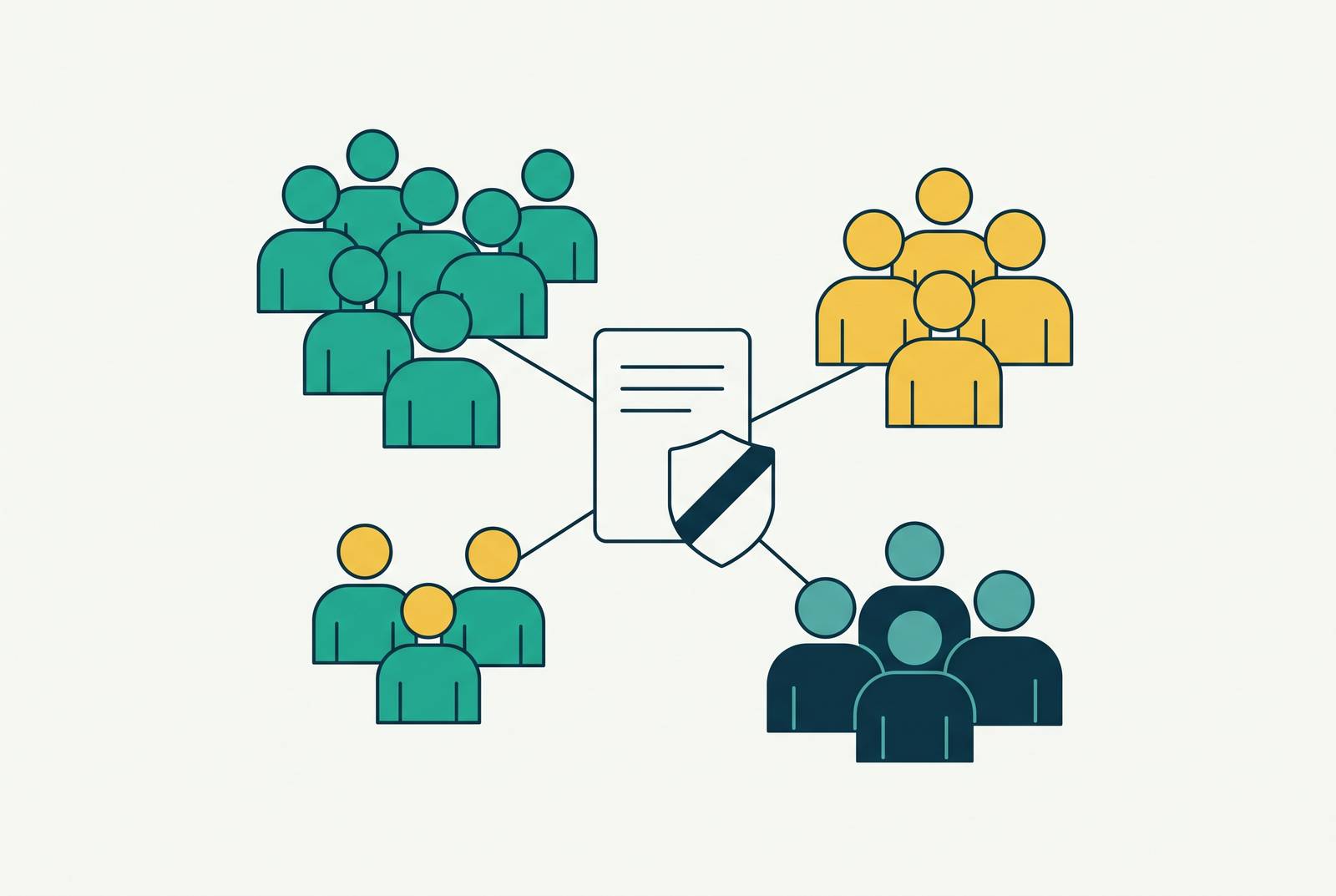
Cybersecurity vendors write for one person. Buying committees are made of five, sometimes ten. That mismatch is the whole story here, and it explains why perfectly good products lose deals to worse ones with better content coverage.
The CISO signs the contract, sure. But the CISO rarely gets there alone. Security engineers pull apart the technical claims. Compliance officers check the paperwork against frameworks nobody outside their department has memorized. IT directors ask who's going to be on call when the integration breaks at 2 a.m. CFOs want to know why this line item exists at all.
Gartner's read on complex B2B buying groups puts multiple stakeholders in the room as the norm, and enterprise security deals tend to run past that baseline, not under it. More stakeholders means more chances for the content to miss somebody. And missing somebody early is fatal in a specific, measurable way: 6sense's 2025 Buyer Experience Report found that buying groups build most of their vendor shortlist on day one of research, then pick the winner from that shortlist almost every time. Sales never even meets the vendors that got left off. They just don't know it yet, because nobody sends a rejection email to a company that never got considered.
Why the composite persona model fails the buying committee
The industry's answer to this has been "John the CISO." One persona, one voice, one imaginary buyer who reads every whitepaper and signs every check. It was built for a purchase structure that hasn't existed in cybersecurity for a while, if it ever did.
The mechanical problem with it is this. Each role in the committee isn't just a different job title, it's a different filter. The engineer runs your claims against the actual documentation and checks whether the architecture holds up under a second look. The compliance officer skips straight past the marketing copy to ask whether this maps onto NIST or GDPR. The IT director wants to know what breaks during rollout. The CFO wants the ROI math. A single composite persona averages all of that into mush that satisfies none of it.
And the CISO doesn't operate in isolation from this. Security veteran Luke Stephens wrote in April 2025 that CISOs lean heavily on their technical teams, and those teams tune out buzzword pitches almost on contact. So content that fails the engineer doesn't just fail the engineer, it fails upward. The CISO's confidence is partly downstream of what their own team reports back after reading your site. Write only for the executive and you've actually written for nobody, because the executive is listening to people you never talked to.
The pattern appears every time somebody audits a vendor's content library. Plenty for the CISO. Almost nothing for anyone else. It's the content equivalent of throwing a dinner party and only setting one place at the table, then wondering why the other four guests left hungry.
Vendor content needs by buying committee role
Segmentation, done properly, is about repackaging one core insight into formats calibrated for each role's proof type and reading context. It's about figuring out what kind of proof each role trusts, and when in a months-long research cycle they're actually paying attention.
Security engineers and architects read the documentation before they ever open a marketing page. They're checking whether the architecture actually coheres, and they notice, immediately, when a diagram conveniently skips the hard part. Content that names its own limitations earns more trust from this group than content that claims to do everything, because "does everything" is the tell of something that's never been stress-tested. Security Boulevard noted that this reader holds an informal veto and forms an opinion from public content long before a vendor conversation even starts, which means the sales team can lose the deal before they've dialed a single phone number.
Compliance officers work from a different rulebook. Regulatory alignment sits above everything else for them, and vague phrases like "compliance-ready" mean nothing. What lands is a direct map: this capability, this control, this named framework, whether it's NIST, SOC 2, GDPR, or HIPAA. Specificity here isn't a nice touch, it's the entire signal.
IT directors are focused on integration burden, operational complexity, and what this is going to cost their team in hours and headaches. They need honest architecture documentation and straight talk about deployment.
CFOs approve the budget, and they've grown tired of threat statistics designed to scare them into signing. Ponemon's 2026 research found a majority of surveyed buyers wanted stronger ROI justification from cybersecurity vendors. Fear doesn't move this audience. Numbers do: risk reduction, cost avoidance, concrete evidence rather than threat statistics deployed to generate anxiety.
CISOs, finally, need something defensible. They're reading thought leadership and peer-validated proof.
A wrinkle sits here. The Edelman-LinkedIn B2B Thought Leadership Impact Report found that the "hidden buyers," the quiet influencers sitting in finance, legal, and compliance, consume nearly as much thought leadership as the primary target buyer does, and strong thought leadership makes most of them noticeably more open to being contacted. The people nobody bothers writing for are reading anyway. They're just not being spoken to.
Building one piece of content that speaks to all five roles without diluting any of them
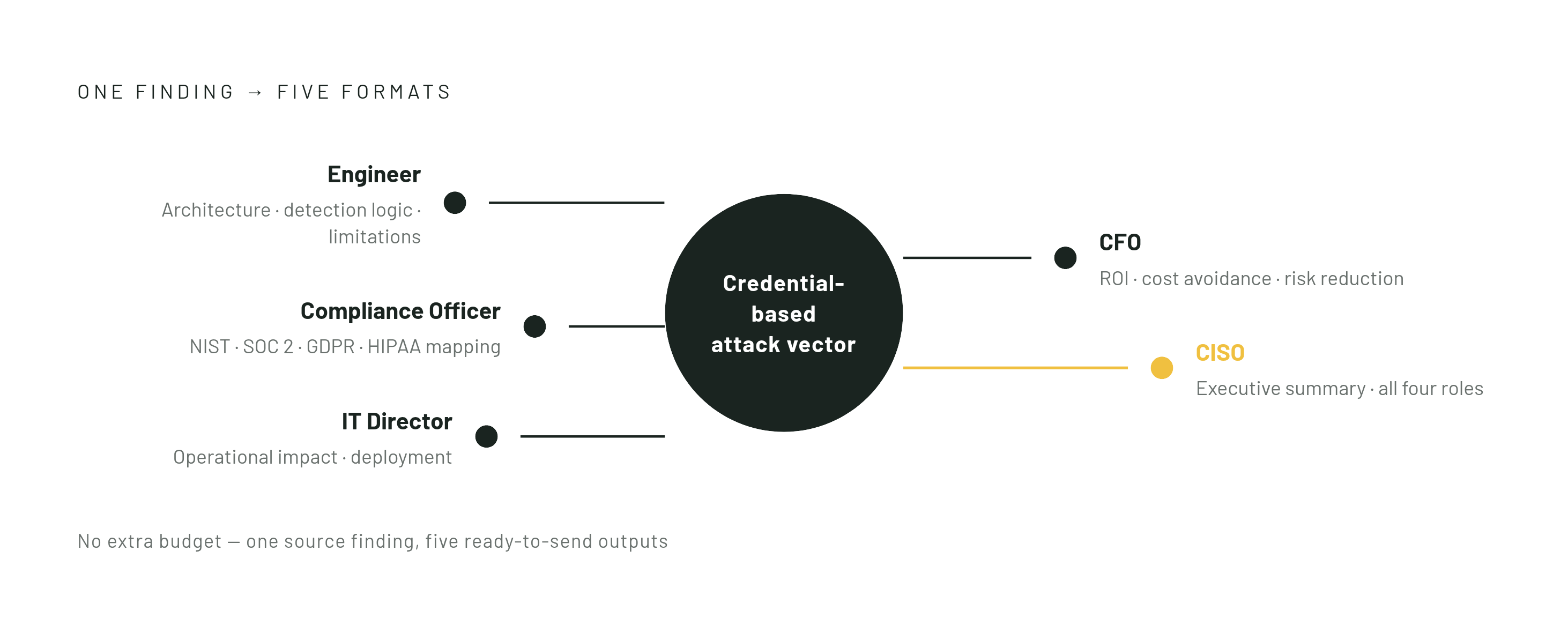
None of this requires five separate content departments. That's the fear that keeps marketing leaders from even starting: the assumption that role-based content means five times the budget and five times the headcount. It doesn't. The actual production model is one insight, repackaged five ways.
Take a single research finding, a new credential-based attack vector, for example. That one finding becomes a technical deep-dive for engineers, complete with architecture detail, detection logic, and an honest list of where the analysis stops working. It becomes a compliance mapping brief tying the vector to specific regulatory language. It becomes an integration note for IT directors, spelling out the operational impact. It becomes an ROI and risk-reduction brief for the CFO. And it becomes an executive summary for the CISO that pulls all four together into one coherent argument.
The engineer track is where this either works or falls apart. Accuracy and timeliness matter more than polish there, and marketing language fails on contact if the technical depth isn't real. The bar isn't "sounds authoritative." The bar is "specific enough that someone could go test it themselves".
That specificity turns out to be the thing that travels across every role, not just the technical one. A claim that says what a capability does, how it works, and where it stops doing anything useful reads as more credible to a compliance officer, a CFO, and a CISO than a claim nobody could ever verify. Naming your own limits is, oddly, how you get people to believe your strengths.
And this is where fear-based marketing quietly sabotages itself. Threat statistics thrown around to generate anxiety, without any actual analysis attached, don't scare practitioners into buying. They annoy people who deal with real threats for a living. The frame that works is analysis. The frame that backfires is alarm.
What vendors who earn practitioner trust do differently
The vendors who've actually pulled this off share one structural habit: they produce genuinely useful intelligence for practitioners who aren't even their customers yet, and let that credibility climb the ladder to the executive tier on its own.
CrowdStrike's Global Threat Report is the reference case. It became an industry-standard document because it was useful to security practitioners who had never bought a CrowdStrike product. The model spread. Palo Alto's Unit 42, Check Point Research, SentinelLabs, and Mandiant's M-Trends all run the same playbook now, each pulling in large subscriber bases and real citation share inside AI discovery engines.
Rapid7's technical writeup on the Notepad++ supply chain compromise is a smaller, sharper version of the same move. It laid out, in real detail, how one distribution failure at a single point in the chain can cascade into an enterprise-scale event. No marketing claim anywhere in it. Rapid7's post-incident technical analysis of the Notepad++ supply chain compromise served the engineer, the CISO, and the compliance officer simultaneously, all from one document.
Silverfort's Dor Segal is maybe the cleanest illustration of practitioner credibility built in public, on a timeline. He presented at RSAC 2024 on bypassing modern authentication protocols. In January 2025, he released details of an Active Directory Group Policy misconfiguration that allowed an NTLMv1 authentication bypass. In July 2025, he disclosed a vulnerability nicknamed "NOTLogon," letting any domain-joined machine crash a domain controller. None of it dressed up as product marketing. All of it built exactly the kind of authority with engineers that eventually reaches the CISO secondhand, through the people the CISO already trusts.
The common cause behind these examples is internal telemetry, customer data, or straightforward researcher expertise, converted into something publishable that fills an actual gap. A ScienceDirect review noted there's very little empirical evidence in the academic literature about how organizations actually implement intelligence-led security approaches in messy, real-world environments. Vendor research is filling that void faster than academia is, which is either a little embarrassing for academia or a genuine opportunity for vendors willing to publish real findings, depending on how charitable you're feeling.
Producing this at scale takes a specific kind of shop, one built around the security vertical rather than a generalist agency model stretched to fit it. Domain fluency has to be the foundation, not something bolted on after the brief comes in, because a generalist team working at the same speed will land at a shallower technical register, and practitioners spot that register instantly and discount it.
The Objection to Deep Role-Based Content at Its Strongest
The honest objection here is a budget objection, and it deserves a straight answer rather than a dismissal. Role-differentiated, practitioner-grade content is expensive to produce, slow to convert, and largely invisible to the person who actually signs the check. That's a fair complaint, not a strawman.
Event-anchored campaigns are the proven alternative, and they work. Sustained email cadence timed around RSA Conference, Black Hat USA, DEF CON, Gartner's Security & Risk Management Summit, and Infosecurity Europe generates a large share of annual pipeline at the top operators in the category. That's efficient, in-market demand capture, and no one should pretend otherwise.
The resolution isn't picking one over the other, it's sequencing them correctly. Pushing a prospect toward a demo before they understand what they're even looking at converts badly in a sales cycle that runs six to eighteen months. Role-based educational content is what earns the shortlist spot during those long months of quiet research, and the event campaigns then go capture the demand that content already built. Neither one performs as well running solo.
There's a second, sharper objection aimed specifically at thought leadership: that it's stale by the time it's published. The bar for executive-tier content has moved. A "what is zero trust" explainer landing in 2026 tells the reader the vendor is behind the conversation, not ahead of it. The bar for executive-tier content has moved. What earns trust now is rigorous, evidenced analysis of where real implementations actually fail.
A content program genuinely built around the buying committee
A content program built around the buying committee, instead of a single composite persona, runs at two levels at once: technically credible material for the practitioners who evaluate, champion, or veto, and business-level material for the economic buyers who approve.
There's a third layer now, and it arrived fast. As of mid-2026, AI discovery has become its own distribution channel. 6sense's study found that the vast majority of B2B buyers now use large language models to summarize reviews or analyze vendor data during the buying journey, and that hasn't cut down how many times they actually talk to vendors. Content that earns citation inside those AI engines, through depth, specificity, and clear attribution, gets distribution paid media simply can't buy at the same level of trust.
What makes this executable is organizational. The team writing this content has to have the domain fluency to hit the technical register the engineer track demands, because that register is what earns trust everywhere else in the committee too. Practitioners advise the CISO. The CISO's confidence is downstream of what those practitioners report back. Get that one register right, and the shortlist position, the AI citation, the compliance officer's sign-off, and the CFO's approval all tend to follow from the same source: content specific enough that every person in the room believed it before sales ever picked up the phone. The content mix that serves this model combines original research that converts internal telemetry into publishable intelligence, role-differentiated formats derived from that research (engineer deep-dives, compliance briefs, ROI summaries, and CISO executive summaries), and event-anchored campaigns that activate in-market demand the research content has built over the preceding months.