Content Funnel Mapping for the Security Buyer Journey
Security buyers skip stages and research on platforms vendors can't see.
The content gets published. The traffic shows up in the dashboard. The pipeline doesn't move. That's the pattern that drives most security marketing teams to question whether the funnel even exists for this buyer, and the honest answer is that it exists, just not in the shape anyone drew on the whiteboard.
Security buying decisions loop, stall, skip stages, and resolve somewhere nobody on the vendor side can see. The cycle runs many months long, and the reason traces back to who's signing off: a CISO who gets it wrong doesn't just lose a budget line. A bad purchase can mean breach exposure, a call from a regulator, a board asking uncomfortable questions, and in plenty of documented cases, a termination letter. Faced with that kind of downside, the CISO doesn't shop the way a marketing ops manager shops for a new analytics tool. Trust and peer validation outweigh a feature comparison chart every time.
Layer onto that a shift in where research actually starts. A growing share of early-stage buyer research now happens inside AI answer engines, and a benchmark found that most cybersecurity vendors don't show up in ChatGPT responses at all. A meaningful chunk of the buying journey now begins on a platform where the vendor has no owned presence whatsoever. Add in the rest of the research trail, a YouTube video, a Reddit thread full of unfiltered opinions, a LinkedIn post from a peer, an AI comparison, a Gartner report pulled from a colleague's inbox, and the buyer typically crosses five or more platforms before a single salesperson gets a call. None of that activity fits cleanly into a funnel stage. It does not appear in vendor analytics.
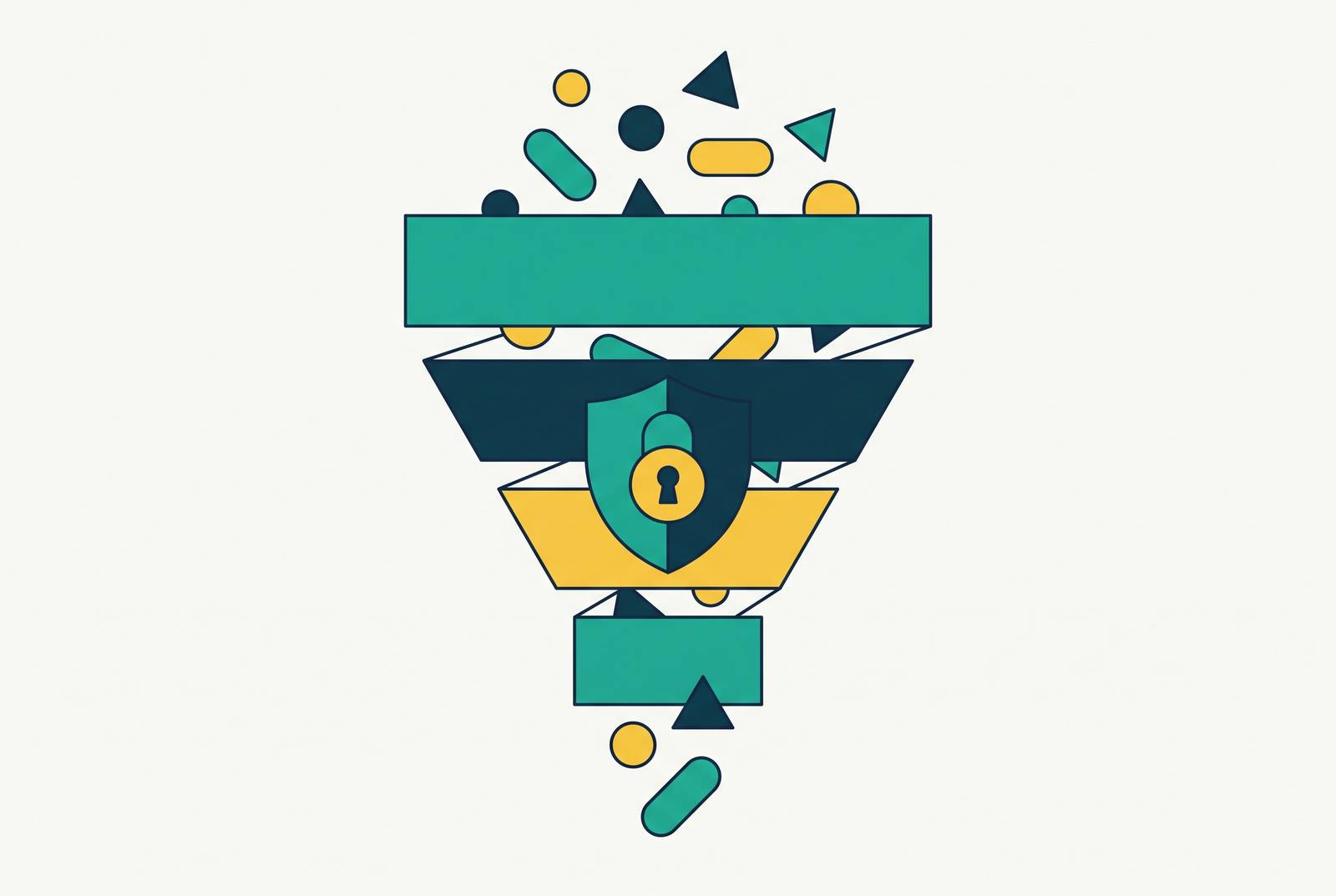
So what is funnel mapping actually good for here? It works as a content inventory, not a behavior model: the stages tell a vendor what to build, awareness content, consideration content, decision content, but they say nothing reliable about the order a buyer will consume any of it. Treating the funnel as a sequence buyers march through in order is the mistake. Treating it as a checklist of assets that need to exist somewhere in the ecosystem is the fix.
The buying committee that funnel maps must serve
A single-persona strategy built entirely around the CISO is a well-documented way to stall a deal, because the CISO signs the contract but can't drag it across the finish line alone. Studios like Cyberou, which write exclusively for cybersecurity audiences, flag this as one of the most consistent structural failures in security content programs. Other people on the committee can block it, slow it down, or quietly kill it in a budget review the CISO never attends.
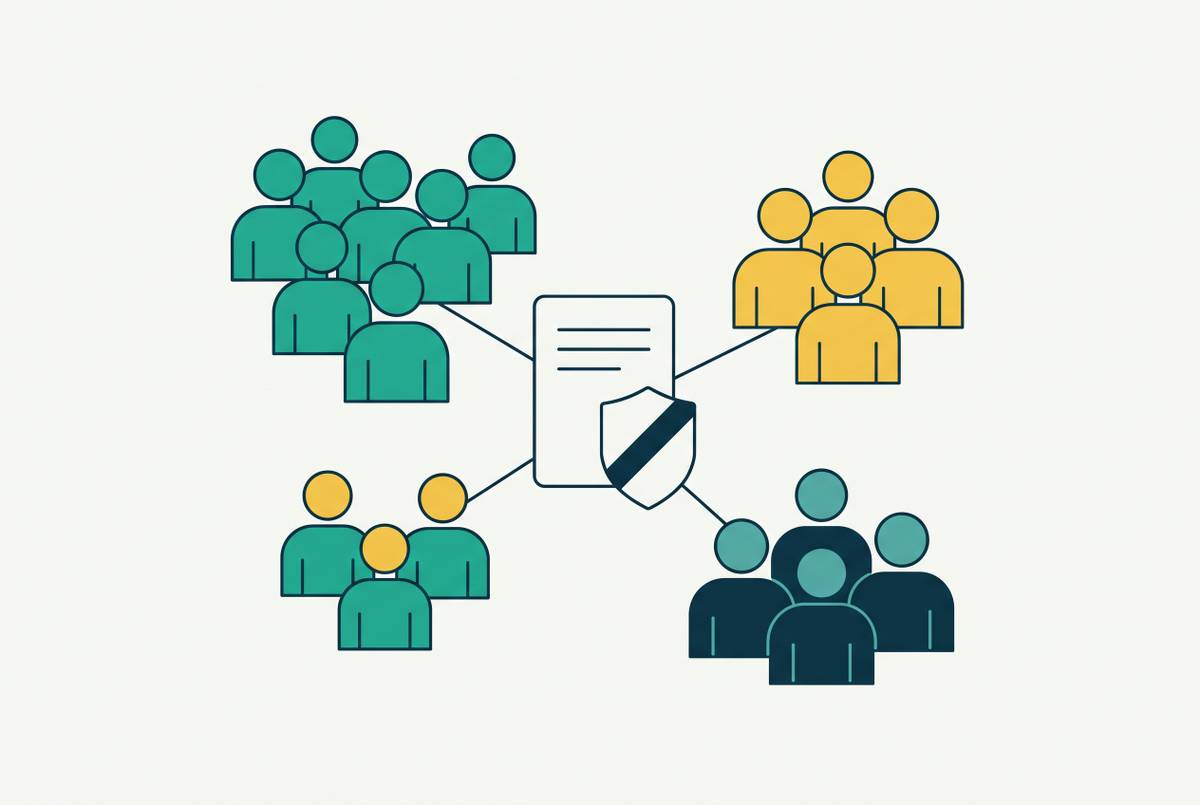
The numbers back this up. The SaaSHero 2026 guide found that most IT professionals report three or more stakeholders sitting on security technology decision committees, and a large share report six or more. Content has to reach security engineers, IT operations staff, procurement, legal, finance, and the audit committee, in addition to the executive with the budget.
Each of those roles wants something different, and conflating them is where most content programs quietly fail. A 2026 buying-committee guide breaks the committee down by what each role actually needs: the CISO is after original research, executive briefs, and peer benchmarks, because the CISO's job is risk reduction and board reporting. The security engineer wants a technical deep-dive and integration documentation, because the engineer's only question is whether the thing actually works. The compliance officer wants regulatory mapping and anonymized audit case studies. The IT director wants architecture diagrams and deployment guides. The CFO wants an ROI calculator and a business case it can defend in a budget meeting.
Most vendors have a closet full of CISO-level thought leadership and almost nothing for anyone else on that list. That's why deals don't die at the top of the funnel. They die in the middle, where the engineer can't find an integration doc.
The obvious objection, that building content for six different roles sounds like running six separate content programs, which sounds like six times the budget, doesn't hold up. One strong insight can be repackaged three ways without starting from scratch: a research report becomes a CFO ROI brief, a CISO executive summary, and a technical engineer deep-dive. Same underlying substance, different formats for different desks.
What content works at each funnel stage
Most cybersecurity vendors are good at two things: top-of-funnel awareness content and bottom-of-funnel sales pitches. The stage in between, where technical teams are quietly forming opinions long before anyone calls sales, is the one almost nobody serves well.
At the top of the funnel, threat intelligence does the heaviest lifting, because it brings new information to the table instead of repackaging advice everyone's already read. Mandiant's M-Trends report and CrowdStrike's Global Threat Report are the standard examples: security practitioners read and cite both regardless of whether they've ever bought anything from either company. This stage consists of threat intelligence roundups and industry analysis, content that earns trust by showing command of the threat landscape rather than pitching a product.
The middle of the funnel is where the real gap sits. Practitioners read documentation and comparison guides to form opinions about a vendor, often well before any contact with sales. Documentation tends to be the most honest thing a vendor ever publishes, since it's written to help someone use the product rather than to persuade them to buy it. Covering integration details, architecture decisions, known limitations, and failure modes reaches the single most influential evaluator in the whole committee, at the exact moment that person is making up their mind. If this is skipped, the engineer still forms an opinion, just without any vendor-supplied information shaping it.
At the bottom of the funnel, buyers are narrowing a shortlist and building internal consensus. The content that matters here is customer references, security documentation, implementation plans, and contract terms. Most vendors actually handle this stage reasonably well. The problem is that by the time a buyer reaches it, too few buyers are still in the room, because the middle of the funnel never gave them a reason to stay. Polishing the awareness content and the closing collateral while ignoring the middle stage is like repainting the lobby and the penthouse of a building and leaving the elevator broken. Nobody gets upstairs.
The dark funnel: where the most influential parts of a security decision happen
The moments that actually decide a security purchase often happen somewhere no vendor dashboard will ever show. A CISO asks three peers in a private Slack channel which vendor actually held up under pressure. An engineer lurks in a subreddit reading a teardown of a product's architecture. A name gets dropped, favorably or not, in a CISO advisory board meeting that no marketing team was invited to.
Otrenix's 2026 guide describes the channels where this verification happens: private Slack groups, the CyberEdBoard, ISACs, ISC2 chapters, and CISO Series podcasts. None of these are owned by any vendor. They do not appear in standard attribution reporting. Category-leading vendors run CISO advisory boards and executive-level content programs specifically to cultivate these peer networks, because that cultivation is what produces the references that actually close enterprise deals.
This creates a strange math problem for anyone building a funnel map. Influence from these dark-funnel conversations arrives at the decision stage with no visible path leading up to it. A vendor that got mentioned favorably in an analyst briefing or a peer's private Slack six months earlier might win a deal that the analytics platform credits entirely to a last-touch demo request. The attribution isn't wrong, exactly.
There's no fixing this by building a better tracking pixel. The dark funnel is structurally un-instrumentable. The only real response is to seed it: publish research practitioners choose to share on their own, keep a visible presence in the communities where these conversations happen, and build the kind of reputation that makes a CISO say a vendor's name unprompted when a peer asks for a recommendation. A funnel map that ignores this is measuring the wrong thing.
How threat intelligence drives the trust-building arc
Original threat research earns something almost no other content format does: practitioners share it voluntarily, cite it in their own work, and come back to it later without being asked. That makes it the main engine for building the kind of durable credibility that eventually resolves, quietly, in the dark funnel.
The mechanism compounds in a specific way. A piece of original research gets picked up by trade press, outlets like Cyberscoop, SC Media, Dark Reading, The Record, and Bleeping Computer. Analysts at Gartner, Forrester, and IDC take notice. Increasingly, AI answer engines start treating that same research as the authoritative source on the topic. One well-built research asset generates practitioner trust, analyst attention, and AI citation at the same time, out of a single investment.
The 2026 CISO Stack analysis names this mechanic directly: vendors publishing original threat research, malware analysis, vulnerability disclosure, ransomware-actor profiling, position themselves as authorities in the broader security community, and that authority then flows downstream into every other channel the vendor touches. Generative engine optimization is won by the exact same assets that win practitioner trust: specific, well-sourced, clearly structured content that an AI engine can parse and cite the same way a human analyst would.
The strongest version of this format breaks down a real incident: how the attack chain actually worked, what would have stopped it, and, critically, what wouldn't have. Honesty about where a product's defenses fall short is itself a trust signal to an audience trained to spot spin the way they're trained to spot a phishing email. Primary research gets shared by practitioners, which seeds the dark funnel, which produces peer recommendations, which show up at the final stage of the funnel attributed to whatever touchpoint happened last. A funnel map that doesn't account for this invisible upstream is going to keep crediting the wrong moment for every win it reports.
What destroys and builds credibility with security buyers
A well-structured funnel can still fail to build any trust at all, and the reason is almost never distribution. It's usually the writing itself.
Certain phrases function like tripwires for this audience. The SaaSHero 2026 guide identifies "industry-leading," "next-generation," and "AI-powered" as language that produces an immediate negative reaction from CISOs, who scan vendor content for hype with the same instinct they use to scan a network for anomalies. Those words don't just sound empty. They signal that whoever wrote them doesn't actually understand the domain.
What works instead is content that helps a practitioner get something done, regardless of whether the vendor's product is involved. A step-by-step implementation guide consistently beats a conceptual overview with this audience. Otrenix's 2026 guide makes this contrast concrete: a guide titled "How to Pass Your SOC 2 Audit in 90 Days" produces more pipeline than one titled "Continuous Monitoring for Modern Enterprises," even covering similar ground, because the first speaks to an operational reality the buyer is living through right now, while the second speaks to a category. Independent benchmarks, public security research, and named certifications give a technical evaluator something concrete to check, and compliance evidence, audit reports, attestation letters, named regulatory frameworks, closes the security veto before it ever opens, because compliance works as an evaluation gate rather than a nice-to-have feature.
Named-author content from founders and security executives outperforms anonymous corporate posts in practitioner communities, because a name attached to a claim signals someone is putting their professional reputation behind it. Credibility-building in this market is the real sales mechanism, not a branding exercise run in parallel with it. It's the actual mechanism by which months of quiet dark-funnel influence eventually gets deposited into a decision.
Case study and proof-of-concept content as the bridge between practitioner trust and purchase decision
Case studies are the most underused asset in security content marketing, mostly because vendors write them like marketing summaries instead of the operational narratives security teams actually think in.
The structure that works follows the shape of an incident report: a problem stated in practitioner terms (a large enterprise facing SOC analyst burnout from a high volume of daily alerts), a resolution with a specific outcome (automation cutting non-actionable alerts by a large margin within weeks), and a business result (a CISO reporting a measurable jump in analyst retention the following quarter). Three beats. Pain, resolution, value. No abstractions about "improved posture" required.
CrowdStrike builds its customer stories this way, describing actual breach attempts, response timelines, and operational detail rather than vague claims, which mirrors the incident-narrative format security teams already use internally. Cloudflare shows a different angle on the same idea: a library of customer stories featuring recognizable companies like Shopify, Canva, and Skyscanner, where the sheer volume and the familiarity of the names make the proof feel like a track record rather than a sales pitch.
Proof-of-concept content works on a different mechanism. The SaaSHero 2026 guide points to Semperis, where CloudShare helped speed up and scale proof-of-concept demos, deploying new environments quickly enough that sales teams could run hands-on POCs and training sessions that improved both product engagement and channel partner onboarding. The tooling itself isn't the lesson. It's that letting an evaluator actually experience the product is a content decision as much as an engineering one. Anonymized case studies carrying hard numbers consistently beat generic ones on time-on-page and form completions, because specificity, not polish, is what reads as trustworthy.
None of this works as a single asset, either. The engineer on the buying committee wants the technical narrative, the walkthrough of what broke and what fixed it. The CFO wants the retention number and the business impact line. Same case study, different cut for different readers on the committee.
Building a funnel map that accounts for what the data will never show
A security content funnel map has to do two jobs at once: function as a content inventory organized by stage and by role, and function as a trust-building architecture aimed at decisions that standard attribution reports never capture.
Building the content inventory is straightforward. Lay out assets by stage, threat intelligence and industry analysis at the top, documentation and comparison guides in the middle, customer references and implementation plans at the bottom, and cross each stage against the roles on the buying committee so the CFO and the security engineer both have something built for them, not just the CISO. Accepting that a sizable share of what moves a deal forward will show up as a last-touch demo request when the real cause was a peer recommendation in a private Slack six months earlier is harder.
This is a narrow slice of the broader content mix, but it gets picked up, shared, and cited in exactly the channels a funnel map can't directly see.
The visible funnel functions as the paperwork while the dark funnel functions as the actual decision-making process, because that's closer to how this buyer behaves than any clean, linear diagram will ever be.