Legal and Compliance Review Alongside Technical Review for Security Content
Regulators and buyers now scrutinize the same marketing claims, requiring parallel review.
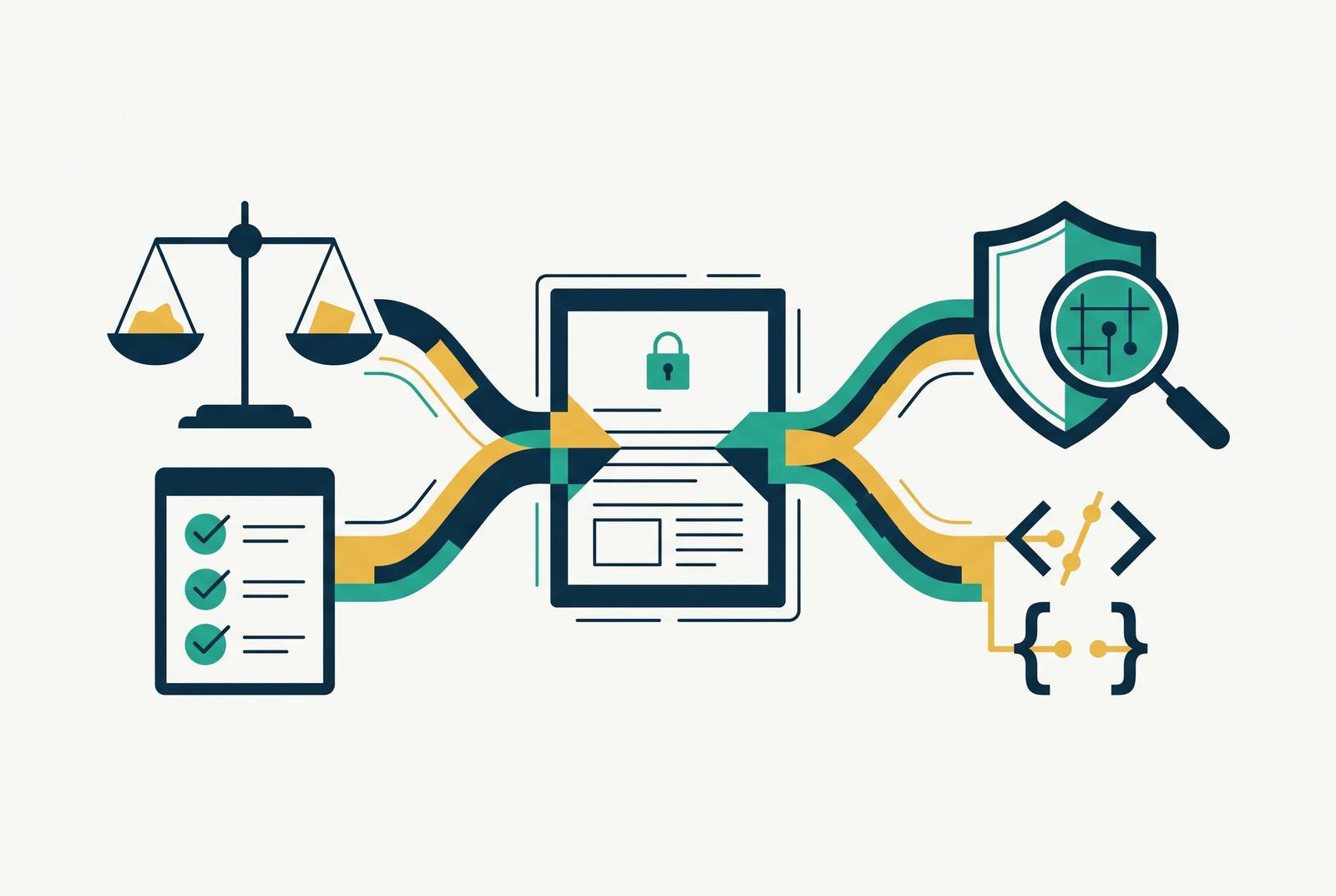
Security content needs legal and technical review at the same stages. Regulators can challenge the same claims that practitioner buyers expect to check, so those claims must be both legally defensible and technically accurate. A parallel workflow lets both reviewers shape claims from the brief onward, with shared evidence and a documented approval trail.
Why security vendors can no longer treat legal and technical review as separate workflows
A technical reviewer approves a precise capability claim, only for legal review to soften it until an engineer can no longer tell what the product does. Reversing the order allows a technical edit to introduce a promise that legal never assessed. Both reviewers did their jobs in isolation. The published asset still fails because approval of one version does not establish the accuracy or defensibility of the next.
That collision reflects two pressures on the same words. Regulators can take legal action over published marketing claims, while practitioner buyers read them for technical signals to check before they buy. Legal risk once moved through slower enforcement cycles, and practitioner skepticism could be dismissed as a softer concern. Neither now fits that comfortable division. Sequential review leaves each function exposed to changes made after its work is done.
How regulatory enforcement turned marketing claims into legal liability for security vendors
The False Claims Act makes inaccurate cybersecurity representations a risk even without a cyber incident. Morgan Lewis identifies heightened exposure around those representations, with documentation, internal controls, and audit readiness all implicated. A breach is not the required opening act. For a security vendor, statements about capabilities and compliance can therefore demand the same legal care as statements in a contract, rather than the lighter treatment often given to promotional copy.
The DOJ’s 2025 settlement with Illumina Inc. puts that exposure in concrete terms. The settlement concerned allegations that Illumina sold genomic sequencing systems with cybersecurity vulnerabilities to federal agencies without adequate product security programs. The representation about product security was the actionable element. The FTC’s GoDaddy settlement, finalized in 2025, follows a parallel deception theory by prohibiting misrepresentations about security measures and programs, including compliance with government, self-regulatory, or standard-setting privacy and security programs. Those restrictions reach directly into marketing language.
The FTC’s “Operation AI Comply” extends the warning to AI-related deception. Its actions and consent orders covered unsubstantiated AI capability claims, AI-enabled fake reviews, and fraudulent business-opportunity schemes. For security vendors using “AI-powered” and “autonomous,” the relevant issue is substantiation. An adjective is not a supporting document. Morgan Lewis also reports that states are putting more of their enforcement focus on deceptive practices and inadequate disclosures, with less focus on failures in breach response.
The CMMC final rule connects these claims to contract eligibility. Published September 10, 2025 and effective November 10, 2025, it requires proof of cybersecurity maturity to qualify and passes those duties through the defense industrial base via contractual flow-downs. Subcontractors, suppliers, and prime contractors share the exposure. Marketing representations used to win those contracts can contribute to FCA risk, so the review boundary cannot stop at formal certifications while leaving the sales narrative untouched.
How practitioner readers evaluate security content — and what happens when legal hedging degrades technical precision
Security engineers, SOC analysts, and CISOs check what they read in vendor content as they would check threat intelligence. They look for omissions, examine the framing, and ask whether a claim can be tested. Vague language makes that work impossible. “Industry-leading,” “next-generation,” and “AI-powered” offer no useful basis for evaluation when they contain nothing specific enough to verify or falsify. They are labels where the reader needs evidence.
That is why legal edits can create a commercial failure without introducing a factual error. A reviewer trying to lower legal risk may replace a precise technical claim with one that is broad and hedged. The result may be safer under a deception standard but less useful to an engineer trying to understand the capability. The hedge has swallowed the claim whole. Once the reader can no longer use the asset to evaluate the vendor, the content has lost its purpose, however tidy its approval record looks.
Lawyers can water down technical content when they lack the domain knowledge to understand which details establish a claim’s limits. But that argues for a different composition of the review function. Precision can set a boundary. A reviewer without domain knowledge cannot distinguish a necessary hedge from one that destroys precision.
The specific regulatory obligations that now attach directly to a security vendor's content and marketing infrastructure
The exposure extends beyond the words on the page. A vendor can publish accurate compliance content while using distribution or measurement practices that create compliance problems of their own. The content is only part of the operation. The DOJ’s Bulk Data Rule, effective April 2025, restricts certain transactions involving sensitive personal data, and its scope can reach marketing and analytics operations that process or transfer covered data types.
By the end of January 2026, businesses in multiple states must recognize universal opt-out mechanisms such as Global Privacy Control signals. For vendors running intent data campaigns, retargeting, or website analytics, those requirements concern how the content operation works. Paul Weiss identifies escalated state enforcement around opt-out mechanisms, privacy notices, children’s privacy, biometric data, and verifiable vendor governance. It expects vendors to face closer oversight and consumers to have stronger privacy rules in 2026.
That broader scope changes what a legal reviewer needs to see. Text alone is not enough to assess the tracking and distribution mechanisms attached to an asset, or whether public representations match those practices. A compliant paragraph cannot redeem a non-compliant campaign. Embedded legal review therefore needs visibility into content operations as well as claims, which is a different function from receiving a finished draft and checking its wording.
What a parallel review workflow actually looks like in a security vendor content operation
The practical response is to integrate both functions at three stages of production. At the brief stage, before writing begins, legal and technical reviewers agree on the claims the asset can make and the documentation that supports them. This is where claim boundaries take shape. The technical reviewer assesses the underlying accuracy, while the legal reviewer considers whether the proposed assertion is defensible under applicable standards. Writers then know the agreed limits as they write, before they finish a draft.
At the draft stage, both reviewers assess the content concurrently. Concurrent review is not simply sending two people the same document and treating their approvals as unrelated events. Each function needs to assess the claim as it will actually appear, including the scope and qualifications established through review. The source is their common reference point. Every assertion about capability, compliance posture, or threat intelligence should map to evidence both functions have reviewed, so a disagreement can turn on what that evidence supports.
At publication, the approval trail records what was reviewed, by whom, and against what standard. IntelligenceBank says approval workflows with secure audit trails are a key part of marketing compliance. That record serves a purpose beyond administration. If a published claim attracts scrutiny, the vendor needs evidence of the review behind it. Legal visibility at this stage also needs to cover the tracking and distribution mechanisms attached to the content.
This structure changes the legal reviewer’s role from catching problems in finished prose to helping define defensible claims at their origin. It requires enough cybersecurity fluency to distinguish an overstatement from a carefully scoped technical assertion. Content built on actual adversary data, named TTPs, and sourced incident data gives both reviewers more to work with from the start, because the evidence comes before the marketing promise.
Why threat intelligence as a content foundation resolves the tension between legal defensibility and technical credibility
A sourced observation can be both more specific and more defensible than a broad marketing assertion. Generality is not the same thing as safety. A claim that attackers exploited a named CVE against organizations in a particular sector using a stated technique gives reviewers something to assess, while an unsupported claim of “industry-leading protection” offers a superlative without a stable basis for comparison.
The advantage is not simply that threat intelligence sounds more technical. Technical review checks whether the observation and the way it is described are accurate, while legal review checks whether the wording claims only what the evidence supports. Neither needs to erase the useful detail. The boundaries that make the statement defensible are also what let a practitioner check it.
The same discipline applies to product capability claims. Documenting an assertion against a named framework, CVE, or adversary technique gives both reviewers a defined basis for assessing its scope. The evidence still has to support the assertion. A named reference makes the relationship between a capability and the threat it addresses available for scrutiny. That relationship is more useful to a practitioner than a description of the product in isolation.
This is why the composition of the content function affects how well parallel review works. A studio built at the intersection of threat intelligence and content production starts with domain expertise, rather than adding it to a generic marketing framework after drafting. Practitioners, including the peers whose conversations CISOs trust, respond to content that shows an understanding of the threat landscape. An intelligence-led operation gives that understanding a place in the production process instead of relying on a late technical pass to supply it.
What breaks when legal and technical review operate in silos — and how to recognize the failure modes
Siloed review has two recognizable failure modes. When legal dominates without technical input, claims become so general and qualified that practitioners cannot use them to evaluate the vendor. The asset may survive scrutiny but contribute no commercial value. Published language needs to describe something a reader can check as well as avoid claims a regulator could challenge. A page full of caveats is not automatically a useful page.
When technical review dominates without legal input, the symptoms run in the other direction. Specific capability claims, compliance assertions, or AI representations can reach the page before anyone checks them against the standards that apply. Detail alone does not make them defensible. Such claims can put vendors at risk of FCA, FTC, or state enforcement, especially those that sell to government customers or operate under CMMC. Diagnosing this failure requires checking whether the precision has been substantiated and legally assessed.
Both failures can appear in one asset. A security engineer may reject the imprecision introduced by legal hedging while procurement or in-house counsel challenges an unvetted compliance claim added during technical review. The buying committee does not share the vendor’s departmental boundaries. NIST CSF 2.0 emphasizes enterprise-wide accountability, including incident response planning that integrates legal, compliance, communications, executive leadership, and technical teams. The same cross-functional principle applies to content, where a published representation can create consequences beyond the team that wrote it.
A review record needs to survive the handoffs. Documentation of the reviewed claim, reviewers, and applicable standard becomes evidence of good-faith compliance if that claim is later challenged. Approval also needs a life beyond publication. IntelligenceBank identifies ongoing monitoring and regular audits as parts of mature compliance, and changing state privacy requirements and federal enforcement priorities make that repeating discipline relevant to content. Parallel review is not a project to finish, but a standing workflow to maintain.