Technical Review Standards for Regulated Industries in Cybersecurity Content
Compliance claims need framework-specific review, not just technical accuracy.

Cybersecurity content for regulated industries needs technical review that checks both the technology and its applicability in the reader’s regulatory context. The standard is framework-specific accuracy backed by evidence that holds up in an audit. Meeting it requires compliance judgment from the drafting stage forward, because a polished claim built on the wrong scope is still wrong.
Why regulated-industry audiences read compliance content differently than general practitioner audiences
A healthcare security engineer reads vendor content with both security operations and compliance obligations in mind. A financial-services architect brings a similar double lens, testing the technical argument while looking for claims that would unravel under scrutiny. These readers already scan for omissions, question architecture claims, and discount descriptions that suggest the writer has never operated the technology. Compliance adds another test alongside that technical skepticism. The content has to survive both.
That second test comes from work the reader already does, including interpreting requirements, mapping controls, and responding to audits. A healthcare security engineer knows whether HIPAA’s addressable versus required control distinction is being used correctly. A financial-services architect knows whether a PCI DSS scoping claim would hold under a real QSA review. These details are part of the reader’s working vocabulary, and misuse is as conspicuous as a fire exit painted onto a wall.
The reader also rarely decides alone what to buy. Compliance teams want controls mapped to a framework, legal wants contractual defensibility, and audit committees want claims that survive scrutiny. Content aimed only at a security practitioner or only at the CISO leaves other members of that committee without what they need. Because compliance requirements trigger a meaningful share of security purchases, those missing answers have commercial weight. Compliance outcomes and audit evidence can make a case that a feature-led description cannot.
How standard technical review processes fail when the audience operates under a compliance regime
A standard technical review usually asks whether a draft gets the technology right. That is necessary, but it does not establish whether the compliance argument holds for the audience’s circumstances. A developer may find that the technical account makes sense while a security architect in a regulated industry spots a wrong assumption about control sequencing or framework applicability. Both readers can be competent and still reach different conclusions. The review was built to answer only one of their questions.
Generic fact-checking has the same boundary. It can establish that a sourced claim appears in the cited material without catching the draft’s misuse of that claim. For example, a statement that a control satisfies a PCI DSS requirement may depend on scoping decisions the article never acknowledges. A missing condition can change the conclusion even when the fact itself is correct.
The workflow compounds that mismatch when subject-matter expert review happens only after the draft is complete. By then, an unsupported interpretation may shape the whole argument. Fragmented feedback across Slack, email, PDF, and Word adds missed comments and version ambiguity to an already difficult review. Meanwhile, broad claims such as “comprehensive HIPAA compliance support” can sound respectable enough to pass. “Meets FedRAMP requirements” has the same problem until someone asks which authorization baseline, at which impact level, and whether the authorization is current.
What framework-specific accuracy actually requires from a content review
Every compliance claim must trace to a specific control, requirement, or authoritative guidance document, and it must hold under the conditions that source imposes. A source supports a claim only if the draft preserves those conditions. Familiarity with cybersecurity terminology is not a substitute for that comparison. The reviewer needs to examine the relationship between the product capability, the requirement, and the circumstances in which the claim applies.
For HIPAA content, that means checking whether the claim gets the addressable versus required control distinction right. A broad statement about compliance support does not answer that question merely because it names HIPAA. For PCI DSS content, the reviewer must examine whether a claim about satisfying a requirement depends on scope and whether the draft makes that dependence clear. The review should not let a conditional claim become unconditional on its way into a headline. That small editorial shortcut can remove the very fact that makes the statement defensible.
Specific identifiers make this work possible by giving claims an exact reference point. Framework control numbers, MITRE ATT&CK technique identifiers, and CVE and CWE references turn broad assertions into claims a practitioner can investigate. “Detects T1078 Valid Accounts” is testable in a way that “stops insider threats” is not. Audit-evident content then goes further by describing what evidence the product produces, in what form, and how it maps to what an auditor needs to see. A capability claim explains what the product does, while an evidence claim explains what can substantiate that account.
Oversight must also match the kind of claim being made. General educational content needs an editor to check its facts and sources, while claims about compliance interpretation or framework applicability need a technical SME and a compliance owner. Detection logic, vulnerability analysis, or incident-response guidance in a regulated context requires a security practitioner or researcher, editorial source checking, and legal or compliance review where appropriate. This risk-tiered review assigns oversight according to the claims each paragraph makes. Its purpose is to put each question in front of someone qualified to answer it.
Why practitioners in regulated industries can detect decorative compliance language on first reading
Practitioners use these same terms when they write policies, answer audit questions, and map controls. They notice when an article borrows the vocabulary but leaves out the conditions that give it meaning. A framework name serves only as a label without a framework mapping.
The contrast is sharpest in claims about coverage. “Advanced protection against sophisticated identity-based attacks” gives the reader little to evaluate. By contrast, “Detects credential stuffing through per-account rate limiting and device fingerprinting, with configurable thresholds, and does not currently cover session hijacking after successful authentication” names a mechanism and a boundary. The limitation strengthens the account because the practitioner was already looking for it.
That first-reading judgment matters because the reader may brief the CISO, influence an evaluation, or raise the objection that ends a deal. AI-assisted vendor research gives the claim more places to appear, since a growing share of cybersecurity buyers use AI tools to help decide what to buy. Those systems base their answers on sources with specific facts and a clear structure, so having a wrong claim cited in an answer poses a different problem from failing to rank. Whether encountered on the page or through an AI answer, the tell is the same missing scope, evidence, or limitation.
The structure of a review process built around a specific regulatory context
A sound process begins with the target audience’s regulatory context and the claims the content intends to make. That establishes which expertise the draft needs before general editorial quality becomes the focus. A HIPAA interpretation needs a reviewer who can judge the distinction the claim relies on. A PCI DSS applicability claim needs someone who can assess its scoping assumptions.
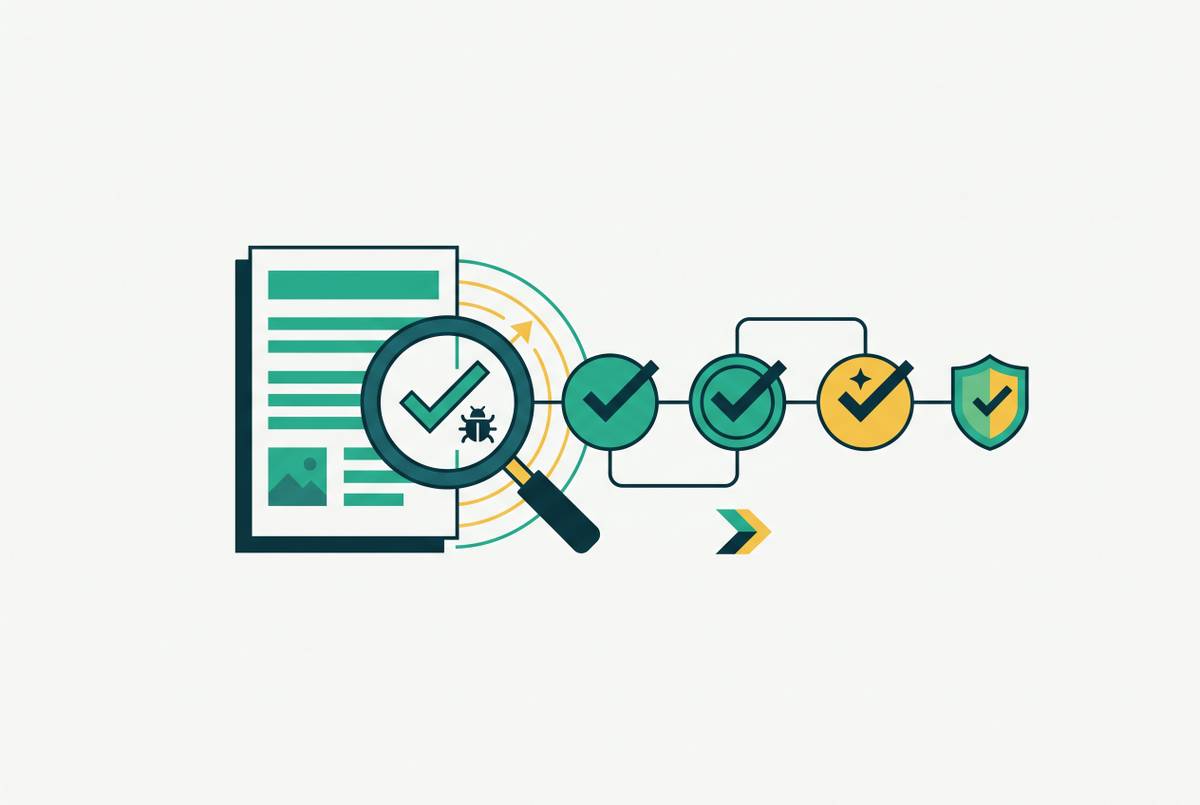
The document then moves through a governed sequence of drafting, peer review, SME review, editorial review, compliance review, final approval, and post-release tracking. Each stage needs explicit exit criteria. Before a framework claim can move forward, reviewers must settle the questions about where it applies and what evidence backs it up, beyond just leaving comments. Editorial review can improve the explanation, but it cannot substitute for that domain decision. An approval should mean something more precise than “nobody objected before the deadline.”
A claim-evidence ledger connects those decisions to the assertions in the article. It records each compliance assertion by type, source, reviewing SME, check date, and the trigger that would require refreshing it. Reviews should examine rendered output rather than source files, and each approval should become a timestamped, identity-bound artifact. Together, these records show which claims were reviewed, by whom, and against what support.
Cybersecurity information ages quickly, frameworks change, and authorizations lapse. The refresh trigger in the ledger gives the program a reason to reopen a claim when its basis changes. When that basis changes, an article that was once correct may need a rewrite that goes well beyond surface changes. Publication ends the production cycle, but it does not end responsibility for the claim.
How embedding compliance-domain judgment at the drafting stage changes what the review catches
Even a well-defined sequence has limits if compliance judgment arrives only after the argument is written. A factual error may involve replacing a wrong datum with the correct one. A framework misapplication can instead make an entire section depend on a mistaken reading of scope. Correcting that problem means reconstructing the reasoning.
A writer with genuine cybersecurity and compliance knowledge can frame an argument around the conditions that govern it from the outset. Independent review remains necessary, with its attention shifted from fundamental errors in applicability toward edge cases. The later checkpoint becomes more useful because the earlier work was built for it.
This is a staffing requirement as much as a workflow choice. Senior writers who know the field write drafts that need less reworking during SME review, which makes that review faster and more reliable. A purpose-built cybersecurity studio can offer that capability, but specialization matters because of the judgment it brings. Threat-intelligence-powered content studios such as Cyberou provide one option by anchoring compliance claims in real-world regulatory context from the research phase forward. The useful distinction is expert-led production rather than generic writing with an expert asked to rescue it at the end.
What a credible, audit-evident content program looks like in practice for a cybersecurity vendor
The resulting program is recognizable in its published work. Claims have clear limits, each framework reference has a clear purpose, and descriptions of what a product can do explain what evidence backs them up. Explicit compliance conditions demonstrate knowledge of the audience’s environment. The content makes the case through what it can substantiate.
Original research gives that substance a foundation that republished commentary cannot match. Mandiant, Recorded Future, and SentinelOne have built trust in their brands through research that practitioners use. Sustained threat research, technical documentation, and substantive thought leadership also build authority inside AI engines as a byproduct of direct-marketing programs. Production therefore calls for a smaller number of substantial pieces. One genuine research piece grounded in real framework applicability offers more than a quarter of generic compliance posts.
Behind those pieces, the claim-evidence ledger, staged review record, and refresh triggers support material that customers can use in evaluations, share with audit committees, or reference in analyst briefings. Important cybersecurity claims need a reliable source, a qualified reviewer, and a process for revisiting them. A vendor that can demonstrate this infrastructure shows the same governance discipline it asks of its customers. The content that earns trust with compliance-obligated practitioners does not require them to redo its review, because the process that produced it was designed around the same standards they apply to their own operations.