Building a Technical Review Workflow for Security Content
One wrong fact in security content signals vendor incompetence to practitioners.
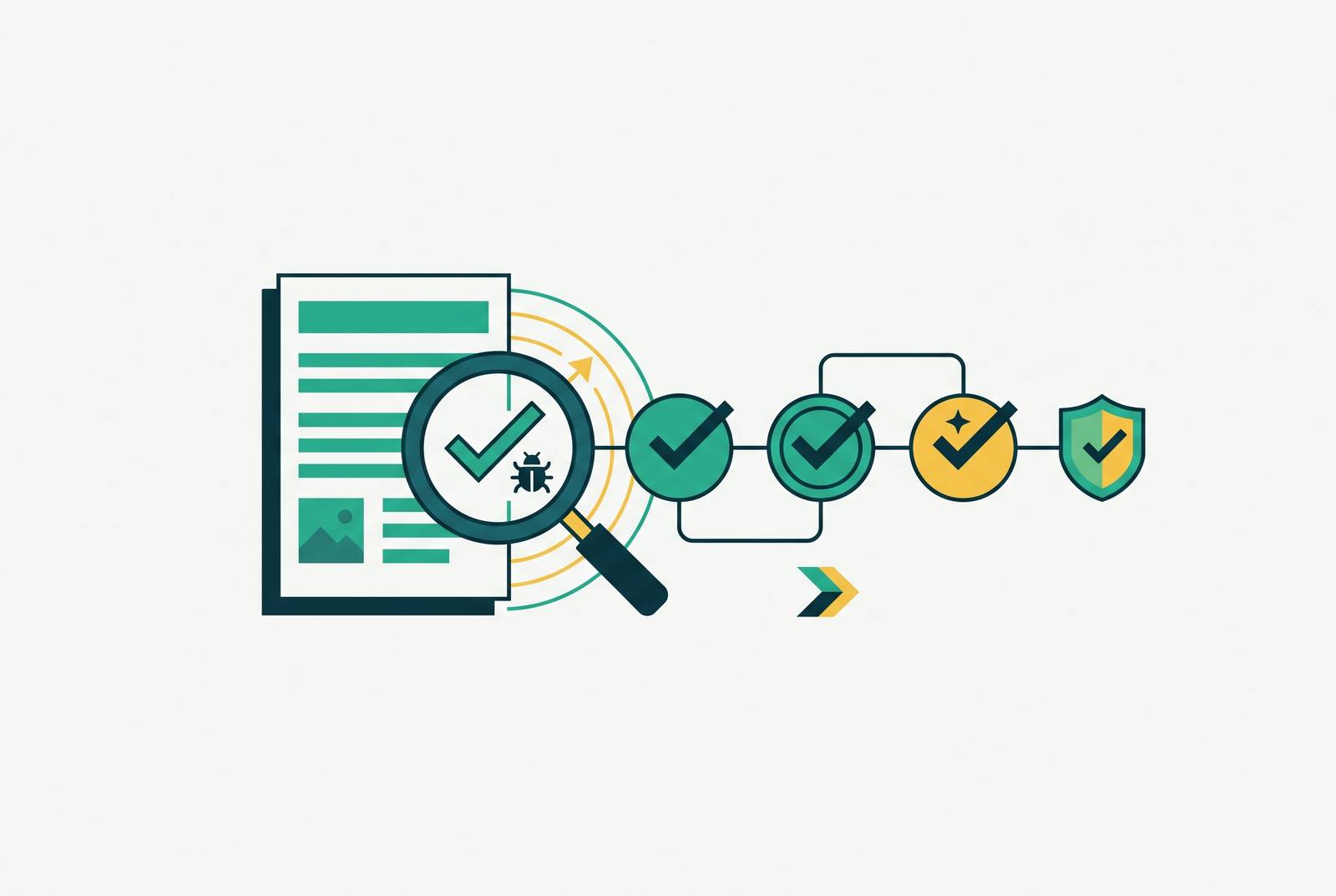
A technical review workflow for security content is a structured, role-defined process that catches technical inaccuracies before they reach practitioners who will spot them in seconds, and building it correctly decides whether a vendor earns trust or quietly torches it.
Why security content fails practitioners
Picture a CISO reading a vendor blog post on their lunch break. They're reading it the same way they'd read a threat intelligence feed or a third-party risk assessment: looking for the seam, the soft spot, the place where the claim doesn't hold up. Security engineers, SecOps leads, and CISOs all apply this same lens, and it means a single factual error or unsupported claim gets caught immediately. That error doesn't get filed away as a writer's mistake. It gets filed away as evidence of the vendor's incompetence.
A typo is forgivable. A wrong detail about how a detection rule works, or a mischaracterized attacker technique, reads as proof the vendor doesn't understand its own product, let alone the threat landscape it claims to defend against. Add to this the dual-audience demand baked into most security content programs: business-level messaging must share the same content calendar, often the same quarter, sometimes the same piece, as technically credible material. Most vendors are good at one register or the other. Few manage both.
The stakes are sharpest for the CISO audience specifically, because their professional risk doesn't look like anyone else's. A wrong purchase decision for a CISO can mean breach exposure, a regulatory inquiry, or a resignation letter with their name on it. For that reader, vendor trust built through technically accurate content outweighs a slicker feature list or a better brand story. They're shopping for someone who won't get them fired.
What a technical review workflow solves for
A technical review workflow exists to catch three specific things: the claim-evidence gap, the outdated statistic, and the generalized assertion that sounds confident but means nothing to a trained reader. None of these are style problems. They're credibility problems wearing a style problem's clothes.
The claim-evidence gap is the one that does the most damage. If a content program can't trace every technical assertion back to a verifiable, current source, it's producing material that a sophisticated reader will distrust on first contact, not on the tenth. Practitioners don't give vendors the benefit of the doubt on technical claims the way a general audience might. They check.
Generic AI-generated content and writing handled by people without security backgrounds make the gap worse, not better. Content that can't explain threat modeling in a way that holds up, or that leans on marketing language where a precise term belongs, or that reads like it was written to satisfy a search algorithm rather than a security engineer, fails in two places at once. It gets the facts wrong, and it gets the voice wrong. A practitioner audience notices both, often in the same sentence.
A functioning review workflow has to solve for the accuracy of each individual claim and for something harder to pin down: the cumulative sense of technical fluency a reader picks up across an entire piece. One correct fact surrounded by four vague ones still reads as hollow. The workflow has to catch the vagueness, not just the errors.
The roles a technical review workflow requires and what each one owns
A technical review workflow works when every role has a defined scope of accountability. Handing "technical review" to one person, or treating it as a final pass after the writing is done, recreates the exact failure modes the workflow was built to prevent. Accountability spread across everyone is accountability owned by no one.
The subject matter expert owns technical truth. That means the accuracy of claims, the correctness of threat descriptions, the validity of detection logic, and whether the content reflects how attackers are actually operating right now. It does not mean the SME is responsible for prose quality or whether the piece fits its intended audience. Asking an SME to also judge tone is asking them to do a second job they weren't hired for.
The technical writer owns translation. Their job is turning SME-provided truth into content that's clear, usable, and aimed at the right reader. It's not their job to conduct original technical research or make accuracy calls on their own. A good technical writer is a skilled translator, working under the SME's license rather than as a second SME.
Compliance or legal review sits in its own lane entirely: checking that content doesn't make claims the product can't back up, doesn't bump against regulatory limits, and doesn't overstate a certification. This role should never get folded into technical accuracy review. Compliance checks what you're allowed to say. The SME checks whether it's true. Those are different questions with different wrong answers.
Then there's the practitioner proxy, the role that owns the final credibility check. This could be an internal security engineer, a trusted outside reviewer, or a structured bar like the one ASIS International sets for Security Management submissions: vendor-neutral, non-promotional, built for a practitioner audience. Their question is simple. Would a skeptical reader in this field actually trust this piece?
Skip any of these roles, or let one person informally cover two of them, and edge cases and outdated claims slide through because nobody with the right expertise was actually looking for them.
When each role enters the workflow
Who reviews the content matters. When they review it matters just as much, and getting the order wrong turns an efficient workflow into an expensive one. SME involvement has to happen before the content hardens into polished prose, not after the fact.
Bring the SME in early, at the outline or interview stage, and they help set the technical frame the writer builds from. Bring them in late, after a full draft exists, and now they're correcting a finished structure instead of shaping it from the start. The second version costs more time and produces worse results, because the writer may have already built an entire argument on a technical premise that turns out to be wrong.
The SME bottleneck is a real constraint on every content program. Senior technical staff are expensive, and every hour one of them spends marking up a polished draft is an hour that could have been spent catching the same issue at the outline stage for a fraction of the cost. Smart workflows batch SME involvement into focused sessions, define clearly what "done" looks like before the review starts, and skip the slow drip of one question at a time over email.
The claim-evidence ledger belongs in the workflow at the draft stage, ahead of SME review. That way the SME is checking claims against sources that are already tracked, instead of reconstructing the evidence chain from nothing while also trying to judge whether it's accurate.
Practitioner proxy review, the final credibility check, comes after SME sign-off on accuracy, never alongside it. Running both at once makes it hard to tell which objections are about facts and which are about tone or framing. Keep them sequential, and each reviewer's feedback stays legible.
The costliest sequencing mistake a content program can make is publishing without practitioner sign-off. A piece can be completely accurate and still read as vendor-centric or marketing-filtered, and that's exactly the version a CISO rejects when they encounter it through a peer's share rather than a vendor's own distribution.
The Claim-Evidence Ledger as the Workflow's Connective Tissue
A piece of content that passes technical review is only as trustworthy as the day it was published, unless something keeps tracking whether its claims still hold up. That something is the claim-evidence ledger, a structured table that turns a one-time review into an asset that stays defensible over time.
Each row tracks five things: the claim as it appears in the content, the source backing it, the date that source was checked, the reviewer who verified it, and the trigger that should prompt a fresh look, whether that's a new annual threat report, a product version change, or an updated regulatory requirement. A single row might read something like this: claim, "ransomware groups increasingly use double extortion"; source, a named threat report; date checked, a specific month; reviewer, the assigned SME; refresh trigger, the next year's report release. Nothing complicated. Just a record that someone can audit later without starting from scratch.
The refresh trigger is what separates a ledger from a glorified footnote list. A footnote tells you where a claim came from. A ledger tells you when that claim is due for a recheck, before it gets recirculated or picked up by an AI-assisted buyer evaluation tool that has no idea the underlying source is two years stale.
The ledger also speeds up SME review itself. Instead of hunting down sources or rebuilding the evidence chain from memory, the reviewer is checking a record that's already organized. Their time goes toward judgment calls on accuracy, not administrative digging. That's a better use of an expensive person's hour: SME review takes an afternoon instead of a week.
Where threat intelligence fits into the review workflow
Threat intelligence should do for the review workflow what it already does for a detection queue: triage. It tells the team which claims need the most scrutiny and which topics are worth writing about at all, rather than sitting off to the side as a once-a-quarter content idea.
A claim about a specific attacker technique or an active threat actor's current tradecraft goes stale fast. A claim about a general security architecture principle ages much more slowly. Treating both with the same refresh cycle wastes effort in one direction and leaves risk exposed in the other. The review workflow has to know the difference and schedule accordingly.
Vendors who ground their content in current threat intelligence, and who build a review workflow that confirms those claims still reflect the live threat landscape, end up producing the kind of content practitioners actually cite and pass along through their own networks. CrowdStrike's Global Threat Report is the clearest example of this model at work: flagship research built on live telemetry, cited by practitioners directly, and a factor in citation share inside AI-assisted buyer evaluation tools. The report's credibility doesn't come from the CrowdStrike name sitting on the cover. The review workflow behind the research is what produces this credibility: it keeps the claims tied to what's actually happening in the wild.
Not every security vendor has a dedicated threat intelligence function sitting in-house. For those that don't, a content studio with real security domain expertise and access to live intelligence can serve as that review layer in a way a generalist team simply can't replicate. The underlying logic doesn't change based on where the intelligence comes from, internal telemetry or an external partner. The review has to be anchored in something current, wherever it originates.
How AI Tools Change the Review Workflow
AI tools have earned a real place in the administrative layer of a review workflow: extracting claims, mapping sources, managing long questionnaires, flagging documentation gaps. What they can't do is make the accuracy judgment or the practitioner-credibility call that sits at the center of the whole process.
AI-assisted workflows cut review time by automating the repeatable grind: pulling evidence out of internal systems, flagging answers that contradict each other, mapping claims to the relevant compliance framework, and catching documentation gaps before a claim ever reaches the SME. That's real time saved, and it's worth using.
But there's a constraint here that should sound familiar to anyone running a security operations center. A SOC team knows that an AI system plugged into production data can still lack the contextual judgment needed to make a reliable call on its own. Content review has the exact same constraint. AI output treated as the final word, with no human accuracy check behind it, reproduces the very failure a technical review workflow exists to stop. The tool gets you further, faster. It doesn't get you to done.
AI can own the ledger maintenance layer, flagging claims whose sources have aged out and surfacing refresh triggers before anyone has to go looking for them manually. SME accuracy review and the practitioner proxy check stay human-owned, role-defined gates, full stop, because both require a kind of judgment no current tool reliably delivers.
What a review workflow looks like when it is working, and the signals that it is not
A working technical review workflow produces content where every claim traces back to a current, verified source, every role has actually signed off on its own piece of the process, and the practitioner proxy has cleared the piece against the bar a skeptical reader would apply. These checks are documented. None of them are assumed.
The signals that it's working are specific and checkable. SMEs get pulled in at the outline stage, not handed a finished draft to mark up. A claim-evidence ledger exists and gets maintained between publications, not built once and forgotten. The practitioner proxy review turns up real corrections before publication. Content is shaped differently for different readers, so the CISO-facing asset doesn't read like the security engineer-facing one wearing a different headline.
The signals it's failing look almost identical in reverse. SME review happens informally, or it doesn't happen. Claims float around without any tracked source behind them. "Technical review" is one person's quick read before the content goes live, lacking a defined gate with real accountability behind it. Older content gets recirculated without anyone checking whether its intelligence sources have aged past relevance.
The market has already started pricing this discipline as a product category in its own right. Cisco's acquisition of SnapAttack, a threat detection and defense company brought in to strengthen Splunk's detection and engineering roadmap, is a sign that structured, validated security content and detection logic now carries measurable workflow value. The same logic holds for a vendor's content program. The workflow behind the content is the asset; the piece itself is not.
That logic extends to co-created case studies too, the kind where the customer's own voice carries the piece and the vendor's role is closer to facilitator than narrator. Those clear the practitioner credibility bar in a way vendor-narrated case studies rarely do, and they need the same review workflow applied to them, not an exemption because a customer's name is attached. A content studio built specifically around security, rather than a generalist agency bolting security onto a broader practice, can run that full workflow consistently and at the depth the subject demands. Domain expertise here is the baseline requirement for the review to mean anything.
The cost of skipping this entirely is not abstract. A single technically inaccurate piece that reaches a practitioner audience can undo months of trust that accurate, carefully reviewed content took time to build. That trade is almost never worth it.