Content Strategy for Cybersecurity Vendors Entering a New Vertical
Shortlists form before sales calls begin—here's how to get on them.

Security buyers aren't building long lists anymore. Budgets are tight, procurement teams are tired of managing forty-point vendor sprawl, and the trend across the industry is consolidation: fewer tools, fewer contracts, fewer vendors in the stack. That changes what a new-vertical entry actually requires. A vendor that fails to build credibility early doesn't get bumped to "maybe next quarter." It gets cut before anyone on the buying side even opens a sales call. Committees in this space can run eight to fifteen stakeholders deep, and every one of them is a potential reason to say no. The practical result: showing up isn't the hard part. Getting onto the shortlist of three or four vendors a buying committee will actually evaluate is the real contest, and that contest is decided before a single demo gets booked.
Why new-vertical buyers distrust vendor claims by default
Security buying committees start from suspicion, and for good reason. A bad vendor choice doesn't just waste budget. It can produce regulatory fines, downtime, breach costs, and a damaged reputation that sticks around far longer than the contract did. So the default setting toward any unfamiliar vendor is distrust until proven otherwise. A strong track record in one vertical buys nothing in another. A healthcare buying committee has never heard of a vendor that dominates retail. There's no peer network vouching for it, no analyst coverage in their specific context, no reference customer they recognize by name.
Generic language makes this worse, not better. Phrases like "AI-powered," "next-generation," and "complete protection" flood inboxes by the dozen every week, and technical evaluators have learned to treat them as a tell. Those words don't signal sophistication. They signal a vendor that hasn't done its homework on the vertical it's trying to enter. Fear-based pitches fare no better: buyers have heard every version of "the threat landscape has never been more dangerous" and have stopped reacting to severity language that isn't tied to their specific environment. The objection a new-vertical vendor actually faces is "we don't know if you understand how our environment actually works," and no feature list answers that question.
The Technical Team's Influence on Shortlisting
CISOs rarely make vendor decisions alone. They lean on security engineers and architects to vet anything unfamiliar, and that technical layer acts as a filter long before a proposal reaches the top of the org chart. Content written only for the CISO, pitched entirely in business outcomes and risk reduction, gets stopped at that filter. It never reaches the person who signs.
Security engineers read a lot of vendor material, and they can tell within a paragraph whether a piece was written by someone who understands the category or someone paraphrasing a product spec sheet. Generic or shallow content doesn't just underperform with this audience. It gets a vendor removed from consideration outright, often without the CISO ever knowing the content existed. Earning the technical team's respect is the precondition for the CISO relationship, not something that runs alongside it. Credibility built at the practitioner level is what travels upward to the signature, not the other way around. That means the actual target for a new-vertical content strategy is the security engineer or architect holding the veto, not the executive holding the budget.
Original Threat Intelligence as a New-Vertical Vendor's First Credibility Signal
Security teams are buried in threat information. What they lack is intelligence that keeps pace with how adversaries actually behave and maps cleanly onto their own environment. That gap is where a new-vertical vendor can make its first real impression: if it publishes original, vertical-specific threat research, it proves domain fluency before a single sales call happens. It shows, in public, that the vendor understands the attack surface, the adversary behavior, and the operational risks particular to that vertical.
Recorded Future's State of Threat Intelligence report found that most respondents plan to increase their threat intelligence investment, and more than half expect their threat intelligence needs to change moderately or significantly in the near term. That's a market actively shopping for better sources, which means new entrants who show up with something genuinely useful have an open door.
The test practitioners apply isn't volume. It's specificity. If intelligence reflects what a security team actually worries about day to day, it reads as insider knowledge. Intelligence that chases whatever AI threat headline is trending that week reads as marketing dressed up as research. Rapid7's detailed writeup of the Notepad++ compromise is a useful model of the difference. The report laid out, in granular technical detail, how a failure in the distribution infrastructure for a widely used utility turned into a targeted supply chain event. It earned trust because it was precise and mechanical, not because it was alarming. That's the bar: show the mechanism, not the scare headline.
Vertical Specificity in Content Positioning vs. Broad Coverage Claims
Owning a narrow position beats chasing a broad one. A vendor that positions itself as "cloud security for healthcare" or "SSPM for mid-market financial services" competes on different terms than a vendor claiming to protect everything, everywhere, from every threat. Specificity makes every piece of content that vendor publishes directly useful to the exact buying committee it's trying to convince. Broad coverage claims, by contrast, read as noise.
This isn't just a messaging preference. It shapes the entire content operation: which threat scenarios get covered, which compliance frameworks get referenced, which peer organizations get cited, which practitioner communities get engaged. A vendor claiming to cover everything ends up saying very little about any one buyer's actual risk. That same vagueness creates a second, more mechanical problem. AI-driven search tools now play a real role in how buyers research vendors before a shortlist even forms, and generic coverage claims are harder for those systems to match to a specific query like "DSPM vendor for healthcare." A vendor invisible in that research phase never makes the shortlist discussed earlier, no matter how good the product actually is.
The content sequence that builds credibility before the sales cycle starts
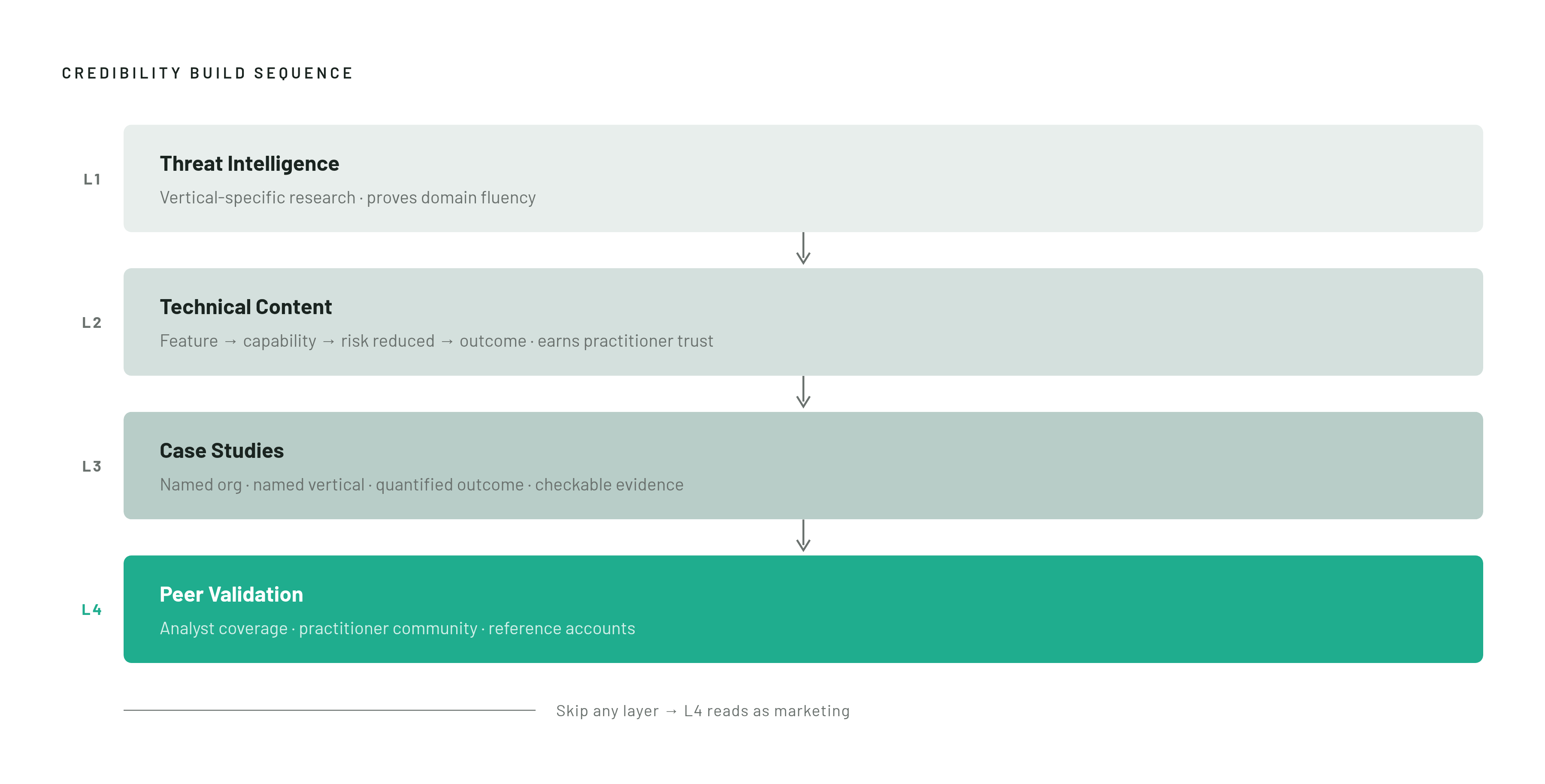
Credibility doesn't get built by publishing everything at once. It gets built in order, with each layer making the next one believable. Threat intelligence establishes that the vendor understands the environment, and that understanding is what makes technical content worth reading. Technical content credibility is what makes case studies believable. And case studies are what make peer validation land. Skipping a layer, or publishing them out of order, makes the later content read as marketing no matter how well it's produced.
The first layer is the threat intelligence and vertical-specific research described above. Without it, everything that follows reads as a vendor talking its own book rather than an informed source commenting on a real environment.
The second layer is technical content that connects product capability to the specific risk surface of the target vertical. This is where the formula that works for engineering audiences applies: feature, tied to capability, tied to risk reduced, tied to business outcome. Security engineers are persuaded by a clear line from a specific feature to a specific risk it addresses.
The third layer is case studies and proof-of-concept storytelling, and this is where credibility turns into evidence a buyer can actually check. SecurityScorecard's published case library shows what this looks like done well: cases involving the Insurance Authority of Hong Kong, energy company Solarig, and a healthcare solutions company whose case study credits the vendor with reducing vendor assessment time by 96%. Those cases work by naming the organization, naming the vertical, and quantifying the outcome, so a buyer in insurance, energy, or healthcare can evaluate the claim against their own situation.
The fourth layer is peer validation: analyst coverage, practitioner community participation, reference accounts. This is where credibility becomes self-sustaining, because buyers entering an unfamiliar vendor relationship lean hard on what their peers and trusted analysts say, precisely because they have no history with the vendor themselves. None of these four layers substitutes for the one before it. A reference account means little if the vendor has never published anything that proves it understands the vertical. A case study means little if no technical content establishes how the product actually works. Order is the strategy here, not just content variety.
What case studies must contain to survive practitioner scrutiny
Buyers in 2026 run proof-of-concept evaluations that actively test vendor claims about latency and API compatibility, so a case study can't just assert an outcome. It has to survive someone trying to poke holes in it. A technical buying committee reading a case study wants to know what was tested, what was measured, and what the baseline looked like before the vendor's product entered the picture. A case study that only states the ending, "reduced incidents by 40%," without showing the mechanism that produced that number, fails the exact scrutiny it's going to get.
The structural requirement is pain, resolution, and business impact, each one quantified. Done well, a single case study gives every committee member something to extract on their own terms: the CISO reads it for risk reduction, engineering reads it for mechanism, procurement reads it for total cost of ownership, compliance reads it for regulatory alignment. Done poorly, with language like "next-gen AI," "military-grade encryption," or "total protection," the case study signals the opposite of competence to a technical reader. Buzzwords tell a practitioner that the vendor hasn't actually grappled with how messy real environments are. The language of a case study is itself a test, and most vendors fail it before the data even gets read.
Anonymizing a case study is sometimes necessary, and that's fine, as long as the vertical specificity survives the anonymization. A healthcare buyer doesn't need the name of the hospital system in the case study. They need to know the subject operated under a comparable regulatory and threat environment, not just that "a large enterprise" saw good results. Strip out the name if needed, but never strip out the context that makes the case relevant to the reader evaluating it. And because different committee members pull different things from the same case study, that single document has to carry the weight of the entire committee, not just the person who signs the final contract.
Producing content for each member of the buying committee, not just the CISO
A content program built only for the CISO leaves everyone else on the committee without ammunition. In a group of eight to fifteen stakeholders, that's not a small gap. Any one of them, unconvinced or simply unequipped to make the internal case, can stall a deal that was otherwise headed toward a signature.
Each role on that committee reads differently and needs a different kind of proof. Security engineers want technical depth and architecture detail. Procurement wants a clear total-cost-of-ownership breakdown. Legal wants compliance documentation mapped specifically to the vertical's regulatory framework. Finance wants an ROI model with real numbers attached. Audit wants evidence of control coverage they can point to later. None of these roles will accept a repackaged version of the CISO pitch, and none of them should have to go looking for the material themselves.
This is the same sequence described so far, redirected. The threat intelligence and technical content that earned the security engineer's trust also gives that engineer the vocabulary to make the case upward to their own boss. The quantified outcome in a well-built case study gives finance and procurement the exact numbers they need to get a purchase order approved. Building out this library closes off the veto points where deals die after a vendor has already won the CISO's interest, which happens more often than most sales teams want to admit.
Domain Expertise in the Content Function as a Non-Negotiable Requirement
None of the preceding strategy survives contact with a writer who doesn't know the subject. Technical readers can spot a generalist author within a paragraph, and that recognition kills a vendor's credibility faster than saying nothing at all would have.
The people producing this content need to understand the category, SIEM, XDR, SASE, Zero Trust, EDR, DSPM, IAM, without reaching for a glossary. They also need to write about the target vertical's specific threat surface, its regulatory environment, and its operational constraints with the kind of accuracy that practitioners expect from one of their own. This is a structural requirement: a case study that misdescribes a technical mechanism, a threat brief that repeats a misconception any working analyst would catch, or a compliance explainer that misreads a regulatory requirement gets noticed. And in the practitioner communities where vendor reputations actually get made, it gets shared, pointedly, as an example of a vendor that didn't do its homework. The entire sequence, threat intelligence, technical content, case studies, committee-wide material, depends on being produced by people who already speak the language of the vertical. That's the one input nothing else in this strategy can substitute for.