Competitive Intelligence Gathering for Cybersecurity Marketing Teams
Buyers decide 95 percent of the way through research, leaving most vendors scrambling to catch up.

Competitive Intelligence Gathering for Cybersecurity Marketing Teams.
Why the 8,500-product market makes genuine differentiation structurally hard
More than 8,500 mapped security products get tracked across categories right now https://mandos.io/brief/how-to-sell-to-cisos. A buyer sitting across from a sales rep is not picking between two reasonable options. That buyer is wading through a swamp of near-identical feature lists, trying to work out which vendor is actually different and which one just hired a better copywriter. The average U.S. data breach hit $10.22 million in 2025, so the budget to solve this problem exists, and boards are paying attention https://www.cyberdb.co/the-cyber-security-industry-in-2026-a-comprehensive-market-intelligence-guide/. Money is not the bottleneck here. Information overload is, and no amount of extra budget fixes a buyer who cannot tell one vendor from the next.
The category-wide claim from every vendor is AI-native. Every vendor says zero-trust. Every vendor says cloud-first, cloud-native, cloud-something, until the words stop meaning anything, the way "extra crispy" stopped telling anyone what actually happened to the chicken. Buyers cannot separate hype from a real technical claim anymore, and that confusion is the exact problem competitive intelligence exists to solve. Differentiation in a market this crowded does not come from a punchier tagline. It gets dug up, verified, and pointed at a real gap a competitor left open, and that digging is what CI actually does.
Competitive intelligence in a security context
CI means the legal, ethical collection and analysis of publicly available information about competitors and the broader market, done to sharpen a decision rather than to snoop on a rival's sales team or guess harder. It tracks what competitors sell, who buys from them, how they price, who they partner with, what they say in public, and where their technology is heading, then turns those observations into a forecast of what they will do next.
The directory tracks more than 8,500 mapped security products across categories (buyers are not choosing between two options, they are navigating near-total feature parity at scale). Market research describes the weather. It does not tell a sales rep what to say when a prospect brings up a competitor by name. Most security marketing teams are already gathering research, quietly assuming it counts as intelligence, and wondering why none of it changes what the sales deck says. It does not count until it changes a decision, full stop.
Average eCrime breakout time fell to 29 minutes in 2025 https://www.cyware.com/blog/top-threat-intelligence-platforms-and-solutions. Attackers move from initial access to lateral movement inside a coffee break, and the competitive landscape marketers track does not sit still either. A CI function running on last quarter's notes is reading a map of a city that already got rebuilt.
The gap between competitive pressure and competitive readiness most security marketing teams have
Competitive pressure is the baseline condition of doing business in this market. Readiness has not caught up. The average sales team rates its own competitive preparedness at 3.8 out of 10, a number that should embarrass anyone who has sat through a "we're different because we care more" positioning meeting https://unkover.com/blog/competitive-intelligence/. That gap between pressure and readiness costs companies an estimated $2 to $10 million a year in deals that were, in theory, winnable https://unkover.com/blog/competitive-intelligence/.
The intelligence gap does not start at the analysis stage. It starts before anyone opens a spreadsheet, because nobody logged who the deal actually got lost to.
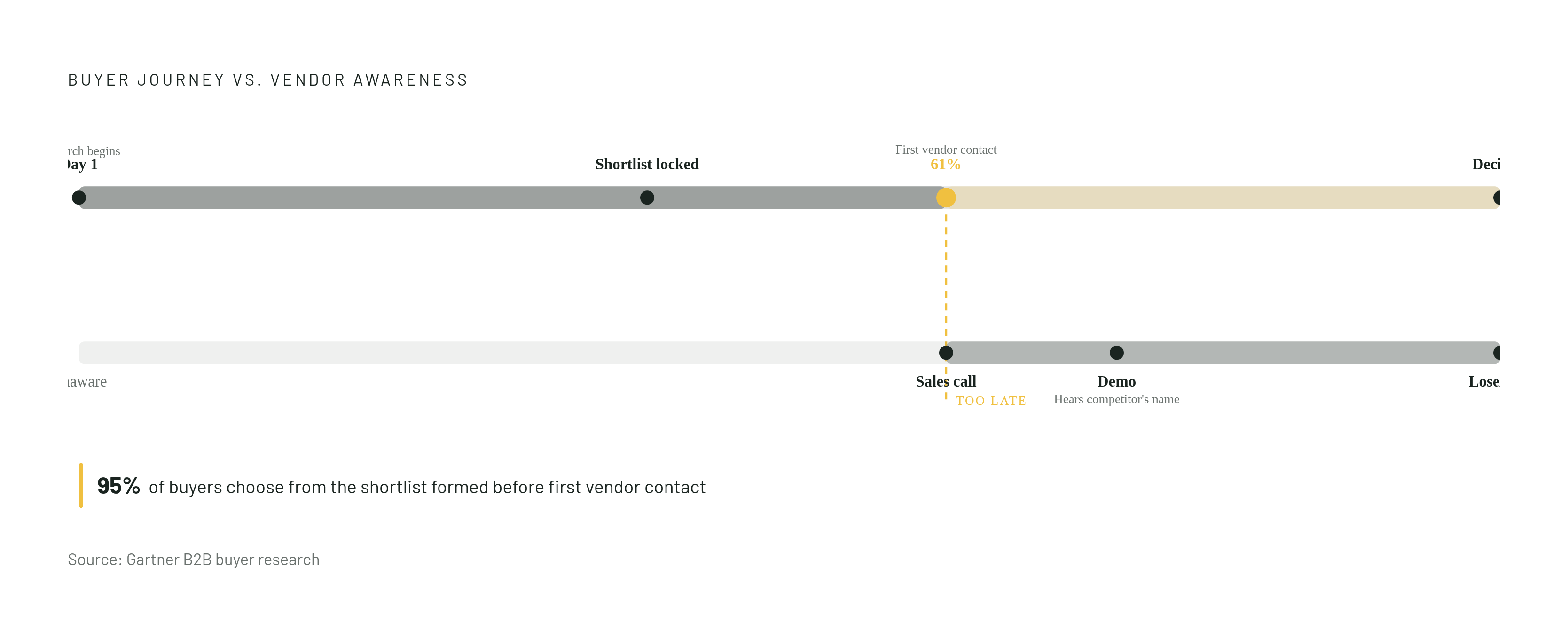
Add the buyer's side of the timeline, and things get uncomfortable fast. Buyers make first contact with a vendor roughly 61% of the way through their own research journey, and once a shortlist gets built on day one, buyers pick from that shortlist 95% of the time https://martal.ca/cybersecurity-marketing-lb/. The competitive battle is mostly decided before the vendor's sales team even knows a battle started. By the time a rep hears a competitor's name on a call, the war got fought and settled weeks earlier, in browser tabs nobody on the vendor side ever saw. 44% of companies still lack visibility into which competitors show up in their own CRM pipeline. The intelligence gap opens before a single analysis ever runs.
The primary sources security practitioners trust as the center of a CI program
The 2026 Vereigen Media Cybersecurity Marketing Spend Benchmark Report identified threat intelligence and research-driven content as the strongest trust drivers in the category. That fact works double duty for CI purposes. It tells a marketing team what practitioners actually believe, and it tells them exactly where competitors go to reveal their hand.
Adversary reports, ISAC feeds, NIST and other regulatory guidance, and analyst reports are the primary sources worth building a program around. These are the documents practitioners read on their lunch break, the ones that quietly set buying criteria long before a vendor's sales deck enters the room. Secondary sources, analyst aggregators, review sites, news monitoring tools, have a place in the mix, but they describe what happened without ever explaining why a buyer picked one vendor over another. They are the weather report; someone still had to decide to bring the umbrella.
The reason appears only in primary buyer research: win-loss interviews, competitor-switching interviews, buyer journey interviews. These produce verbatim evidence, in the buyer's own words, sturdy enough to survive an internal stakeholder asking "wait, says who?" Secondary sources tell a team what a competitor announced. Primary interviews tell them why anyone cared enough to switch.
Structuring a CI function that produces intelligence rather than a collection backlog
Most CI programs fail the same way: they collect endlessly and analyze nothing. If nobody on the team can say, in one sentence, why a specific deal got lost to a specific competitor, the team does not have an intelligence program. It has a very expensive filing cabinet.
Scope discipline fixes a lot of this on its own. Most security marketers try to track the whole category, when the real competitive pressure usually comes from three to five names that keep recurring in actual deals.
Traditional CI ran on quarterly cycles, with manual collection, a slow synthesis phase, and a report that lands weeks later. By the time that report hits a marketer's inbox, the positioning is locked, the campaign brief is already written, and the insight is about as useful as a weather forecast for yesterday. The CI tools market is growing fast in response, from $590 million in 2025 to a projected $1.46 billion by 2030, at roughly 20% a year https://unkover.com/blog/competitive-intelligence/. Buying better tools without building an analytic process to sit behind them just means the backlog gets collected faster. It is still a backlog, only now it refills itself in real time.
Translating CI findings into positioning that practitioners will not dismiss
Security practitioners are a specific, tough kind of skeptical buyer, sharper than the generic "B2B buyers are cautious" line everyone reaches for. Practitioners disengage the moment content feels technically thin or disconnected from what is actually happening in the threat landscape, and they rarely come back to give a vendor a second look.
Buyers land on a shortlist 95% of the time and rarely leave it, so CI-informed positioning has to reach a practitioner before evaluation starts, not during it https://martal.ca/cybersecurity-marketing-lb/. Showing up with the perfect competitive argument during the demo is showing up with the right answer to a test that already got graded. CyberBridge Marketing's analysis of over 200 cybersecurity company websites found that most firms pour 80% of their marketing into bottom-of-funnel "buy now" messages, while buyers actually spend 6 to 10 months researching before they are ready to purchase https://chatterbubble.co/resources/content-marketing-for-cybersecurity-firms-2026. That mismatch is roughly the size of showing up to a first date holding a ring.
CI's job in that window is not to catalog which features a competitor lists on a pricing page. Buyers typically consume three or more pieces of content before they will even engage a vendor, so CI findings need to shape that whole sequence of content, not get bolted onto a single product page as an afterthought.
Using threat intelligence as both a CI input and a content asset
Threat intelligence leadership is turning into the defining marketing differentiator of 2026, and that has nothing to do with a stylistic preference for a certain kind of blog post. It works as a trust signal, maybe the trust signal, in a market where practitioners have learned to tune out anything that smells like marketing copy.
The threat landscape will not sit still long enough to make this a one-time content project either. AI-enabled adversary activity rose 89%, infostealer phishing emails grew 84% in 2024 versus 2023, and CrowdStrike's 2026 Global Threat Report named 24 new adversaries during the year, bringing its total tracked count to 281, with the fastest observed breakout time clocked at 27 seconds https://flare.io/glossary/top-14-threat-intelligence-platforms-for-2026 https://www.cyware.com/blog/top-threat-intelligence-platforms-and-solutions. That is a genuinely renewable well of material, refilling itself constantly whether a marketing team asks it to or not.
The CI read here does two jobs. First, it shows which competitors are publishing credible threat research and which ones are producing marketing-dressed summaries that practitioners ignore on sight. Second, it reveals the coverage gaps nobody else is writing about, because those gaps are where a genuine positioning opportunity sits, wide open and mostly unclaimed.
What a mature CI program looks like operationally
Run this test before spending another dollar on tooling. Can the team name the top three competitors that actually show up in active pipeline, without checking a slide deck? Can they explain each one's biggest practitioner-facing weakness, backed by real buyer evidence instead of a hunch? Does the CI output reach sales before a deal closes, or does it arrive afterward, as a very well-researched autopsy?
That timing question is structural. Intelligence that arrives after the decision is made is functionally useless, no matter how sharp the analysis inside it turns out to be. Mature programs build pull mechanisms into how they operate: a rep asks for CI on a named account before a call, instead of waiting on a quarterly report that lands in an inbox nobody opens on time.
A few warning signs are easy to spot once someone knows where to look. Tracking more than five competitors with equal depth is one, since it usually means nobody made the hard call about which rivals actually matter. CI output that has not shaped a single named content decision or campaign in the last quarter is another. So is the absence of a running win-loss interview cadence sitting alongside the secondary-source monitoring.
None of this comes from a training module a generic market-research vendor can sell a team. Reading a threat report correctly, knowing what a competitor's MITRE ATT&CK coverage claims actually signal about their real capability, telling which analyst opinions practitioners take seriously and which ones get an eye-roll, that is domain fluency, not a methodology anyone picks up from a template. A CI analyst who does not speak the language of the threat landscape is reading the map upside down, confidently, and still calling out directions. Crayon's State of Competitive Intelligence report found that 68% of B2B deals now involve at least one direct competitor, and that 44% of companies still cannot see which competitors show up in their own CRM pipeline https://unkover.com/blog/competitive-intelligence/. It has not started yet. The projected global threat intelligence market size in 2026 is USD 19.27 billion https://www.precedenceresearch.com/threat-intelligence-market. The projected global threat intelligence market size by 2035 is USD 65.34 billion https://www.precedenceresearch.com/threat-intelligence-market. The compound annual growth rate (CAGR) of the global threat intelligence market from 2026 to 2035 is 14.55% https://www.precedenceresearch.com/threat-intelligence-market. AI automation increases marketing efficiency by 61% https://guptadeepak.com/the-future-of-cybersecurity-marketing-ai-driven-strategies-for-2025-and-beyond/.