Balancing Practitioner Depth vs Executive Accessibility in Security Content
Technical credibility with practitioners builds executive confidence in security purchases.
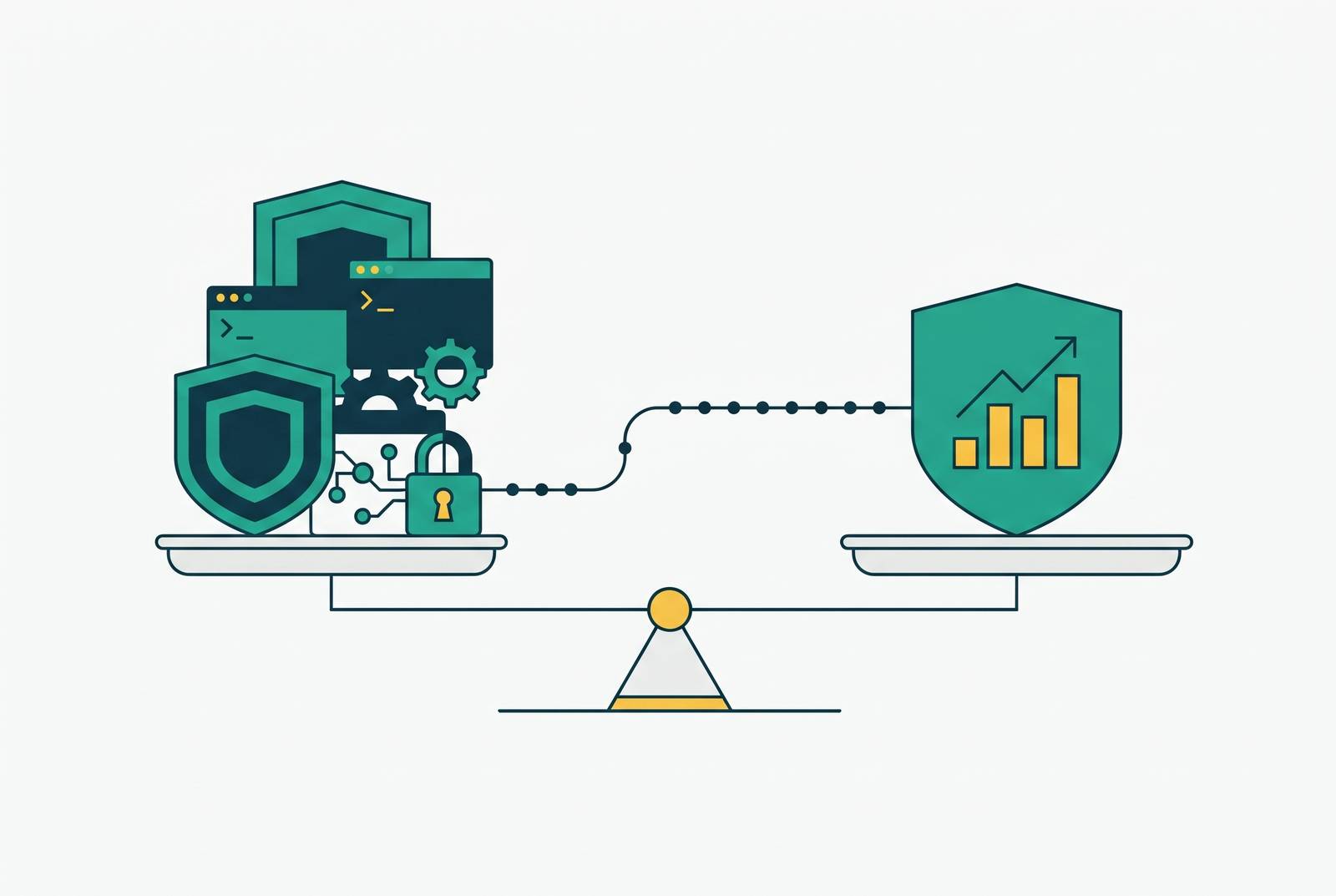
Security content needs practitioner depth and executive accessibility, but splitting the difference produces neither. The balance comes from understanding each audience’s role in the purchase. Practitioners need evidence they can test. Executives need a decision they can defend. A strong content program builds both on the same technical work, without putting the engineering manual and the board brief through a blender.
Why the practitioner-versus-executive split is a buying process problem, not a content problem
The practitioner runs the technical evaluation and holds informal veto power, while the executive signs. Those jobs each need their own kind of information, whatever the amount. An engineer assessing integrations needs to understand how the product works and where it stops. A CISO needs to know whether buying it is a defensible use of budget.
The CISO must justify the choice to a board, a CFO, and a legal team, but a purchase that cannot survive the technical team’s scrutiny is already on shaky ground. The roles are therefore sequential and interdependent. A successful evaluation needs an approval case, and a credible approval case needs evidence from the evaluation. Content that reaches only one audience leaves the deal waiting for the other.
Why content that tries to speak to everyone ends up credible to no one
Content aimed only at executives can miss the people who test whether the product is worth deploying. The architect or engineer running the proof of concept is stress-testing integrations and forming opinions about whether the tool is worth deploying. Those opinions travel upward, even when the content does not. Content aimed only at practitioners can show that the product works but leave out the risk reduction or ROI needed to get it approved.
Averaging the two approaches adds a third failure by producing content too abstract for the practitioner to verify and too dense with jargon for the executive to use. Security practitioners are trained to distrust assertions, inspect omissions, and assume adversarial intent. That habit does not take a lunch break when they open a vendor report. Meanwhile, phrases such as “industry-leading,” “next-generation,” and “AI-powered” offer CISOs marketing claims where they need evidence.
The 2026 Ponemon Institute and NOLA Marketing study of enterprise cybersecurity decision-makers found both deficiencies in vendor marketing. A majority said it lacked technical depth, while nearly as many said it provided insufficient ROI justification. These were failures within the same content programs. More technical vocabulary would not fix the missing business case, just as a polished executive introduction would not fix the missing evidence.
How practitioner credibility travels upward to the executive signature
Practitioner-first sequencing resolves this problem by establishing the evidence before translating its significance. Technical teams heavily influence what the CISO buys, so earning their respect creates a foundation for executive trust. Practitioners are not merely a route to the signer. They are the primary trust-building layer, making judgments that the executive needs but cannot replace with a persuasive vendor brief. Their evaluation gives the purchase case something solid to stand on.
That changes what executive persuasion actually requires from content. A CISO needs evidence that can withstand questions from the people who will operate the product. Technical depth therefore supports the executive decision before anyone writes the executive summary. An acknowledged limitation can be useful evidence, because it lets the team assess the choice with its boundaries visible. A defensible choice need not be a flawless one.
Practitioner credibility also travels through peer conversations and communities. Respect earned there can become endorsement that reaches CISOs through people they trust. This gives technical content a reach beyond its immediate readership. The investment logic is to earn that respect first, then give executives the framing needed to act on it.
What specificity actually looks like in practitioner-grade content
Content for practitioners needs depth, starting with claims a reader can check. “Advanced protection against sophisticated identity-based attacks” gives the evaluator little to work with. Compare it with “detects credential stuffing through per-account rate limiting and device fingerprinting, with configurable thresholds, and does not currently cover session hijacking after successful authentication.” The second statement names the mechanism, the controls, and the boundary. It gives scrutiny somewhere useful to land.
Standards and taxonomies provide one way to make claims checkable. Mapping capabilities to ATT&CK technique IDs, CWE classes, and compliance controls connects a promise to a defined reference. Explaining the architecture is another way to make claims checkable because it shows how something works as well as what it does. Real numbers help when their conditions are visible. Performance under a stated load, false positive rates under known conditions, and the scale of an actual deployment give readers the context they need to judge the numbers.
Operational detail makes the distinction sharper still. Sigma rules, detection queries, log field names, and configuration syntax give practitioners things they can run or check. Public documentation is especially valuable because evaluators often read it before contacting a vendor and regard it as the most honest thing the company publishes. It is written to be used. Documentation that explains integration details, architecture, limitations, and failure modes reaches evaluators while they are still making up their minds.
How to translate practitioner depth into language executives can act on
Layered content gives the engineer technical depth, the CISO a clear business-impact summary, and the board risk-in-dollars framing. Each layer draws from the same research and findings. The production task is to preserve the connection between a technical conclusion and the business decision it supports. Translation should change the language while preserving the underlying claim.
A long-form technical piece can sit behind a short executive brief, so each audience can read what it needs without being interrupted by material meant for the other. The brief is not simply the technical piece with fewer paragraphs. It explains what risk the findings address, what the cost of inaction looks like, and what implementation would demand from the team. Those questions are different and equally demanding.
The same discipline applies to limitations and tone. Practitioners need to know exactly where the technical boundaries are, while executives need to know what those boundaries mean for the purchase. Measured language, real sources, and an honest account of coverage support both layers. A product limitation should not disappear on its way to the boardroom, like an inconvenient suitcase lost in transit. Its business implications belong in the executive framing because they affect whether the decision can be defended.
Threat intelligence as the format where both audiences are served simultaneously
A raw IOC feed serves the practitioner, while a fear-inflected headline serves neither audience particularly well. Original research can serve both when it names threat groups, maps their techniques to ATT&CK identifiers, and draws on first-party telemetry. Practitioners get findings they can inspect and act on. Executives get a case for attention when the research also explains potential costs, disruption, and the industries targeted.
Rapid7’s writeup on the Notepad++ supply chain compromise illustrates that connection. Forrester’s Jeff Pollard referenced it in February 2026 to frame CISO-level implications while directing practitioners toward its TTPs. His framing showed how a single failure in the distribution process for a widely used utility could become an enterprise-scale software supply chain event. Pollard did not explicitly call it a model of dual-audience research, but his use of it demonstrates how detailed findings can inform both audiences.
Anthropic’s September 2026 threat intelligence report works much the same way. Its case studies drew from the Anthropic Threat Intelligence team’s own operations and detailed disruptions involving operators suspected to be ShinyHunters affiliates, as well as state-affiliated influence operations. The details of those operations give practitioners something they can check. The named actors and disruption outcomes give executives a clearer picture of consequence.
The content program structure that sustains both audiences over time
To keep serving both audiences, a team should build its content on the same research. One flagship research asset per quarter, such as a report, benchmark, or annual threat review, can anchor supporting articles, webinars, sales enablement, and nurture sequences. The flagship should have the depth practitioners need, with the supporting formats explaining what the findings mean for executives. This makes the layers part of one production system.
The program can use the “3:1 trust ratio” as a governing principle. For every piece about a product, it publishes three pieces that sell nothing directly. Those can include original threat research based on first-hand data from an attack vector the team has seen, vendor-agnostic implementation guides, and clear explanations of regulations. The reader should get something useful without having to buy anything. That is particularly important for practitioners, whose confidence depends on whether the material helps them understand or do the work.
People who build and operate the technology should publish under their own names with visible credentials, while marketing enables and edits their expertise. Practitioner content belongs in practitioner communities, documentation repositories, conference presentations, and technical newsletters. Content that explains the findings for executives needs to reach them through peer networks, LinkedIn, and analyst co-distribution. Publishing both layers in the same place is not a distribution plan for both audiences.
Pipeline influence and the assets that touched closed-won deals reveal more about this program’s purpose than pageviews or download counts alone. A piece for practitioners may help with a technical evaluation that later leads a CISO to sign, even if few people read it.
Where a specialized content partner accelerates what in-house teams cannot
Expert bandwidth is the hardest constraint in this model. The people whose knowledge makes the content credible are also running detection engineering, threat research, and incident response. Structured interviews and ghost-editing can turn what they know into work that can be published, without asking them to write every draft. The expert remains the source of the judgment.
Disclosure requirements make that work more demanding than ordinary editing. Incident details, customer data, and vulnerability research need to be checked carefully before they are published. A partner without domain fluency can add risk and review work. Technical imprecision, diagrams that omit the hard parts, and architecture claims that do not cohere all reveal distance from the work. Practitioners notice those gaps because assessing such details is part of their job.
A studio working exclusively in cybersecurity can bring familiarity with threat taxonomies, practitioner vocabulary, and the buying dynamics behind the two content layers. That foundation can help it go deeper and faster than a generalist agency without asking experts to teach the basics first. It cannot manufacture the team’s expertise or bypass disclosure review. Its useful advantage is keeping the evidence intact as it moves from expert knowledge into practitioner-grade content and then into a decision an executive can defend.